Zhuravlyova
I.V., Kharkiv National University of Economics,
Ukraine
MANAGEMENT OF THE ENTERPRISE’ INTELLECTUAL SAFETY ON THE BASIS OF MULTI-AGENT SYSTEM
The
number of studies devoted to addressing threats to the enterprise economic
safety and its intellectual component increases under the conditions of crisis
that has lasted far too long. Multidimensionality of the enterprise intellectual
safety is caused by the variety of its components. In this aspect of the
enterprise intellectual safety, large data arrays from wide variety of sources
should be monitored and centers of databases and decision making should be
shared between different structural units. Thus, the use of new intellectual
safety management tools that develop behavior patterns to react against the
threats for all decision-makers becomes actual. One such approach could be to
build a decision support system (DSS) on the basis of multi-agent models which
organize and coordinate the interaction of individual agents that process
information from different data sources and produce a collective justifiable
sound management decisions. The study purpose is to develop a model of
collective decision-making on management of intellectual safety on the basis of
multi-agent approach. This approach would solve the multifactor task of
ensuring financial safety based on the distribution of management functions and
accumulation of information centers monitoring. The set of decision management
solutions of intellectual safety, can be identified with the abovementioned
agent system.
Management
of enterprise intellectual safety the aims to ensure the competitiveness, based
on a system of principles and methods for developing and implementing
management decisions not only on the experience of senior managers of units, but
also through the use of automated tools of economic-mathematical modeling [8аа].
As a tool for management of intellectual security proposed to use Multi-agent
system (MAS). The management system of intellectual safety, which seems set
hierarchically interrelated and interdependent elements that reflect the
content of certain priority processes of business entity at the moment [5zh,
6zh], as these are the elements in the mass intelligent agents.
Intelligent
Agent (IA) is a software or hardware object (entity), autonomously functioning
to achieve the objectives set for the user who has certain intellectual
abilities. The basis of the intelligent agent is its knowledge base, the core
of which performs ontology [3].
Building of ontological models allow to take into
account all the possible links between objects of financial safety management,
to form the corresponding pattern by which it becomes possible to meet the
challenges of diagnosing threats and the emergence of prompt and timely
solutions to prevent them in the management of business entities’ intellectual
safety based on the results of monitoring. Association of agents to collective
solve problems of enterprise intellectual safety management provides their
collective behavior in MAS. Agents, which will act as managers of different
business units, ie decision makers (DM), can interact with each other in
solving individual problems in case of difficulties. Algorithm for collective
decision-making aims to implementation of each stage of the process by group of
specified agents. The output (results) operation previous groups of agents are
inputs for following decision-making [4].
Simulation
system of intellectual safety on the basis of multi-agent model provides a
detailed description of the object, qualitative analysis and prediction of its
dynamic characteristics. Such a management system that can be used to support
decision-making under multi-criteria selection formed a large number of
indicators and data that must be considered involves the formation of effective
solutions based on processing a large amount of information that necessitates
the use of appropriate automated application that will allow simultaneously
consider all criteria effective functioning of the enterprise’ intellectual
capital. The management system provides an optimized search for the best
solution from the set of possible and organizes them for benefits [12]. As
an agent of
the proposed system
will perform the
managers of various
parts of the
enterprise that have
specific knowledge base
required for the
organization of activities to prevent
and leveling of
the factors that
affect the level
of company’ intellectual safety.
Developed
the ontological model of enterprise’ intellectual safety is presented in Fig.
1.
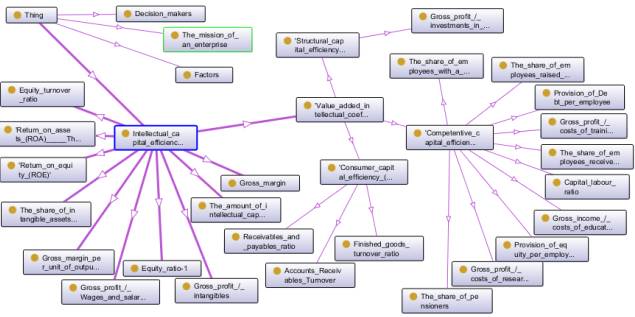
Figure 1.
The ontological management
model
of the enterprise’ intelectual safety developed
in the environment of «Protégé».
As indicators that assess
intellectual safety of business entity used gross margin per unit of output,
equity ratio-1, return on equity (ROE), equity turnover ratio, the
amount of intellectual capital, return on assets (ROA), the share of innovative
products, gross margin, the share of intangible assets in total assets, gross
profit / intangibles, gross profit / wages and salaries, value added
intellectual coefficient (VAIC), structural capital efficiency (SCE), competentive
capital efficiency (CCE), consumer capital efficiency (CCE). The increase in the
market value of a business entity, the quality of earnings and optimal capital
structure based on intellectual component were selected as the major financial
interests of the enterprise in terms of the creation and use of intellectual
capital.
This
model takes into account factors and objectives of the enterprise strategy,
uses semantic structure of knowledge about the environment, allowing enterprise
to perceive multidimensional environment and act in it, adapting to the
situation, monitor the status of intellectual safety and to choose an
appropriate development strategy.
Література.
Vidal J.M. Fundamentals of Multiagent Systems [Електронний ресурс] / J.M. Vidal. – 2007. – 155 p. – Режим доступу: jmvidal.cse.sc.edu/library/vidalfmas.pdf