А.К.
Курмангалиева к.э.н.,
Костанайский
государственный университет им. А Байтурсынова
Казахстан
ECONOMIC CONTENT OF SETTLEMENTS BETWEEN ENTERPRISES
At the present time
we meet with the calculations in everyday life, buying products in stores,
internet sites, in the bazaars. In the old commodity-money relations, or
calculations made by exchange transactions and from
century to century they improved, changed.
In modern XXI century calculations are for us a single
value, as a consequence, we often reflect what we expect settlements in the
future and that they represent themselves.
Dictionary defines
as accountant calculations called commodity-money relations, which arise as
with individuals and legal entities and also within the cooperative.
Calculations are -
cash transactions that occur between firms as trademark and subsistence
operations. Commodity transactions are:
purchase - sale of raw materials, works, services and other.
By subsistence
operations include communications that occur in the calculations with the
institutions research type, etc.
The following are
different types of calculations as:
1. Prepayment - gives the supplier to the recipient of funds to the
payer tangible dominance. Prepayment gives him a guarantee of receipt of
payment from the payer before goods are shipped.
2. Payment after
shipment of the product - make partners of persuasion - the provider and the
payer, more or less equal manner the direct adoption of the documents
confirming the transfer.
Calculated
relationship representation is closely related to the supply and contract.
Delivery, is a
contract concluded between firms, claiming their relationship that are
associated with product sales.
Contract is
considered to be a contract in which the contractor provides for the obligation
to fulfill its riskiness set to work with the customer from the customer's
materials, or their, and the customer commits for acceptance and payment for
the execution of the work.
Creditors whose debt
was the result of buying them various wealth called suppliers. Suppliers and contractors
are organizations that supply raw materials,
various products that provide various types of services (for
example, releasing water or steam), and perform a variety of work (for example,
repair of plant and equipment or repairs, etc.).
Payments to
suppliers and contractors made after shipped material
goods, services rendered, or performed works with them in parallel with the
consent of the organization or on its behalf.
Suppliers - are organizations,
businesses that provide other businesses inventory items, produce for them the
necessary work and services. Payments to suppliers are maintained in the
account «payments to suppliers and
contractors». Taking into account this
account payments for goods and materials received, services, work, where the
settlement documents were not received from suppliers; payment for surplus
goods which have been identified during the acceptance, TMC in transit;
settlements for construction (capital), which were carried out by contractors.
Explanatory
dictionary accountant has another explanation suppliers and contractors
explanation (see Figure 1).
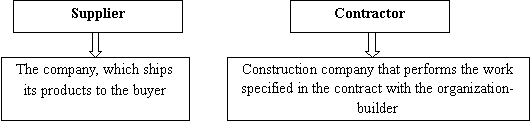
Figure 1. Definition of suppliers and
contractors.
3310 held on account
of all the operations that are associated with the payment for the acquisition
of goods and materials, services consumed or accepted work, unconditioned by
time, when he was presented with a bill.
Cashless
payments are the primary method of calculation between partnerships,
institutions and enterprises. They are made without involving cash. Funds are debited from the payer's account, thus credited
to the account of the seller.
Cashless
payments nowadays economic nature are divided into two types:
1. Cashless payments on commodity transactions;
2. Cash payments to financial liabilities.
Non-cash
payments based on the location of suppliers, buyers are divided into: odnogorodnie
and nonresident.
Odnogorodnimi
(local) are settlements between suppliers and buyers in the same city or region.
Nonresident
are transactions between suppliers, customers who are located in different
cities, districts, villages.
Doing
all of the above analysis, we can see that the suppliers and contractors is a
company who supply materials, raw materials and other goods and materials, and
which have different types of services (eg, electricity supply, gas or water)
and operating various types of work (for example, repair of fixed assets
,maintenance).
Receipt
of products from suppliers, as well as the execution of works and services
carried out by the contracting organization findings on the supply of products,
the provision of services between different,
performers and customers.
Can be drawn letters of guarantee, the contract for the supply of products and
also services. According to these documents, one party undertakes to deliver
products that perform a variety of services , and the other party agrees to
accept products or services and pay for them.