Economic
Sciences / 8. Mathematical Methods in Economics.
Master of
Mathematics, Master of Management
Omarova М.Т., Master of Economic Sciences
Tyngisheva А.М.
Karaganda
Economic University, Kazakhstan
THE INFLUENCE OF INSURANCE PREMIUMS ON ASSETS OF
INSURANCE COMPANIES WITHIN ALMON’S METHOD.
Kazakhstan's insurance
market is one of the fastest-growing markets of the CIS. In recent years there
has been an evidence of positive trend in estimated figures of the insurance
market, insurance companies' assets in particular, in the Republic of
Kazakhstan. The following factors have contributed to the rapid growth of
assets: 1) high rates of increase in the insurance premiums; 2) low rates of
loss; 3) gradual capitalization of insurance companies; 4) increase in the
number of insurance companies, including state and foreign participation; 5)
changes in accounting for insurance reserves and reinsurer's share; 6) the use
of the profit on the development of the insurance organization, rather than on
paying dividends to shareholders [1].
In the given
paper, we shall consider the influence of “insurance premiums’ growth” factor
on the increase of assets as a whole while using the Almon’s method.
In the study of
relationships between indicators as well as in the analysis of their
development during the time, not only the instantaneous values of
variables are used
time “t” itself.
Models of this type are known as dynamic or temporal. In turn, the variables,
influence of which is characterized by a certain time lag, are called variable
lags. There are a number of reasons for the presence of lags in the economy;
the following ones can be distinguished among them:
- Psychological reasons. These reasons
are usually expressed in terms of inertia in human’s behavior. For example,
people spend their income gradually rather than instantly. Getting used to a
certain way of life leads to the fact that people get the same benefits for
some time even after the fall of their real income;
- Institutional reasons. For example,
contracts between firms as well as labor contracts require certain constancy
within the time of the contract (agreement), etc. [2].
The Almon’s model is based on the assumption that the “weightings” of the β1coefficients in the model can be approximated by polynomials of a
certain extent of the j lag:

Supposing
that , than it can be represented by:


By
setting 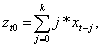
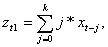
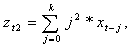 we have:
 .
.
Values ,
, may be determined by OLS.
The procedure for applying the Almon’s method for
calculating the parameters of the distributed lag model is as follows:
1.
Maximum value of the lag is determined.
2.
The polynomial degree describing the structure of the lag is determined.
3.
Values of the variables are calculated.
4.
The parameters of the linear regression equation are defined.
5.
Parameters of the original distributed lag model are calculated.
By this means, we determine the impact
of insurance premiums on the size of assets of insurance companies by using
this method [3].
Table 1. The dynamics of assets and premiums of
insurance companies.
|
Assets mln. |
Insurance
premiums
mln. |
|
|
2000 |
8 382,0 |
8630,1 |
|
2001 |
15768,4 |
13873,5 |
|
2002 |
22419,0 |
22642,0 |
|
2003 |
20700,0 |
28870,0 |
|
2004 |
44100,0 |
39978,1 |
|
2005 |
73 346,3 |
67 123,1 |
|
2006 |
135 489,7 |
120 265,9 |
|
2007 |
223 556,1 |
147 343,3 |
|
2008 |
268822,9 |
133487,6 |
|
2009 |
297252,5 |
113289,7 |
|
2010 |
343 234,4 |
139 963,9 |
|
2011 |
387672,0 |
175 528,7 |
|
2012 |
442647,7 |
211 513,1 |
Note - data taken from the Financial Supervisory
Committee reports of the National Bank of the Republic of Kazakhstan
|
||
We shall construct a model of
distributed lag method for l=3:

Assuming that the lag structure is described by a second degree
polynomial:
 ,
,
For calculating the parameters of this model it is necessary to
transform the original data into new variables  :
:
 ,
,
 ,
,
 .
.
Table 2. Converting the data
into new variables .
.
|
Year |
Assets( |
Insurance
premiums |
z0 |
z1 |
z2 |
|
2000 |
8382 |
86301 |
|
|
|
|
2001 |
15768,4 |
13873,5 |
|
|
|
|
2002 |
22419 |
22642 |
|
|
|
|
2003 |
20700 |
28870 |
151686,5 |
309292 |
854845 |
|
2004 |
44100 |
39978,1 |
105363,6 |
115774,5 |
244299,5 |
|
2005 |
73346,3 |
67123,1 |
158613,2 |
165644,1 |
359236,1 |
|
2006 |
135489,7 |
120265,9 |
256237,1 |
233689,3 |
486865,5 |
|
2007 |
223556,1 |
147343,3 |
374710,4 |
374446,4 |
748561,2 |
|
2008 |
268822,9 |
133487,6 |
468219,9 |
589244,4 |
1232515 |
|
2009 |
297252,5 |
113289,7 |
514386,5 |
788971,9 |
1805254 |
|
2010 |
343234,4 |
139963,9 |
534084,5 |
822294,8 |
1973330 |
|
2011 |
387672 |
175528,7 |
562269,9 |
767006,1 |
1794511 |
|
2012 |
442647,7 |
211513,1 |
640295,4 |
795325,6 |
1754992 |
|
Note - Compiled by authors based on Table 1 |
|||||





Calculation of
the parameters of the regression equation by ordinary least squares for the
selected values in the table, leads to the following results:
 -73544,41223 + 1,186828
 - 0,7836504
 + 0,212455
 .
.
The equation of
regression is statistically significant and so do all the regression
coefficients in variables.
We shall find the
coefficients of the original model by the formulas:
 ,
, 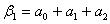 ,
,  ,
,  .
.
Hence,
the original distributed lag model is as follows:
 =-73544,41223 + 1,186828
 + 0,6156326
 + 0,4693472
 + 0,7479718
Analysis
of the model shows that an increase in insurance premiums of 1 million tenge
will lead to an average increase in assets up to 1,186,828 tenge.
As insurance
premiums increase, the growth in total volume of assets will be 1.802.460, 6
tenge in a year, in two years it will show an increase of 2.271.807, 8. The
increase of insurance premiums of 1 million tenge will lead to increase in the
volume of assets up to 3.019.779, 6 in three years.
Hence,
39.3% of the total increase in assets is currently in progress; 20.4% - in one
year; 15.5% - in 2 years; 24.8 – in 3 years.
Average
lag of the model is:
 = 0*0,393 + 1*0,204 + 2*0,155 + 3*0,248 =
1,258.
= 0*0,393 + 1*0,204 + 2*0,155 + 3*0,248 =
1,258.
The magnitude of lag of 1, 3 years confirms that the
significant part of growth effect of the insurance premiums is evidenced after
the first year.
Consequently, the Almon’s method model shows a direct
dependence of assets on insurance premiums.
Literature
1. The Abstract. Mayanlaeva.
GI Insurance market of Kazakhstan: theory, practice and development imperatives.
2. Boroditš SA
Econometrics textbook. - M.: New Knowledge, 2001.
- 408.
3. Data analysis and
forecasting of the economy: Textbook / N. Emelina. - Karaganda Economic University, 2011. - 111c.