Математика/ 1.Дифференциальные
и интегральные уравнения
К.ф.-м.
н. Ысмагул Р.С.
Костанайский государственный университет им.
А.Байтурсынова, Казахстан
SHORTENING METHOD FOR FINDING A SOLUTION OF
A COUNTABLE
SYSTEM OF INTEGRODIFFERENTIAL EQUATIONS
This
article gives a review of finding a solution of a countable system through
shortening method. It describes necessary and sufficient conditions for
uniqueness of an almost multiperiodic solution of integrodifferential equations
in partial derivatives.
Let’s
introduce some notations and definitions:
 - The class of n-dimensional
  -functions,
  -satisfying the conditions.
 and almost multiperiodic in
  с
с  - vector- almost period
  , where
  when
when  ; countable-dimensional vector
 , where
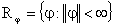 ; Wm и
Vm - functionals that
assign vectors Wm
; Wm и
Vm - functionals that
assign vectors Wm = ( φ1, …, φт, 0,…)
и Vm
= ( φ1, …, φт, 0,…)
и Vm = ( 0,…,0, φm+1,φт+2, …) to the vector φ = (φ1,
..., φt, ...).
= ( 0,…,0, φm+1,φт+2, …) to the vector φ = (φ1,
..., φt, ...).
Let’s consider a system of
integrodifferential equations of the form
 , (1)
, (1)
where x, Q, R are n-vectors-columns; P (t, φ) is
a matrix of dimension n × n, φ =
(φ1, ..., φt, ...) is a countable vector, and  ,
, >0 are small parameters.
Let’s
consider that the conditions  [1,c.168] и
  (
( ) are met if:
1) vector-function  is bounded and contiguous with all
variables, and has limited contiguous derivatives of first
order in  ,
, ; diagonally - almost in period
 , belongs to
  -class evenly relatively to
 ;
;
2)
continuous function  provides improper integral
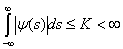 , where
  is permanent.
Let’s
contemplate the differential operator:
 .
.
To reduce the record we’ll take  . It should
be noted that the coefficients of Lipshitce enhanced condition for
vector-function
. It should
be noted that the coefficients of Lipshitce enhanced condition for
vector-function  are
are  .
.
Let’s
contemplate the linearized equation:
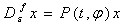 .
(2)
.
(2)
Let  be the characteristic function of the functional
 , which satisfies the integral equation
 .
.
.
For
characteristic function  there are rates
analogous to relations of the
form I(a-b) и 10-90 [1,c.77,158-162].
there are rates
analogous to relations of the
form I(a-b) и 10-90 [1,c.77,158-162].
Let’s consider the
functional Т,
representing each vector-function 

 in vector-function


 , where

which is known from
[1,c.170].
We will study

Considering that  , we can
write
, we can
write  . From rates
III(a-d) [1,c. 171] we can conclude that there is such a number
. From rates
III(a-d) [1,c. 171] we can conclude that there is such a number  , for which
with all
, for which
with all  there are the following
relations:
there are the following
relations:
1)  ,
,
2)  ,
,
3)  ,
,
4)  .
.
Thus, we come to the
statement of theorem 1.
Theorem 1. If the conditions  ,
,  are met for the equation (1), than for all
the meanings
are met for the equation (1), than for all
the meanings ,
,  equation (1) has a single almost
multiperiodic solution from the class
equation (1) has a single almost
multiperiodic solution from the class  , converging
in a zero vector with
, converging
in a zero vector with  .
.
Let’s consider a system
shortened in φ, obtained
from (1):
 , (3)
, (3)
where
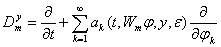 is a shortened differential
functional. Then
is a shortened differential
functional. Then 
 is a characteristic function
of the functional
is a characteristic function
of the functional 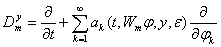 .
.
Then
we can see that an almost
multiperiodic solution of the basic system (1) can be evenly approximated by an
almost multiperiodic solution of the system in  of the form (3).
Theorem 2. If the equation (2) is
uncritical and the conditions  ,
,  for the quantities
  are met, then the equations (1) and (3) with
  and with
  have a single
almost multiperiodic solution
have a single
almost multiperiodic solution ,
,  respectively, and at that we have the relation
 in the sense of convergence in the form [2], where
 .
.
REFERENCES:
1.
Umbetzhanov D.U. Almost periodic solutions of evolution equations. Alma-Ata,
Nauka, 1990, 188 p.
2. Ismagul R.S.. About a countable
system of some differential equations in partial derivatives // Materials of international
scientifically-practical conference of students, graduates and young scientists "Lomonosov-2009"
.- Astana, 2009, .51-53.