V. Sigitov, D.Batyrbekuly
Kazakh-British Technical University
ESTIMATION
OF POSTTREATMENT SKIN FACTOR VALUE
AT
KUMKOL OILFIELD
In
the article below, it was explained the primary goal of well stimulation, which
is to increase the productivity of a well by removing damage in the vicinity of
the wellbore or by superimposing a highly conductive structure on to the
formation. New and novel fracture stimulation technologies can provide
attractive deliverability enhancement results. Even though fracture stimulation
was very successful at several test sites and led to significant improvements
in deliverability, not every stimulation treatment was effective. The most
consistently effective stimulation technology should be hydraulic fracturing.
In
the paper, we tried to pay your attention to Hydraulic fracturing, the
stimulation method which is intended
to provide a net increase in the productivity index, that can be used either to
increase the production rate or to decrease the drawdown pressure differential.
A decrease in drawdown can help prevent sand production and water coning, and
shift the phase equilibrium in the near well zone toward smaller fractions of
condensate. Injection wells also benefit from stimulation in a similar manner.
Commonly used stimulation techniques except hydraulic fracturing, include
fracpack, carbonate and sandstone matrix stimulation (primarily acidizing), and
fracture acidizing.
Many
reservoirs must be hydraulically fractured to become economically productive.
Hydraulic
fracturing involves injecting a large volume of proppant-laden fluid at a
pressure sufficiently high to fracture the formation. After the fracturing
fluid leaks off into the formation, the remaining proppant keeps the fracture
open. Although a hydraulic fracture is narrow (a fraction of an inch in most
cases), the presence of this high-permeability channel significantly enhances
the productivity of the well. The presence of a fracture alters the flow regime
inside the formation as the fluid flows into the fracture and then through the
fracture into the wellbore, with very little or no fluid flowing directly from
the formation into the wellbore. The presence of a hydraulic fracture adds
another dimension to the fluid flow in porous media and to well test design and
analysis.
Using
of hydraulic fracturing at KUMKOL oilfield recommends starting at J-II horizon,
with installation of packer against clay in the interval: 1300.0-1305.0 m.
Necessary
measures before doing hydraulic fracturing are:
- Isolation of interval 1312.0-1316.0 m, at
the bottom, where it was fluid flow
with
water (December, 2001)
- Installation of cement plug at the depth of
1317.0 m in order to avoid
deformation
of casing against water producing formation of J-III horizon.
- Re-perforation filter 1305.6-1308.4m
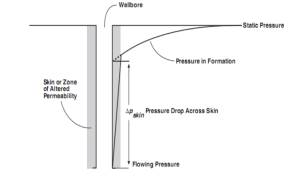
Figure – 1.Pressure
distribution in a reservoir with a skin
It
was proven that as a result of drilling and completion practices, the formation
permeability
near the wellbore are usually reduced. Drilling fluid invasion of the
formation, dispersion of clay, presence of a mudcake and cement tend to reduce
the formation permeability around the wellbore. A similar effect can be
produced by a decrease in the area of flow exposed to the wellbore. Therefore,
partial well penetration, limited perforation, or plugging of perforations
would also give the impression of a damaged formation. Conversely, an inclined
well or inclined formation increases the area of flow near the wellbore, giving
the impression of a stimulated well. The zone of reduced (or higher) formation
permeability has been called a ‘‘skin,’’ and the resulting effect on well
performance is called ‘‘skin factor.’’ Skin factor can be used as a relative
index to determine the efficiency of drilling and completion practices. It is
positive for a damaged well, negative for a stimulated well, and zero for an
unchanged well (Figure-1). Acidized wells usually show a negative skin.
Hydraulically fractured wells show negative values of skin factor that maybe as
low as -7. Well stimulation ranks second only to reservoir description and
evaluation as a topic of research or publication within the well construction
process. There as, on for this intense focus is simple: this operation
increases the production of petroleum from the reservoir. Thus, this facet of
the construction process actively and positively affects a reservoir’s
productivity, where as most of the other operations in this process are aimed
at minimizing reservoir damage or eliminating production problems.
Hydraulic
fracturing is a proven technological advancement which allows natural gas
producers
to safely recover natural gas from deep shale formations. This has the
potential to not only dramatically reduce our reliance on foreign fuel imports,
but also to significantly reduce our national carbon dioxide (CO2) emissions
and to accelerate our transition to a carbon-light environment. Experts have
known for years that natural gas deposits existed in deep shale formations, but
until recently the vast quantities of natural gas in these formations were not
thought to be recoverable. Today, through the use of hydraulic fracturing,
combined with sophisticated horizontal drilling, extraordinary amounts of
natural gas from deep shale formations across the United States are being
safely produced. Hydraulic fracturing has been used by the oil and gas industry
since the 1940s and has become a key element of natural gas development
worldwide. In fact, this process is used in nearly all natural gas wells
drilled in the U.S. today. That’s why we should use this method almost in all
oil and gas wells in Kazakhstan. Properly conducted modern hydraulic fracturing
is a safe, sophisticated, highly engineered and controlled procedure.
KEY
POINTS:
•
Hydraulic fracturing is essential for the production of natural gas from shale
formations.
•
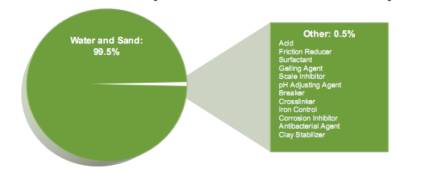
Fracturing fluids are comprised of more than 99% water and sand and are handled
in
self
contained systems.
•
Freshwater aquifers are protected by multiple layers of protective steel casing
surrounded
by cement; this is administered and enforced under state regulations.
•
Deep shale gas formations exist many thousands of feet underground.
Fracturing Fluid
Makeup
In
addition to water and sand, other additives are used in fracturing fluids to
allow
fracturing
to be performed in a safe and effective manner. Additives used in hydraulic
fracturing
fluids include a number of compounds found in common consumer products.
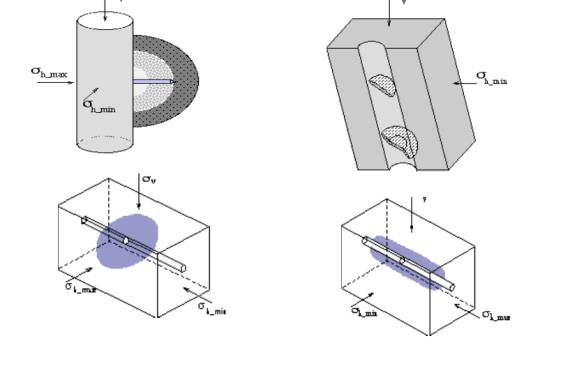
Hydraulic
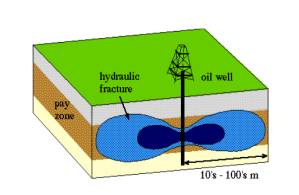
fracturing consists of injecting fluid into the formation with such pressure
that it induces the parting of the formation. Proppants are used in hydraulic
fracturing to prop or hold open the created fracture after the hydraulic
pressure used to generate the fracture has been relieved. The fracture filled
with proppant creates a narrow but very conductive path towards the wellbore.
In almost all cases, the overwhelming part of the production comes into the
wellbore through the fracture; therefore, the originally present near-wellbore
damage is ‘‘bypassed,’’ and the pretreatment positive skin does not affect the
performance of the fractured well. Perhaps the best single variable to
characterize the size of a fracturing treatment is the amount of proppant
placed into the formation. Obviously, more propped fracture volume increases
the performance better than less, if placed in the right location. In
accordance with the general sizing approach outlined above, the final decision
on the size of the fracturing treatment should be made based on the NPV analysis.
Often
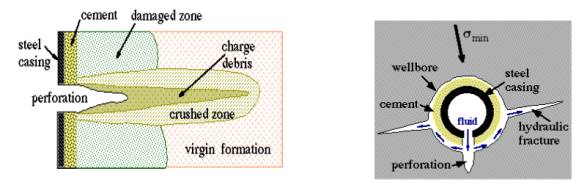
the well is cased a steel casing cemented to the rock. The pressurized fluid
that causes cracking must be allowed to pass from the cased well bore to the
rock. This is done by perforating the casing and cement. The process of
perforating the casing causes damage to the rock as well as the cement bond
between the steel and the rock. Fluid may be able to enter the interface
between these materials and fracture initiation may not occur from the
perforations as desired.
Finally,
the wells may not always be vertical and the fractures may not always be simple
planar features. Multiple deviated wells are commonly drilled from ocean
drilling platforms,and horizontal wells are increasing. Fractures from these
various wells, in addition to vertical wells, need to be modeled.
Example of Typical
Deep Shale Fracturing Mixture Makeup
A
representation showing the percent by volume composition of typical deep shale
gas hydraulic fracture components (see graphic) reveals that more than 99% of
the fracturing mixture is comprised of freshwater and sand. This mixture is
injected into deep shale gas formations and is typically confined by many
thousands of feet of rock layers.

To
sum it up, engineers design a fracturing operation based on the unique
characteristics of the formation and reservoir. Basic components of the
fracturing design include the injection pressure, and the types and volumes of
materials (e.g., chemicals, fluids, gases, and proppants) needed to achieve the
desired stimulation of the formation.
When
applied to stimulation of water injection wells, or oil/gas wells, the
objective of hydraulic fracturing is to increase the amount of exposure a well
has to the surrounding
formation
and to provide a conductive channel through which the fluid can flow easily to
the well. Computer models are used to simulate fracture pathways, but the few
experiments in which fractures have been exposed through coring or mining have
shown that hydraulic fractures can behave much differently than predicted by
models.
References:
1.
Economides,
M.J., and Nolte, K. (eds.), Reservoir Stimulation (2nded.), Prentice Hall,
2.
Englewood
Cliffs, NJ (1989).
3.
Haimson,
B.C., and Fairhurst, C.:‘‘Initiation and Extension of Hydraulic Fractures in
4.
Rocks,’’ SPEJ
(Sept.1967)310–318.
5.
"Application
of New and Novel Fracture Stimulation Technologies to Enhance the
6.
Deliverability
of Gas Storage Wells," Topical Report, Contract No. DE-AC21-94MC31112,
U.S. Department of Energy, Washington, DC (April, 1995).
7.
4. Gidley,
J.L., Holditch, S.A., Nierode, D.E., and Veatch, R.W., Jr. (eds.), Recent
8.
Advances in
Hydraulic Fracturing, Richardson, TX (1989), SPEMonograph12.