UDC
621.867
d.t.n.,prof. Sazambaeva B.T., Baimukanova B.D magistrant.
KazNTU K.I.Satpaeva's
name, Almaty, Republic Kazakhstan.
«To a question of movement of a
loose cargo from a ladle»
Buchet elevators
for loose cargoes are used for vertical and inclined transportation of a loose
cargo in mining, building, chemical, coal and other industries.
In all spheres where
continuous transportation is applied, the effective utilization of this
transport and accordingly capital investments is required. The effective
utilization of traditional conveyor systems demands perfection of the existing
designs, allowing to overcome those factors limiting productivity, height of
transportation and reliability of these systems.
Before domestic
experts at the present stage of development of industrial branches the problem
of creation высоко-the productive
conveyor systems providing modern technological manufacture [1] was designated.
The Level конвейеризации modern industries grows, that demands introduction of
more powerful conveyors of the big extent, including vertical ковшовых элеваторов with
the increased height of transportation.
Also it is known,
that domestic conveyor systems on the cores technical and economic lag behind
the best samples foreign
Machines{Cars}.
Now in the coal industry of 50 % of park of
transporting machines{cars} havefailed [1], it is necessary to replace them
conveyors of higher level.
Such effective
versions of conveyor systems with use of new technologies are abroad developed
and mastered: ҢFLEXOWELL,FLEXOLIFT,POCKETLIFT,FLEXOFAST+  [2], allowing to
promote by new boundaries in technology of transportation of loose cargoes.
[2], allowing to
promote by new boundaries in technology of transportation of loose cargoes.
Are rather indicative
application abroad Rubberfabric
and Rubbercable tapes with the
raised{increased} durability of a skeleton on the basis of use of polyamide
fibres of type «кевлара», possessing high
durability properties, good working capacity in smaller specific volume, and
corrosion stability{resistance}. «Кевлар» is
much stronger some steel, has the high module of elasticity, very low fluidity
under loading and they are a subject of the further researches of scientists.
Application such vertical buchet elevators are economic and respond questions
of ecology. These designs buchet elevators have high engineering-technological
parameters, provide good reliability and long service life of sites and
elements.
But high cost of these tapes demands
alternative decisions on the basis of existing designs. Therefore improvement
of existing designs of topull -bearing bodies of conveyor systems, by
improvement of parameters of reliability and durability are actual.
Existing
designs elevators for transportation loose and smallpiece cargoes have a
number{line} of the restrictions, increases of speed of moving being by the
deterrent and the heights of rise directly depending on a design of a ladle. In
turn, the design of a ladle, профилируемая
surfaces стенок, influences speed
of a unloading (removal{distance}) of a material from a ladle, as predetermines
the decision of tasks in view.
Elevators
systems on the design are calculated on universal application and can be
integrated into complex conveyor lines for maintenance of continuous
transportation of a cargo. Buchet elevators can be mounted on a small platform
in conditions of strictly limited space, to have height of vertical
transportation depending on durability of a tape up to 400 m.
Designs
and elevators installations do{make} opportunities their perspective at
application in the open and underground mines for dredging materials from штолен at a lining of tunnels, warehousing of materials in отвалы, submissions in silage holes, blast furnaces, in
conditions of a self-loaded vessel and cars, and also at realization of
projects стройиндустрии and
transport highways.
Efficiency of operational expenses
depends also on economy of power resources. Reduction of power consumption and материалоемкости is possible{probable} due to reduction of weight
elevators, and increase in speed of transportation of a cargo probably due to
increase in speed of unloading of a ladle - высыпания a
cargo.
At designing ковшовых элеваторов the great value has a structure of a ladle and a
choice of speed of transportation.
The
new design offered by the author of a ladle, concerns to cargo handling transport
of vertical rise of loose cargoes and can be used for transportation of loose,
lumpy materials mountain, metallurgical, building and other industries. In
offered buchet elevators lateral walls of a ladle from the bottom edge up to
the top edge of a forward wall are executed in the formcycloid concerning a
start of a ladle.
Elevators
provides the raised{increased} productivity by reduction of time of a unloading
which is provided with a design of the ladle, allowing to accelerate process of
unloading and to prevent a return prorash. Ковшовый элеватор contains короб with
a loading part, a unloading head and linear секциями,
with established{installed} drives and tension drums{reels}. They are covered
by vertically closed traction body, with the ladles fixed on him. Lateral walls
of a ladle, from the bottom edge up to the top edge of a forward wall are
executed on formcycloid concerning a start of a ladle.
The
curve on which the forward wall of an offered ladle is executed, is called
braxistrona- as a line Fast descent{release}.
To provide fast
movement of a loose cargo from a ladle during the moment of unloading it is
necessary to track{look after} movement of a cargo and to describe a curve of
movement. The method of calculation of unloading parities{ratio} known till now
is based that unloading begins in a point where the radial component  is equal to centrifugal force
 .
.
Having written down
this equality, we shall receive
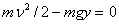 , (1)
, (1)
Where  - weight of a cargo;
 -speed to pour out a cargo.
Movement of a cargo along a
wall occurs{happens} to speed
 (2)
(2)
Having expressed
speed through a way of passage by a particle of a cargo for certain time, we
shall receive expression
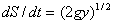 . (3)
. (3)
And at  , we shall
receive
, we shall
receive
 (4)
(4)
Having transformed expression  in the differential equation, we shall
receive
in the differential equation, we shall
receive
 , (5)
, (5)
Here the sequence of
trigonometrical equality is used. Having written down identity  , we shall receive
 (6)
(6)
Integrating this equality, we
receive the equations for  and
and  , describing a
curve of a forward wall:
, describing a
curve of a forward wall:
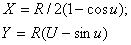 , (7)
, (7)
Where  - radius of a
ladle;
- radius of a
ladle;  - parameter for performance of equality.
Productivity and height of transportation are limited to
durability of conveyor tapes on a stretching, weight of a tape in weight of a
ladle with a cargo. The increase in durability of a tape will lead to increase
in height. The height of transportation can be approximately calculated on the
basis of following parameters of durability of a conveyor tape on break,
its{her} weight and loading.
Height of transportation without taking into account resistance to
movement it is possible to define{determine} under the formula:
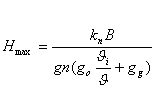 , (8)
, (8)
Where  - nominal effort of a tape to the break,
carried by the width of a tape;
- nominal effort of a tape to the break,
carried by the width of a tape;
 - Width of a tape, m;
 - factor of a stock equal 10:1 (1);
 -acceleration of free falling, m / with
 ;
;

 - Weight per meter
of тягово-bearing body, Н/m;
- Weight per meter
of тягово-bearing body, Н/m;

 =
=  +
+ ,
,
Where  - weight per meter
of a tape;
- weight per meter
of a tape;
 - Weight per meter
of a ladle;
- Weight per meter
of a ladle;
 -weight per meter
of a cargo, Ұ/m;
-weight per meter
of a cargo, Ұ/m;
 - Speed of submission of a cargo, m/with;
 - Speed of movement
of a tape, m/with.
- Speed of movement
of a tape, m/with.
Reduction of weight per meter of a tape leads to increase in
height, and increase of speed leads to increase in productivity.
Resistance to
movement
 , (9)
, (9)
Reduction  will lead to reduction of resistance of
movement.
will lead to reduction of resistance of
movement.
Weight per meter of a ladle
and cargo is defined{determined} under formulas:
 (10)
(10)
Where  - weight of a
ladle;
- weight of a
ladle;
 - A step of ladles.
Hence, parameters of a ladle, durability of a tape and weight элеватора directly are connected with height of vertical rise
and speed Transportations of a cargo that is defining{determining} factors of
their expedient application in mining, building and other industries.
THE LITERATURE:
1. Спиваковский A.O.Transportirujushchie of the machine{car},
1986,383 with.
2. Vertical
conveyor systems, Mountain magazine, №5,2005г.;