Abstract - In the article is given the calculation of
resistance movement to running belt and line circuits for rope belt car
conveyor. Running belt and line circuits for conveyor are
considered in separate, taking into account the loads of freight and traverse.
Defined maximum length of running supporting belt circuit of conveyor taking
into account the strength and hauling ability of the belt.
UDC 621,867
Rope belt car
conveyor is a transport installation with faltering contact of friction between
non-drive supporting circuit and driving load-carrying tape and also hauling
rope [1].
Feature of a
rope belt car conveyor design is presence of frictional bond between traction
(tape and ropes) and driven (supporting arcuate traverses) circuits.
Construction
of rope belt conveyor (Fig.1), containing an infinite load-carrying tape (1)
freely lying on supporting arcuate traverses (2); the upper and lower branches
of closed hauling ropes (3); traverse axis made of composite with articulation
and having thrust clips for interaction with the driving hauling rope (4) on
both sides of the tape’s driving ram (5), of the driving pulley (6), and of
bypass pulleys (7), can increase the traction between the hauling ropes and
frictionally interacting elements of traverse, both on freight and idle
conveyor branches [2].
For the
calculation of the traction conveyor considered each circuit individually,
taking into account the loads from the traverse and goods, distributed between
the belt running body and the driving rope circuit. At the same time there is
an assumption that there is no slippage between the traverse and belt, as well
as between the driving rope and traverse. We believe that the load from the
traverse, freight and belt on the site L2 is divided equally between two circuits
[3].
Design scheme
of belt car conveyor is shown in Figure 1, where a site length L1 = Lload
the belt is rest upon stationary grooved roller carriages, which support
pulley; on a site length of L2 = Lpk belt is rest upon moving
traverses; on a site of L3 = Lunload belt is rest upon stationary
grooved roller carriages, from the vanishing point of the bypass pulley to
driving barrel of belt.
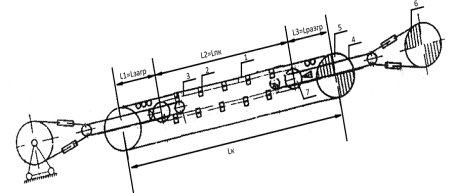
Fig.1 Design scheme of
belt cat conveyor
Furthermore,
it should be noted that the traction between belt and initial arcuate traverse
which supports circuit counterbalances resisting force to the movement of
loading site L3, vacant branches of supporting circuit and belt, i.e. Wload,
Wv.s.c and Wv.s.b.
Found total
resistance movement of freight branch and vacant branches. With the resistance
of freight and vacant branches and maximum breaking force of belt is defined
the circumferential force of haulage (driving) barrel. With the driving force
is defined limit length of belt conveyor.
Possible
length of the supporting circuit conveyor is determined from the non-slip
conditions of conveyor at the initial traverse after the loading site.
Calculation
of hauling rope is done with the method of bypass route on vanishing points of
the branches on the pulley along the rope, with all resisting forces, arising
from the movement of the rope.
Unlike other
conveyor and belt car conveyor constructions structure of the rope belt car
conveyor for the lumpy cargo allows to improve efficiency of using the hauling
rope both on linear part of conveyor, and on the drive, avoiding slip
phenomenon, which in turn, provides increase of length of transportation in 1,5
... 2,0 times and anglulation up to 250…300. Therefore,
increase of equipment’s length of belt
car conveyor by one drive when transporting over long distances reduces the
amount of transfer points from one conveyor to another [4].
The conveyors
mentioned above are able to move virtually all of the rock mass, prepared by
drilling-and-blasting way, and does not require the use of expensive crushing
units and additional funds of cyclic transport.