Engineering sciences. Effective tools of modern science – 2014
Graduate student V. A. Ruk, Doctor
of Engineering Sciences, professor A. Nurzhauov
Pavlodar State University named after S. Torayghyrov,
Kazakhstan
The
definition of the moments of inertia in the pinion of transport vehicle’s
transmission
While doing the theoretical study of movement of
transport vehicles arises necessity in their dynamic modeling. Dynamic model of transport vehicle is represented
as rotationally or translationally moving masses, applied
to the shaft and connected
between each other by elastic connections. The quantity of masses and the degree of freedom in the
system depend on the specific approach to the solution of the problem. The measure of inertia in the
applied rotational mass determines by the applied
moment of inertia relative to the axis of rotation. For the definition of the value of applied moment of inertia it is
necessary to know moments of inertia of every mass relative to its own axis of
rotation, which will be led to the axis of adduction then.
The construction of transport vehicle consists of big quantity of joints and aggregates, which have very
different configurations.
The definition of the moments of inertia in all details is not possible. At the same time, it’s
possible to determine theoretically in the first approximation moments of
inertia of details by the analyzing of their construction and by the defining
of their locations and kinds of moving. In the transmission
of transport vehicle the most common details are cylindrical pinions. For the definition of
the moment of inertia relative to the axis of rotation let’s take like
an example the pinion of seventh gear, located on the secondary shaft in
gearbox of crawler tractor DT-75M ‘Kazakhstan’.
The sketch of this pinion is shown at the figure 1.
Axial moment of inertia is the sum of multiplication
of points’ masses in this system and of squaring of distances from the axis
[1]:

where  – moment of inertia of system
relative to the axis Ox;
– moment of inertia of system
relative to the axis Ox;
mi – mass of point i in the system;
ri – distance of this point from the axis.
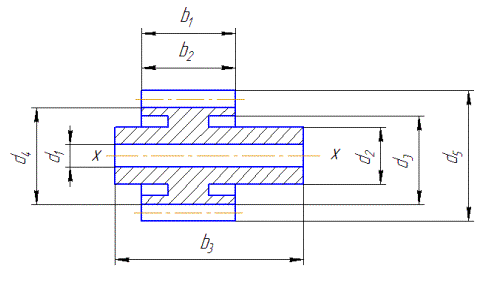
Figure 1 – The sketch of pinion
For the definition of moment of inertia of pinion
let’s divide it to the simple geometrical parts.
At the picture pinion is shown like a detail,
consisted of cylindrical parts with the diameter di and the length bi
(i = 1, 2, … - numbers of parts). By
looking at the sizes of parts and by the using of known formulas it’s possible
to determine the values of volumes Vi.
Also by the using of drawings or parts’ catalog we can find the weight of
detail and its mass.
While determining of axial moment of inertia we can
divide the pinion to four parts. Three parts are thick-walled hollow cylinders.
The fourth part consists of teeth and empty spaces between neighboring teeth,
surrounded mentally by cylindrical surfaces in the foot and top of teeth.
The moment of inertia of hollow cylinder with mass m,
outer radius R1 and inner radius R2 is
determined by the formula [2, 3]:

According to this formula the moment of inertia of thick-walled hollow cylinder with
inner diameter d1, outer
diameter d2 and height b3 is determined by the
formula:

The mass of thick-walled cylinder m1 is
determined from the formula:

where ρ – density of the pinion.
By analogy let’s make the formulas
of two next thick-walled hollow cylinders with inner diameters d2 and d3, outer diameters d3
and d4 and heights b2 и
b1:




Then we will accept that moment of inertia of teeth in
the pinion is equal to the half of moment of inertia of hollow cylindrical body
relative to its axis, coincident to the axis of pinion. Now we can determine
the moment of inertia of fourth part in our pinion [4]:

where mц – mass of hollow cylindrical body with the length b1, inner diameter d4
and outer diameter d5.
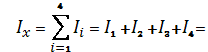
Moment of inertia of examined pinion relative to the
axis x, passing the centre of masses,
is equal to the sum of moments of inertia of its parts, determined relative to
this axis:

Axial moments of inertia in similar
from the view of geometry pinions of other mechanisms in transport vehicles are
determined by this formula. For details with other construction formulas must
be created with the sequence, described above.
Literature:
1 Савин Г. Н., Путята Т. В., Фрадлин Б. Н. Курс теоретической
механики. Издательское объединение «Вища школа», 1973, 360 с.
2 Дерюгин Е. Е. Динамика вращательного движения абсолютно твердого тела [Текст]: учебное пособие / Е. Е. Дерюгин, Л. А. Теплякова. –
Томск: Изд-во Том. гос. архит.-строит. ун-та, 2010. 65 с.
3 Whittaker E.
T. A Treatise on the Analitical Dynamics of Particles and Rigid Bodies. Библиотека “R&C Dynamics”, 1999, 587 с.
4 Нуржауов
А. Н. Исследование динамики гусеничного
трактора класса 30 – 40 кН тяги и ресурса его планетарного механизма поворота :
монография. – Павлодар: Кереку, 2009. – 329 с.