Doctor of Economics, professor Dulambaeva R.T., Nurbai A. E.
Kazakh national
University named after al – Farabi, Kazakhstan
The impact of human capital on the competitiveness of the national
economy
Currently, the economy is no exact
definition of human capital, respectively, and there is no structure. In the
understanding of the human capital structure can be identified: knowledge came
from school or activities, practice, ability, competence. The concept of human
capital can be seen in the 3 modes of - biological, social, economic.
The founders of the human capital
theory are Theodore Schultz and Gary Becker. They have given a narrow meaning
of the concept of human capital, but it extends to the present day. In a narrow
sense, human capital - is intelligence, health, knowledge, quality and
productive work, quality of life [1].
Human capital in nature and structure
is a rich set of potential human resources, which is not sufficiently explored
and is the subject of a comprehensive study.
The problem of assessing the state of
human capital is one of the unsolved problems of economic theory. The power of
the concept of human capital, theoretical and practical, is adjacent to the
lack of tools and indicators to measure it
[2].
The need to address this problem is becoming
more obvious and is dictated by the urgent needs of solving global economic
problems faced by humanity in the transition to a new stage of civilization,
called the emergence of the information society, knowledge-based economy, the
new economy.
The most modern methodological approach
to assessing the state of human capital in the conditions of formation of
competitiveness of the country - the measurement of human capital and national
competitiveness through indexes.
In assessing the state of human capital
in the conditions of formation of competitiveness of the country's most
important are the two main index - the Human Development Index (HDI) and the
Global Competitiveness Index (GCI). Let
us consider the structure and the method of calculating each of the indices.
Human capital is a complex economic
category, has a qualitative and quantitative characteristics. Many scientists,
economists at various times suggested for that use a variety of methods and
measurement approaches. At the present time to evaluate it using aggregate -
human development index, previously known as the Human Development Index.
The Human Development Index - a
composite indicator of the human development in the countries and regions of
the world. Every year is calculated by
experts of the United Nations Development Programme in collaboration with a
group of independent international experts who use in their work, along with
the analytical development, statistics, national institutions and international
organizations. Used in a special series of
publications UNDP Human Development Report, Purlik 1990.
The Human Development Index was
developed in 1990 by Pakistani economist Mahbub ul-Haq. The basis of the Index
does not put subjective expert assessment, and real numerical indicators taken
from official sources, so it is believed that it is relatively objective and
amenable to verification [3].
Since 2010, the basic components for
the calculation of the HDI is:
· life expectancy;
· per capital GNI;
· the average length of education;
· expected years of schooling.
The Human Development Index is a
summary measure of human development. It shows the average level of the
country's achievements in three basic dimensions of human development:
longevity and health, access to knowledge and a decent standard of living.
To convert indexes in the index with a
scale from 0 to 1, set the minimum and maximum value (or targets).
After
determining the minimum and maximum values for the calculation of indices is
made according to the following formula:

Human development index a particular country depends
on the following three factors:
1. Index of life expectancy, which is calculated by the formula:
LEI=
Where,
LE - life expectancy.
2. Education Index, which is calculated by the formula:
EI=
MYS – the
average length of education
MYSI=
EYS – expected years of schooling.
EYSI=
3. Income Index:
II=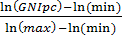
GNIpc –
per capital GNI.
Thus, the HDI is the geometric mean
of these three indices:
HDI = 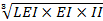
Another important index is the Global
Competitiveness Index - a global research and accompanying ranking of countries
in terms of economic competitiveness in the world. Calculated in accordance
with the World Economic Forum, based on a combination of public statistics and
the results of a global survey of business executives - a comprehensive annual
survey conducted by the World Economic Forum together with its network of
partner organizations - the leading research institutes and organizations in
the countries analyzed in the report. A study carried out in 2004 and currently
represents the most comprehensive set of indicators of competitiveness in
various countries of the world.
The World Economic Forum defines competitiveness
as the country's national power and its institutions to ensure stable economic
growth, which would be stable in the medium term.
Global Competitiveness Index has
been created for the World Economic Forum, a professor at Columbia University
Xavier Sala-i-Martin and was first published in 2004.
Global Competitiveness Index is
composed of 113 variables that describe in detail the competitiveness of
countries at different levels of economic development. All the variables
grouped into 12 benchmarks that determine national competitiveness: quality of
institutions, infrastructure, macroeconomic stability, health and primary
education, higher education and training, goods market efficiency and services,
labor market efficiency, financial market sophistication, the level of technological
development, the size of the domestic market, companies' competitiveness,
innovation potential.
The methodology of the World
Economic Forum uses the following formula:

Table 1 - rating and the
Global Competitiveness Index and the Index of Human Development of the Republic
of Kazakhstan for a five-year period, 2011-2015.
|
Year |
GCI |
HDI |
||
|
Rating |
Index |
Rating |
Index |
|
|
2011 |
72 (142) |
4,2 |
68 (187) |
0,745 |
|
2012 |
51 (144) |
4,38 |
69 (187) |
0,754 |
|
2013 |
50 (144) |
4,4 |
70 (187) |
0,757 |
|
2014 |
50 (144) |
4,42 |
70 (187) |
0,757 |
|
2015 |
42 (140) |
4,49 |
56 (187) |
0,788 |
|
Note - Source: compiled on
the basis of the author [4, 5, 6]. |
||||
Currently, the level of competitiveness
of the national economy is presented as its "business card". To prove
the hypothesis that human capital is a key factor in improving the
competitiveness of the national economy, it is necessary to identify the
correlation between the competitiveness of the national economy and the level
of development of its human capital. You can use the calculation method of
Spearman's rank correlation:

Now
human capital is considered as a complex, intense factor in the development of
economy and society, which is directly proportional to affect the level of
national competitiveness, includes a set of knowledge, skills and human
resources skills, accumulated on the basis of educational, scientific,
cultural, innovative and
personal human development capable of ensuring the well-being of the nation,
economic stability, growth and the country's high ranking in the international
economic environment.
The advantages of Kazakhstan are a
flexible and efficient labor market and relatively stable macroeconomic
situation. At the same time the country's main problems are related to health
and primary education systems, the development of the business environment and
low levels of innovation.
References
1. Доклад о человеческом развитии 2010. Реальное богатство пути к развитию
человека / ПРООН. – М.: Изд-во Весь Мир, 2010. – 244с.
2. Смит А. Исследование о природе и причинах богатсва народов. – М.:Эскмо, 2007.
– 320 с.
3.
Трошин А.В., «Человеческий капитал как фактор развития инновационной
экономики России» // Современная экономика: проблемы и решения. № 9 (9). – М.,
2010. – с.49-53
4. ПРООН /
Главная / Развитие/ http://www.nac.gov.kz/news/analytics/1101/
5. ПРООН /
Главная / Развитие/ http://ortcom.kz/ru/news/proon-indeks-razvitiya-chelovecheskogo-potentsiala-kazahstana.1974
6. ПРООН /
Главная / Развитие/ http://www.nac.gov.kz/news/analytics/Analysis%20of%20Kazakhstans%20rating%20in%20Global%20Competitiveness%20Index%20(GCI)%202014-2015.pdf