Senior
lecturer Sameteeva M., Srazhan Inkar
Kazakh national University named
after al – Farabi, Kazakhstan
Theory and practice of crisis management
The crisis is in socio-economic
systems, viability in the environment that
threaten contradictions, exacerbation.Various factors of occurrence
of crisis situations in the country: modernization of market relations,
improvement of legal base and mechanism of its implementation, preparation of
data, processes of globalization and their consequences, inefficient management
system and other companies.
Under the statement of some authors:
a crisis is a phenomenon of existence of the enterprise several times and the
profit in the company, which is mandatory, specifies the time of his life.
Institutional crisis can distinguish
3 groups [1]:
1) the liquidity crisis. This crisis
- with a specific enterprise, the loss of solvency, which led to the loss of
the enterprise, requires a quick action out of it.
2) crisis. Plans characterized by
the deviation of the actual condition and negative cases (the rate of sales,
the parish funds, income and profit).
3) crisis strategy. It's not a
crisis dalaris the world market.
The crisis is an important element
of the economy, is cyclic structures.
Phase of the economic cycle is
presented in figure 1.
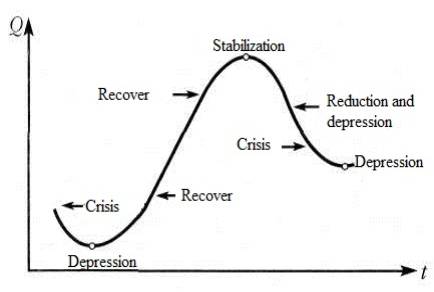
It may seem that the company is
currently in a satisfactory condition, but the place starts to failure in the
development of the enterprise. Decreases potential for success, competition,
possibilities of defense in case of suffer. The threat of a crisis and can
always be seen in advance, forecasting.
Specifically to prevent negative
consequences of the crisis are implemented diagnostic measures, in order to
prevent crisis situations and specific activities carried out in the system.
Nowadays, many research a new type of control that is needed to get the economy
out of the crisis. This type of management, "crisis management" is
called.Such concepts in the theory and practice of crisis they are called[2 ].
Crisis management in the economic dictionary,
in turn, is seen as a problem of overcoming the crisis and prevent that from
enterprise management.
In crisis management according to
B.N.Pak, the quality of economic reform and enterprise restructuring, is an
effective means of ensuring favorable investment climate[3].
V. I. Koshkin: anti-crisis management - a set of methods of implementing procedures ACM in
specific regards to the quality of the debtor's business. According to him: ACM
it is at the enterprise level is the category of production relations in
microeconomic distribution and rehabilitation [4].
In addition, the authors of the
anti-crisis management in conditions of economic crisis, this administration in
general, the latter authors say measures before bankruptcy, anti-crisis management
of the affairs of the bankrupt, according to other authors, they tie court
cases.
Thus, crisis management is crisis
prevention, prediction and measures of comprehensive prevention and also
treatment of the crisis, exit of crisis and elimination of its consequences in
the loss.
Special systems aimed at solving
complex problems anti-crisis management, it is possible to allocate internal
and external. Crisis management at the enterprise level, internal, and external
- on the state level.The system of external and internal crisis management in close
contact with each other.
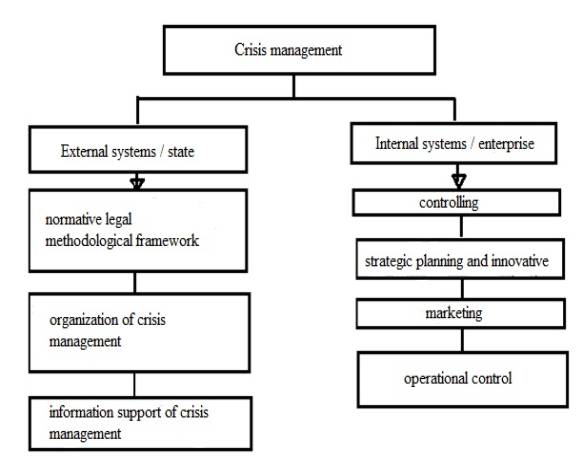
The organization consists of various
structural elements, internal and external systems and crisis management, as
follows.
However, it is very important that
the crisis is advance preparation, warning and prevention of crisis situations,
the first stage of its liquidation.
Thus, the importance of crisis management this is:
1) analysis of many issues in the enterprise;
2) implementation of measures for overcoming the
economic decline of the enterprise;
3) reduction and elimination of the bankrupt;
4) coordination of activity of the enterprise as a whole;
5) the rational allocation and efficient use of
resources;
6) questionable to help to overcome in a market
environment.
The
President of the Republic of Kazakhstan N. A. Nazarbayev in his address to the
nation: two anti-crisis plan we have developed and implemented well. It is our
vast experience in overcoming its economic difficulties and successful. For the
first
time with the use of crisis prevention strategies of Kazakhstan.
First,
we have industrial-innovative development, started the second five-year plan,
that is build only to see the economy looking for commodities in.
Secondly, we «Nurly Zhol» adopted
the program of development of infrastructure. An important aspect of
anti-crisis measures in connection with the transition to vacant positions of
the national currency tenge.
Thirdly, we 100 concrete steps on
the implementation of the 5 institutional reforms of the Nation" plan
implement. Legislative support plan for the Nation, the Parliament works. They
are more than 80 laws. Observed plan we will begin work on January 1, 2016.
Administrative barriers of public
administration for small and medium businesses are destroyed, education and
health care improved. All of these measures to the state, the society provides
additional tolerance in our economy.
В-четвертых,
мы, необходимых для фонда и золотовалютных резервов мы получили.
Fourthly, we needed to
Fund and gold and currency reserves we have got.
Fifthly, on my instructions, as before, the price
of a barrel of oil to 30 dollars decreased to 20,sophisticated conditions of
action developed online.
Sixth,
become the drivers of economic growth In new sectors created in the framework
of the innovative industrialization of the economy. In many manufacturing
industries, the growth.
Five
years in the manufacturing industry by 1.3 times, chemical industry and
construction materials production-by 1.7 times. Manufacture of engineering
products in 2.2 times, export increased 3 times. Over 800 projects have been
implemented. This year, just 15% of the steel industry, the chemical industry
increased by 3.2%. The production of mineral products by 3.2%, clothing
increased by 4%. The world Bank and the Asian development Bank predicts
economic growth in 2016 for high.
Seventh, economic Kazakhs behavior
changes. There is an increase in labour productivity of more than 60% [5].
Summing up, crisis management
company from the management is characterized by the features of his quite
traditional, that is closely connected with the activities of the enterprise,
in the context of recession and new management changes.
These 7 steps required to read, out of the crisis
will be easier. We immediately from horizontal obstacles, push step toward the
goal of entering the top 30 developed countries of the world.
References:
1 Zakharov V. Y. anti-Crisis management. Theory
and practice: a textbook for University students studying in the field of
Economics and management (060000) / V. J. Zakharov, A. O. Blinov, D. V. havin.
– M.:UNITY-DANA, 2007. – 287 S.
2 Kruglov N. Yu. Anticrisis management: textbook.
p. / N. Yu. The circle of crystals. – M.: KNORUS, 2009. – 512 p
"INFRA-M").
3 In Pak.N. Anti-crisis enterprise
management: Course of lectures /V. N. Pak. – Ekaterinburg: Publishing house
Ural. state economic. University press, 2006. – 266 p.
4 In Cat.And. Crisis management: 17-modular program for managers
"Management development organization". Module 11 / V. I. Koshkin. –
M.: PUBLISHING house: INFRA-M, 2000. – 512 p
5 The President Of The Republic Of Kazakhstan N.
And.And. Nazarbayev to the people of Kazakhstan.November 15, 2015