Senior
lecturer Ilyashova G., Rakhmetova T.
Kazakh national University named after al – Farabi, Kazakhstan
Improving the
competitiveness of domestic enterprises in the implementation of the import
substitution policy
While import substitution policies might
create jobs in the short run, as domestic producers replace foreign producers,
economics theory shows that in the end output and growth will be lower than it
would otherwise have been. This is because import substitution denies the
country the benefits to be gained from specialization and foreign imports. The
law of comparative advantage shows how countries will gain from trade.
Moreover, protectionism leads to dynamic inefficiency: Domestic producers have
no incentive from foreign competitors to reduce costs or improve products.
Import substitution can impede growth through poor allocation of resources, and
its effect on exchange rates harms export [1].
Analysis
of domestic market in the implementation of the import substitution policy and
offer optimal ways of improving domestic enterprises
Competitiveness
pertains to the ability and performance of a firm, sub-sector or country to
sell and supply goods and services in a given market, in relation to the
ability and performance of other firms, sub-sectors or countries in the same
market [2]. In recent years, the concept of competitiveness has emerged as a
new paradigm in economic development. Competitiveness captures the awareness of
both the limitations and challenges posed by global competition, at a time when
effective government action is constrained by budgetary constraints and the
private sector faces significant barriers to competing in domestic and
international markets. The Global Competitiveness Report of the World Economic
Forum defines competitiveness as "the set of institutions, policies, and
factors that determine the level of productivity of a country"[3].
Each
country in a world market tries to be more competitive and invade larger bar of
the “market pie”. There are many policies have been taken by governments to
make their economy to prosper. One of them is the policy of import
substitution. Import substitution helps
domestic enterprises to cope with their financial problems and survive in a
tough market conditions.
Government strategy that emphasizes replacement of some agricultural or
industrial imports to encourage local production for local consumption, rather
than producing for export markets. Import substitutes are meant to generate
employment, reduce foreign exchange demand, stimulate innovation, and make the
country self-reliant in critical areas such as food, defense, and advanced
technology [4].
Is it profitable to use the import
substitution policy to be become more competitive or just waste of money and
time? Can our domestic enterprises go up after gain support? Will they need
further support from government even after import substitution policy? To try
to answer mentioned questions we must research, firstly, current situation of
local market export and import.
Current situation in domestic market of Republic of
Kazakhstan: comparing export and import in economy
The economy of Kazakhstan is the largest
economy in Central Asia. It possesses enormous oil reserves as well as minerals
and metals. It also has considerable agricultural potential with its vast
steppe lands accommodating both livestock and grain production, as well as
developed space infrastructure, which took over all launches to the
International Space Station from the Space Shuttle. The mountains in the south
are important for apples and walnuts; both species grow wild there.
Kazakhstan's industrial sector rests on the extraction and processing of these
natural resources and on a relatively large machine-building sector
specializing in construction equipment, tractors, agricultural machinery, and
some military items. The breakup of the USSR and the collapse of demand for
Kazakhstan's traditional heavy industry products have resulted in a sharp
contraction of the economy since 1991, with the steepest annual decline
occurring in 1994. In 1995-97 the pace of the government program of economic
reform and privatization quickened, resulting in a substantial shifting of
assets into the private sector. The December 1996 signing of the Caspian
Pipeline Consortium agreement to build a new pipeline from western Kazakhstan's
Tengiz Field to the Black Sea increases prospects for substantially larger oil
exports in several years. Kazakhstan's economy turned downward in 1998 with a
2.5% decline in GDP growth due to slumping oil prices and the August financial
crisis in Russia. A bright spot in 1999 was the recovery of international
petroleum prices, which, combined with a well-timed tenge devaluation and a
bumper grain harvest, pulled the economy out of recession [5].
World
crisis affected on Kazakhstan economy badly as it is directly depended on
export of oil and gas, which makes our economy vulnerable.
The
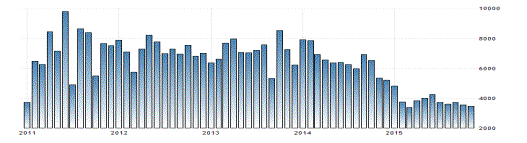
balance between export and import goes down. Following charts show Kazakhstan
Republics export in USD mln between 2010-2015 yr [6].
Chart 1
Kazakhstan’s
export volume (USD mln) between 2010-2015 yr.
According
to the chart, the highest export gain was in between 2010-2011. From 2014,
export is decreasing. Nowadays, world
oil price is not able to reach 40$ for barrel and still sways. Kazakhstan’s
strategic plans were counted on oil’s high price, but as facts show we cannot
rely on oil exports anymore, but it is still main product of export.
Devaluation of tenge affected on import price. Fluctuation of import price is
shown in chart 2 [7].
Chart 2
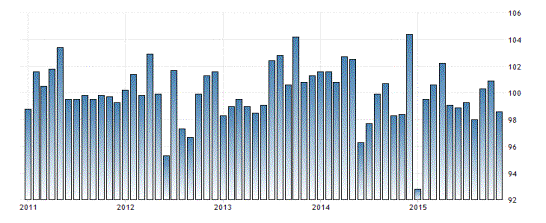
Fluctuation
of import price in Kazakhstan (percentage) in 2011-2015
Fluctuation
of import price in percentage shows that import price is steadily rising. The
highest rise was 104 % in the end of 2014. Now, it fluctuates between 98-102%.
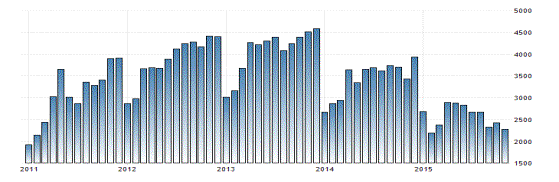
Chart 3
Import
volume in 2011-2015 yr.(USD mln) [8]
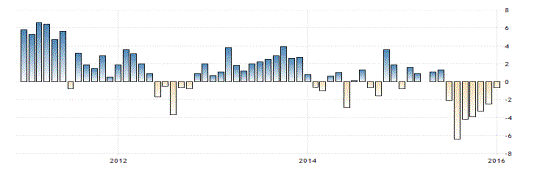
Devaluation
and the fall of oil price negatively influenced on industrial production.
Chart
4
Industrial
production (percentage) of Kazakhstan in 2011-2015 [9]
References
1.
ANALYSIS OF
COMPETITIVENESS OF DOMESTIC ENTERPRISES ON THE GLOBAL MARKET/
http://scindeks-clanci.ceon.rs/data/pdf/2217-8090/2012/2217-80901201001S.pdf
2.
ANALYSIS OF
COMPETITIVENESS OF DOMESTIC ENTERPRISES
https://www.researchgate.net/publication/266285319_ANALYSIS_OF_COMPETITIVENESS_OF_DOMESTIC_ENTERPRISES_ON_THE_GLOBAL_MARKET
3.
World
Economic Forum, The
Global Competitiveness Report 2009–2010 p.3
4.
Import substitution/
http://www.businessdictionary.com/definition/import-substitution.html#ixzz4041WBEFt
5.
Economy & Business
Overview/ https://en.wikipedia.org/wiki/Economy_of_Kazakhstan
6.
Trading
economics/export/http://ru.tradingeconomics.com/kazakhstan/export
7.
Trading economics/import
prices/http://ru.tradingeconomics.com/kazakhstan/import-prices
8.
Trading
economics/imports/http://ru.tradingeconomics.com/kazakhstan/imports
9.
Trading
economics/industrial-products/http://ru.tradingeconomics.com/kazakhstan/industrial-production