Economics / 2. Accounting and Audit
Candidate of Economic Sciences,docent Baidauletov M.B,
Master Omirtassova Sara
The role of complex economic analysis in crisis
management mechanism of the activity enterprises
In any society, both in an integrated socio-economic system, from time to
time there are crises that threaten the existence of the system itself. The
most important in this situation is to overcome the crisis situation in the
enterprises that make up the primary circuit of the economy.
Thus, the actual direction of economic analysis today is the crisis
management of the enterprise. Recent work by international and local scientists
argue that the study of issues of crisis management is now a problem to date
and insufficiently studied, because in need of follow-up study.
Significant attention to the problems of the economic analysis of
anti-recessionary management of the enterprises devoted scholars such as
Ivanenko V.M., Pavlenko A.F.,
Zakharenko V.S. paid considerable attention to the theoretical approach to
problem solving. Theoretical, methodological and practical problems of
organization of economic analysis at the company investigated in scientific
works Zhitnoy I.P, Lazarishina I.D., Savitskaya G.V., and other researchers.
The crisis
at the plant can be expressed that the deteriorating financial performance,
they become unable to make a profit, thus losing its competitive position in
the market, so that may go bankrupt. In order to prevent such effects should be
carried out anti-crisis management of the enterprise.
Crisis management company - is a comprehensive enterprise management
system, which is characterized by a strategic nature, aimed at eliminating
potential and existing problems in its activities by developing and
implementing a special program using the full potential of modern management.
One of the principles for the implementation of crisis management is the
early diagnosis of the crisis of the enterprise [2]. For early detection of
such phenomena it is necessary to systematically analyze the various indicators
of the functioning of enterprises. Thus, a comprehensive economic analysis of
the needs in all stages of business, from the formation of the enterprise to
implement each stage of its functioning [2].
The complex analysis of economic activities as a special area of
scientific knowledge is constantly evolving in line with changes
in the economy and accounting practices. Thus, the accounting separation of
financial and management led to a corresponding separation and analysis of
economic activity.
In the
modern period analysis of economic activity takes place among the great
economic sciences, becoming one of the production management functions. The
control system can be simplified analysis of a place to present Figure 1. The
control system consists of interrelated functions: planning, accounting,
analysis and decision-making.
Planning - a very important function in the production management system in
the enterprise. With the help of planning to determine the content of business,
departments and employees. The main objective - ensuring the systematic
development and business economics, providing the best way to achieve the end
results of production [4].
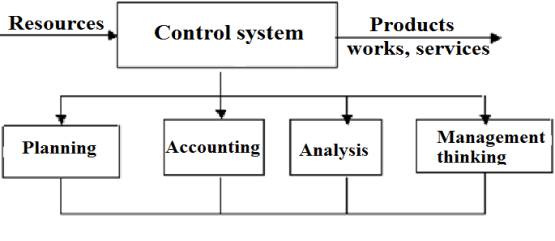
Fig.1. Position control system analysis
Full and objective information necessary for
production management, provided by one of the production management functions -
into account. Accounting provides a permanent collection, systematization and
generalization of data necessary production management functions, as well as
for monitoring of the implementation of plans and progress in production
processes.
In addition, for production management information is
needed about trends and nature of changes occurring in the economy of the
enterprise. Understanding information and understanding are achieved through
economic analysis. During a comprehensive analysis of primary information
analytically processed by comparing the results achieved with the production
data of previous periods, that of other companies, industry averages;
identified shortcomings, mistakes, missed opportunities, prospects and others.
As a result of the analysis are developed and justified management decisions.
Therefore, the economic analysis is a management function that provides
scientific decision-making [3].
Complex economic analysis is not only a means to
justify the plans, but also a tool for monitoring their implementation.
Planning begins and ends with an analysis of the results of the enterprise, and
the analysis can improve the level of planning and make it scientifically valid
[3,4].
The role of the complex economic analysis as a
production management tool is increasing every year. This happens for many
reasons:
- Firstly, the steadily increasing production
efficiency due to increased scarcity and cost of raw materials, as well as an
increase in capital intensity of production and science;
- Secondly, the production moves away from
command-administrative management system and transition to economic methods;
- Thirdly, to create new forms of management in
connection with the denationalization of the economy, privatization of
enterprises and other economic reforms.
Today, management decisions should be based on precise
calculations, a deep and comprehensive economic analysis, therefore
underestimating the role of the analysis, errors in planning and management
decisions in the present conditions bring tangible, sometimes irreparable loss.
All this leads to the conclusion that the analysis of
economic activity- an important element in the production management system, an
effective means of identifying internal reserves, the basis of the development
of science-based planning and management decisions.
The purpose of the complex economic analysis should be
consistent with the main tasks of effective management of the enterprise
activity - the achievement of social and economic results for the preservation
durability of the medium. In this regard, there is need to improve the
methodology of economic analysis itself to expand its capabilities in
addressing the strategic and tactical management tasks [1].
The system of indicators, which exists at the moment,
not focused on the recognition of crises. Obviously, the need to develop new
synthetic indicators in order to determine the probability and the time of the
crisis situations more accurately and on time. The important is not only the
system of indicators, which reflect the main features of the crisis, but also
the methodology of their creation and practical use, which is sufficiently weak
link of modern management mechanism [2].
Nevertheless, the decline in some indicators
(evaluation of property status, profitability, financial stability, business
activity, liquidity, solvency) may be episodic in nature, and may indicate a
crisis trends.
During the complex economic analysis must focus on the
search for reserves for increasing the efficiency of the enterprise through a
detailed analysis of key performance indicators.
At present, the analysis in crisis management is not
possible without the use of computer technology, which improves the accuracy of
the analytical conclusions, gives the opportunity to save time, labor costs,
thus increasing the efficiency of this work. Now we know a lot of computer
algorithms for solving various problems of mathematical programming. Therefore,
even small businesses can apply the methods of mathematical programming in the
implementation of the analysis [1].
In modern conditions of market economy, which has
developed today in Kazakhstan, the role of economic analysis is significantly
increasing, especially in the conditions of crisis phenomena in the company,
when it is due to conduct comprehensive economic analysis can’t determine the
causes of the crisis and to develop and validate the possible ways out of the
crisis. Modern economic analysis makes it possible to implement the enterprise
system of computer analysis of the basic indicators of activity of the
enterprise, but the drawback is that in Kazakhstan this practice economic
analysis has not found wide acceptance.
1. IF Lobachyova Organization of economic analysis in
terms of crisis management now / IF Lobachyova // Agribusiness Economics. -
2010. - № 5. - pp 128-133
2. Naumenko AP now / AP Crisis Management Naumenko //
Economy. - 2010. - №2. - S. 87-93
3. Sheremet AD "The Theory of Economic
Analysis". - Moscow, Infra-M, 2006
4. Savitskaya GV "Analysis of economic activity
of the enterprise." - Moscow, Infra-M, 2007