Doctor of Economics, professor Dulambaeva R.T., Satybaldy Togzhan
Kazakh national University named
after al – Farabi, Kazakhstan
The production of industry in Kazakhstan
Kazakhstan is
important to world energy markets because it has significant oil and natural
gas reserves. With sufficient export options, Kazakhstan could become one of
the world's largest oil producers and exporters in the next decade. But
Kazakhstan's strategic aspiration is to become a modern, diversified economy
with a high value added and high-tech component, well integrated
in to the global economy. The energy sector is viewed as a good basis to
achieve this goal. The perspective of the Economy of Kazakhstan is closely
connected with further integration into international economic relations,
utilization of unique reserves of energy and mineral resources, vast
possibilities to export industrial and agricultural products, optimum
employment of country's transit potential and also with
availability of highly qualified specialists indifferent spheres.
During the Soviet period Kazakhstan was an agrarian,
raw materials supplier of the former Soviet economy, where the military
industry played the major role. The main economic content of more than 10 years
of independence has become transition from the central command planning to a
market system. During these years, Kazakhstan has made considerable progress in
implementing complex political, economic and social reforms to establish a democratic
state with a market
economy. While the country has not experienced political
disturbances during the transition period, it has faced numerous economic,
social and environmental challenges.
The main goals of current structural policy
are diversification and the strengthening of the non-oil sector.
A number of development agencies and research centers (Development
Institutions) have been established and the Government is looking at
establishing techno and science parks to support the diversification of
higher-value added industries. But there are certain obstacles inherited from
the past to quickly achieve this.
This has resulted in a stable level of
inflation (2002 - 6.6%, 2003 - 6.8%, 2004 - 6.7%, 2005 - 6.6%), a budget
surplus, a firm currency, and a decreasing unemployment rate (2003 - 8.8%, 2004
- 8.4%). After posting moderate growth of 2.7% in 1999 as a whole, Kazakhstan's
real gross domestic product (GDP)
rose 9.6% in 2000, 13.2% (2001), easily the country's best year of economic
performance since independence, 9% in 2002, 9.1% in 2003, 9.3 in 2004 and
according to The Economist Intelligent Unit Kazakhstan is within Top 10 world
fastest-growing economies in 2005.
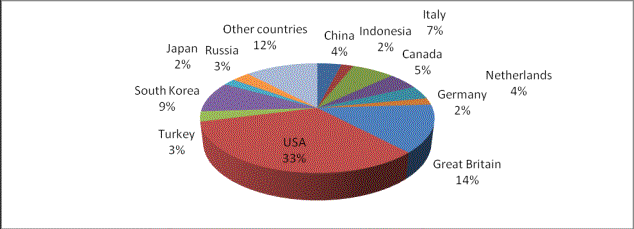
The main driver behind Kazakhstan's economic
growth has been foreign investment, mainly in the
country's booming oil and natural gas industries. Since independence from
Soviet rule in 1991, Kazakhstan has received more than 30 bln. US$ of foreign
direct investment - the highest per capital indicator in the former Eastern Bloc.
Pie chart 1. Structure of direct
foreign investments by countries
Hard
currency reserves of the National Bank and National Fund combined reached US$
14.4 bln. in 2004 (growth 66.3%). In 2004 the minimum wage in comparison with
2003 grew by 32% and average wages grew by 21.4%.Real income during this period
grew by 13.5%. Real growth of average monthly pensions was 23.4% and there has
been a significant increase in social payments by the state. As US
Under-Secretary of state for Economic Business and Agricultural Affairs, Mr.
Alan P. Larson, said recently in his address to the American Chamber of
Commerce in Kazakhstan: "Since its independence in 1991, Kazakhstan has
been in the midst of a remarkable transition from communism to free markets.
When completed, this transformation could bring Kazakhstan into the global
market place in a way not seen since Central Asia dominated international trade
routes hundreds of years ago. Now country's investment potential is based on minerals and raw materials. Because their
exploitation creates more than a half of the gross product, the quality and
extent of deposits utilization and the reproduction of raw material reserves
play decisive role in the present and future of Kazakhstan. For example, it is
supposed that exploitation of the oil and gas field Kashagan which is one of largest
fields in the world will make Kazakhstan one of the major producers of
hydrocarbons not only on the regional, but also on the international level.
According
to certain estimates, in the next 10 years the oil and gas sector of the
country, particularly the Kazakh sector of the Caspian Sea, could attract between to 150-200 bln. US$. At the
same time, the Kazakhstan Government's top priority is to encourage foreign direct
investments into industry, agriculture, innovation, processing sectors in order
to decrease the dependence of the Economy of Kazakhstan on energy and
extracting sectors and to ensure continued growth of Kazakhstan's
economy.Aiming at attracting foreign direct investments
Kazakhstan carries out the policy of ensuring stable macroeconomic environment
and realizes other measures which contribute to the improvement of investment
climate in the
country. The Government and the National Bank pursue the co ordinated policy
directed to ensuring sustainable economic growth with low inflation rate and
budget deficit not higher than it is envisaged.
All
these institutions serve the further development and diversification of the economy
of Kazakhstan. Thus, during these years Kazakhstan has covered
a path which has not been easy, and has achieved significant results. Having
created and strengthened sociopolitical stability by implementing democratic
and market reforms on a steady basis, Kazakhstan has gained macroeconomic
stability, formed legislation essential for conducting
successful business, and realized structural reforms which, while being
unpopular initially, created a firm basis and favorable environment for the accelerated development of the
country in the mid and long terms.During the first decades of the Soviet regime
(1920's and 30's) the Kazakhs, like all other populations of the former USSR,
was attacking an ancient backwardness and struggled against poverty and
economic inertia. Russians and other fraternal people participated in the
construction and exploitation of the mines, plants, and factories in
Kazakhstan, in the agricultural reforms, and the development of education,
science and culture. In 1920, the
production of industry in Kazakhstan was only 5.3% of the total production of
the Kazakh economy, but by 1945, that figure had reached nearly 66 per cent. If Kazakhstan and Russia were behind the advanced countries by
50-100 years in technical development, then in the pre-war, war and post-war
periods our people greatly reduced that distance. As a result, Kazakhstan
became one of the leading industrial centers of the former USSR and held fourth
place among the other republics. In that period, different branches of economy
began to develop in Kazakhstan.
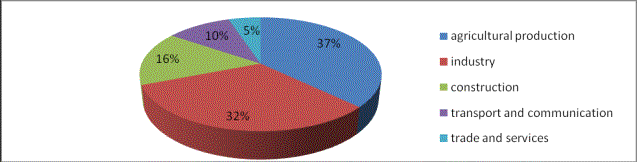
Pie chart 2.The total volume of the
economic production of the republic in 1991
In the
same year, 1991, Kazakhstan was able to satisfy only 42% of the local consumer
market with its own products, which means that Kazakhstan was formed and
remained as a raw material supplier to the economy of the USSR. Up to this
point, Kazakhstan had remained a country with a primary economy - mining,
industry and agriculture, but at the same time one with a big pantry of mineral
wealth. Nevertheless, honestly
speaking, during the Soviet regime Kazakhstan was transformed into a great
industrial and agricultural region. Huge centers of energy, metallurgy, fuel,
chemical and machine-building industry were built in the republic.
Now, Kazakhstan is
the biggest producer of ferrous and non-ferrous metals, uranium, coal, oil,
corn, and products of stock-breeding. The years of the Soviet regime were the
most favourable for the development of Kazakhstan's economy with regard to the
production of these heavy industries . According to the estimation of some
leading specialists, in 1992 the slump in production against the relatively
stable level of 1990 was 14.6%, in 1993 - 28%, in 1994 - 48%, and in 1995-57%. According to the conclusions of many
authoritative scientists, the lands of Kazakhstan can feed more than one
billion people if reasonably used. In
1992, work on the reformation of the economy to a market basis began, and at
the end of 1993 was made more active. During these years especially, the
process of the formation of a multi-structural economy geared up. 91,300
economic enterprises, of which 73,400 represented the non-state sector,
operated in Kazakhstan at the end 1995. The portion of industrial production
produced in 1995 by enterprises in the non-state sector of the economy was
30.4%; their share of the volume of gross production in agriculture was 38.9%.
Medium and small businesses are developing in the republic. At the beginning of
1996, 21,300 enterprises and organizations were represented and 147,200 people
worked at these firms. At the same time, the continued process of privatization
is one of the factors which is promoting the development of business.
Kazakhstan
is intensively searching for new ways to exit the deep economic and social
crisis which has arisen during the last years. The main way is to improve the
basic branches of economy. The transfer of large industrial enterprises to
contract management of local and foreign companies is considered to be one
direction to overcome that crisis. During two last years, 42 contracts were
concluded, 30 of which operated to the end of 1995.
Kazakhstan is used as an intermediate zone
for the transportation of natural gas of the republics of Central Asia to
Russia. The natural gas of Kazakhstan is transferred to Russia without any
processing, but not to its users, even in the western region where the gas is
extracted. Because of this, the main problem of Kazakhstan is the necessity of
the improvement of usage within the republic and the modernization of the
present infrastructure.
References
1.
"Kazakhstan
becoming pillar of energy security in Asia and Europe". Alexander's Gas
& Oil Connections. 13 September 2006. Retrieved 2007-06-10.
2.
"Kazakhstan
energy data, statistics and analysis - oil". US
EnergyInformationAgency. October 2006. Retrieved 2007-06-10.
3.
"Central
Asia's Energy Risks. Asia Report No. 133" (PDF). International Crisis
Group. 2007-05-24. Archived from the original (PDF) on 2007-06-13. Retrieved2007-05-26
4.
Mikhail Alexandrov (February 1998). "Russian-Kazakh
Contradictions on the Caspian Sea Legal Status. Russian and Euro-Asian
Bulletin". CERC - ContemporaryEuropeResearchCentre. Retrieved 2007-05-26.