PhD,
Professor Dulambaeva R.T.
Askerbekova
M.A.
Integration processes in Central Asia :
Kazakhstan's role .
In
modern conditions of international relations between the two countries are
based on the extensive use of regional economic agreements - international
agreements concluded by two or more States, located in a particular region for
cooperation in specific areas.
Regional economic agreements are
interstate in nature, there are between governmental and inter-agency and
international legal point of view can be regulated:
in
the form of contracts, defining the general principles of relations between
states;
• -
agreements providing for specific forms of cooperation;
• -
conventions that define the principles of relations between states in any given
special area, and others.
Regarding
the consideration of economic integration as a process, in the course of
economic theory, edited by MN Chepourin and EA Kiseleva integration is hard to
understand the process of rapprochement and interpenetration of national
economies of several countries, aiming at the creation of a single economic
organism [1]. In our view, clearly the fact that international economic
integration - a process of economic and political union of countries based on
the development of deep, stable relationships and the division of labor between
the national economies, the interaction of their production structures at
various levels and in various forms. [2]
Hence,
characterizing the international economic integration as a process, it must be
assumed that the process of economic cooperation between the countries leads to
the unification of economic mechanisms. At a higher level rises the process of
socialization of production, and this requires organization and purposeful,
systematic regulation of economic processes on the scale of integration associations.
In
other words, all of this means the need to establish certain relationships,
taking the form of international agreements and consistently regulated by
intergovernmental bodies
For
the current business regulation created councils, committees, commissions with
participation of representatives of countries and specially designed machine.
Interstate regulation, carried out on the basis of regional economic agreements
aimed at creating a more favorable environment for the development of the
productive forces in certain areas. The range of issues of regional integration
is predetermined to find the most important and priority areas of cooperation
in the entire system of international economic integration. There are different
levels and scope of international economic integration: a planetary scale, the
regional level, the level of firms.
The
integration processes lead to the development of economic regionalism, in which
separate groups of countries offer each other more favorable conditions for
trade and sometimes for inter-regional and international movement of factors of
production.
According
to B. Balassa, integration - is the alignment of conditions for economic
activity of market players, regardless of whether a resident of two or more
States, united in the integration group, they are [3].
The
objectives of regional economic integration [4]:
• -
Take advantage of economies of scale by increasing market size, reducing
transaction costs and removing the other benefits on the basis of the theory of
scale economy.
• -
Creating a favorable foreign environment by strengthening mutual understanding
and cooperation of the countries involved in non-economic areas.
• -
Preservation and maintenance of peace and security in the region and in the
world.
• -
The decision of trade policy objectives through negotiations for the trade
policy, development of the concept of WTO accession and participation in other
international trade organizations.
• -
Promoting economic restructuring for more effective and efficient management
• -
domestic support and protection of infant industries.
• -
Promoting economic growth and employment.
International economic integration - a process of rapprochement and mutual adjustment of
individual national economies through the development of deep, stable
relationships and the division of labor between countries, inter-penetration of
their reproductive structures in different forms and at different levels.
Integration - an objective necessity, associated with the further socialization of
production and the internationalization of economic life [6].
Integration is the only true way of socio-economic and political development, and
regional integration - this is the real key to the country's joining the global
world economy. A consistent logical choice for the integration - Russia and
Belarus. We have long-standing historical, cultural, economic, political ties,
we share a common historical political and economic past. Kazakhstan
Electricity goes to Russia, the oil goes through Russian transit Ekibastuz coal
supplied to the Ural and Siberian plants ... Now these production relations
come to a new level.
If
you look back to the period of formation and development of independent
Kazakhstan, we can see that this is not the first attempt of regional trade and
economic integration.
After
independence in the early 90-ies of all the former Soviet republics began to
develop their own internal and external economic policies.
The
President of Kazakhstan, Nursultan Nazarbayev, back in the mid 90-ies of the
last century put forward the idea of a single economic space in
the region. In the conditions of globalization of world economic relations
issue is not - integrated or not, the question is - how and with which
countries integrate.
In
1995, he formed the first Customs Union, which includes Russia, Kazakhstan,
Belarus, Kyrgyzstan, and in 1998 they were joined by Tajikistan.
As you know, there are successive logical
stages of international regional economic integration:
• -
The Free Trade Area, which will be free movement of goods and services.
• -
The Customs Union, which applies the common external customs tariff and a
unified customs territory.
• -
General or single market, where there is also the free movement of capital and
people.
• -
The Economic Monetary Union, which is a single common currency in the
participating countries.
• -
The political alliance, or confederation of almost creating a single state, to
this stage of integration has no regional block is not reached.
Targets
have been developed, tasks, principles of organization. But in fact, the
customs union still does not operate, it actually was not a customs union and a
free trade zone, within which there were many problems. Accepted documents are
not worked in practice, and lay down on the table. Countries have different
levels of economic development, there is a conflict of interest. Kyrgyzstan in
1998, joined the WTO as a developed country and exacerbated the available
contradictions. The union was not a unified customs tariff, that is, had
different external tariffs, had a different method of calculation of VAT,
excise duties are different, non-fulfillment of obligations, and so. D.
In
1994 it was created the Central Asian Economic Community, which includes
Kazakhstan, Uzbekistan and Kyrgyzstan. The purpose of this alliance was also
the creation of a single economic space. In 1998 he joined to Tajikistan. But
in fact, in this union there was no single economic space nor the Customs
Union, or even a free trade zone.
In
October 2000, the Agreement on the establishment of the Eurasian Economic
Community (EurAsEC) was signed in Astana. This organization was created to
effectively promote a customs union goals and objectives and a common economic
space.
In
2006, the Customs Union 1, and the Central Asian Union joined the EurAsEC and
ceased to exist as a separate economic blocs. And later originated the new
Customs Union as the real product of the integration process in the EurAsEC.
Turning
to today, we can say that the current Customs Union has all the opportunities
for successful development and full implementation in practice, as already at
the start of the three countries agreed on an external import customs tariff
and in July launched already a single customs territory, where a single customs
Code.
The
legal basis of the CU become international treaties and agreements TC States
Parties, it is based on the norms of international customs and trade law. Of
course, there are both advantages and disadvantages for the participating
countries, particularly Kazakhstan.
The
main objectives of the CU Commission - the creation of conditions for free
trade between Kazakhstan, Russia and Belarus, as well as maintaining an equal
trade policy with third countries. These are the two main functions of the
Customs Union, which does not threaten our independence.
Competitive
advantage, a favorable tax regime and simplification of procedures are the
principal advantages of the Customs Union [7]. The Customs Union (CU) provides
significant opportunities for domestic businesses by the abolition of customs
barriers, the impressive expansion of the market, mutually benefits and
preferences. And investors will attract many times the expanded alliance
partner.
14-15 June 2001 adopted a Declaration on the
establishment of the Shanghai Cooperation Organization ( SCO ) , which includes
China, Kazakhstan, Kyrgyzstan, Russia , Tajikistan and Uzbekistan . Observers in the organization: India, Pakistan , Mongolia , Iran .
accession partial acquisition
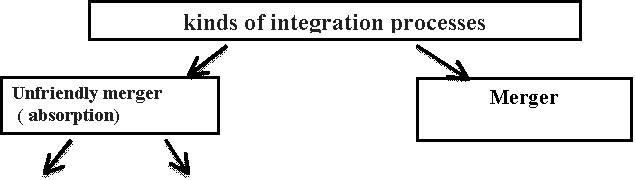
The predecessor of the SCO was the so-called
"Shanghai Five" (Russia, Kazakhstan, Kyrgyzstan, China and
Tajikistan), formed as a result of the signing of the Agreement on
confidence-building in the military field in the border area (1996) and the
Agreement on Mutual Reduction of Military Forces in Border Regions (1997 ). The
convergence of these countries was dictated, first of all, the threat of the
safety of their border areas from the main focus of instability in Central Asia
- Afghanistan, where there was a civil war between the forces of the Northern
Coalition and Taliban. The first of the two agreements were signed in Shanghai,
which was the basis for the emergence of the term "Shanghai Five".
Teamwork at the summits in Almaty (1998), Bishkek (1999), Dushanbe (2000)
helped to create the atmosphere of what became known as the "Shanghai
Spirit" - to develop a climate of mutual trust through the first
experience of mutual consultation to come to a mechanism for consensus building
and voluntary consent to perform the provisions of the agreements reached.
Gradually, the range of issues has expanded to the spheres of foreign policy,
the economy, the environment, including water resources, culture, and so on. D.
The
main objectives of the SCO proclaimed maintaining and ensuring peace, security
and stability in Central Asia, as well as the development of cooperation in
political, trade-economic, scientific-technical, cultural, educational, energy,
transport, environment and other fields. Another important document - the
Convention on Combating Terrorism, Separatism and Extremism, fixed the first
time at the international level the definition of separatism and extremism as a
violent prosecuted under criminal law acts. Its signing is due to China's
worries about separatist speeches near the borders with Central Asia, home to
the Uighurs - Turkic-speaking Muslims, lyayuschie popu-west China. Another no
less interested country - Uzbekistan - has the largest population of all states
Central
Asia and the most exposed to manifestations of separatism on the part of
supporters of radical restoration in the region of an Islamic caliphate.
In
June 2002, held the second meeting of heads of SCO member states in St.
Petersburg, where the three documents were signed - Charter of the Shanghai
Cooperation Organization, the Agreement between the SCO member states on the
Regional Antiterrorist Structure and the Declaration of Heads of SCO member
states.
SCO
Forum was established at a meeting held in Moscow, MGIMO (University) MFA
Russia on May 22-23, 2006 [5].
SCO
Forum is a multilateral, public consultation and expert mechanism established
to promote and scientific support for the activities of the SCO, promoting
interaction research and poly-ontological centers of the SCO member states,
joint research on topical issues of the terms of reference of the Organization,
tasks explanations and principles of activity SCO and expanding its relations
with scientific and social circles, as well as the promotion of exchanges
between academics and experts in politics, security, economy, environment, new
technologies, humanitarian and other fields of ob. Forum bases its activities
on the basis of the principles of the SCO Charter, on the basis of the law and
the Rules of the SCO member states. Forum works closely with the SCO
Secretariat, the Council of National Coordinators, the foreign ministries of
the Member States.
Some
experts say as the two most obvious SCO problems too large divergence of
interests between its members and the uncertainty as to its status due to the
duplication of many of the SCO functions with the Organization of the
Collective Security Treaty Organization (CSTO), which includes four of the six
SCO member states.
Some
experts say as the two most obvious SCO problems too large divergence of
interests between its members and the uncertainty as to its status due to the
duplication of many of the SCO functions with the Organization of the
Collective Security Treaty Organization (CSTO), which includes four of the six
SCO member states.
Thus,
there are about 230 countries and over one hundred inter-state alliances in the
world. The global economy characterized by the trend towards unification, which
is especially evident in the modern conditions of internationalization,
globalization and regionalization.
Kazakhstan
is currently a member of many international and regional economic and political
organizations such as the UN, IMF, World Bank, Evra, ZES, Customs Union, SCO,
OSCE and others. Kazakhstan today under the leadership of President Nursultan
Nazarbayev of the Republic has a policy of multi-vector integration.
Kazakhstan
- a country open to cooperation and regional integration with neighboring
states. Kazakhstan in the Central Asian region is the initiator and leader of
all integration processes, ready for a constructive dialogue with regional and
international political and economic partners.
Literature
1.
Borisov EF, Volkov FM Basic economic theory: a tutorial, 1993. - S. 224.
2.
Kireev International Economics. - 1998 -C. 361.
3.
Aytzhanova J. Competitive Advantage, blagopri¬yatny tax regime and
simplification of procedures - glav¬nye advantages of the Customs Union //
Kazakhstanskaya Pravda 2010.
4.
Alexander Lukin. Moscow. rodon.org/ seminar "Russia and China in the new
international environment" (SCO). 09.10.2009