Today,
the existing studies of thermo-elastic state of one-dimensional elements of the
construction are relatively of private character and are not subject to all
exploitation conditions [1-4]. Also, very important tasks of technology and
chemical engineering, thermo elastic steady state of one-dimensional
construction elements with axial force, unequal distribution of temperature
field, thermal flow, heat exchange and thermal insulation are worth careful
studying.
Earlier
the authors made the fundamental justification for the fact that the function
which gives the minimum to the functional that characterizes the full thermal
energy is the solution to of the heat-transfer equation with the appropriate
natural boundary conditions [2]. The field of temperature distribution along
the rod length, with rod lengthening and tensile strength was defined.
The
differential equation for temperature distribution along the full rod length of
the rod was considered:
 (1)
(1)
With the following boundary
conditions:
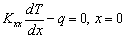
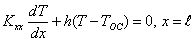 (2)
(2)
If the
coefficient of thermal expansion of the rod material is  , then the lengthening of the rod due to field of temperature
distribution is
, then the lengthening of the rod due to field of temperature
distribution is
 (3)
(3)
To
compare our results with those obtained by other authors, the parameter values
representing the geometric, physical and mechanical and thermal properties of
the rod are defined as follows:
 ;
; ;
;  ;
;  ;
;  ;
; ;
;  ;
; 
The
temperature values  in the points
 ,
,  ,
,  of the rod will be:
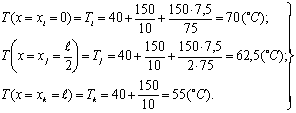
These
found values exactly coincide with the values found previously. Extension of
the rod due to the impact of the tensile strength has the following form
 (4)
(4)
Then,
using (3), (4) the value of the ratio is
 (5)
(5)
If ,
,
Then
for the rod under consideration there will be  .
.
As it
can be seen, here it is necessary to take into account the fact that the
extension of the rod due to the temperature will be much more considerable than
the extension of the rod due to the applied tensile force, when the rod
structural elements are under the influence of heat flow and tensile strength.
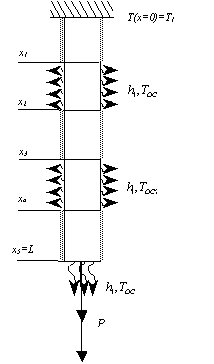
Here
the numerical study of lengthening of partially heat-isolated rod in the
presence of a heat sources and tensile strength is given. The numerical study
with the different source data was conducted.
 0251659264
Fig. 1. Calculation
scheme of the task
To do
it, the rod with length L will be to
discrete quadratic finite elements with three nodes.
Then,
for the final elements in the heat isolated lateral surface parts, the view of
the functional, expressing conservation and change of the total thermal energy
is as follows
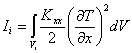 (6)
(6)
For
the finite element heat isolated by the lateral surface, the functional type is
as follows
 (7)
(7)
On the
lateral surface  of the rod, the heat exchange with the environment takes place.
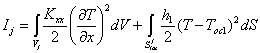 (8)
(8)
On the lateral surface  of the rod, the heat exchange with the environment takes place as well.
 (9)
(9)
Then,
for the rod in general, the expression of the corresponding functional is as
follows
 (10)
(10)
The
influence of temperature and tensile strength on the lengthening of the rod was
analyzed [1].
Moreover, the lengthening of considered rod is
affected the by heat transfer coefficient between the rod material and the
cross-sectional area of the clamped rod ends [2].
between the rod material and the
cross-sectional area of the clamped rod ends [2].
After testing of the developed computational algorithm, the influence of local temperature and heat exchange on the
thermal-strained and deformed state of the test rod is
analyzed. To do this, the values of the
compressive force and the true stress on different rod
parts are calculated [1].The influence of the heat flow on the thermal strained
deformed and state of the test rod was analyzed [2].
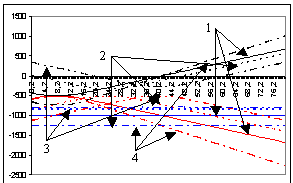
The analysis of the effect of heat flow on the cross-sectional area and
analyses of the effect of the heat exchange with the environment through a
portion of the lateral surface on the thermal-strained and deformed state of the test rod were carried out. These results are
shown in Fig. 2-3.
 0
0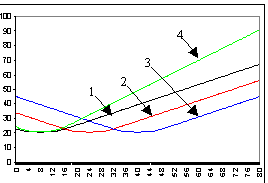 0
0
Fig. 2.The field of temperature distribution Fig. 3.The law on the
distribution
along the length of the rod of
displacements of nodal points along the rod length.
On the
basis of the minimization of the functional characterizing the
full thermal energy using quadratic finite elements with three nodes, the
computational algorithm of tasks of determining the
temperature distribution field in the rods of limited length in the presence of
heat flow, heat exchange and partial insulation was
constructed.
The corresponding developed computational algorithms were tested by
several test problems.
The corresponding calculation algorithm of numerical
study of thermal strained and deformed state of the rod partially thermally
insulated and clamped by two ends, in the presence of the local temperature and
heat exchange, was developed.
references
1.
Kudaykulov A.K., Amirtayev K.B.,
Tuleuova R., Utebaev U.B., Tokkuliev B.M. Steady thermal stress-strained and
deformed state of the rod in the presence of heat sources // Proceedings of the
Fifth All-Russian scientific conference with international participation
"Mathematical modeling and boundary value problems" - Samara - 2008.
- p. 161-165.
2.
Kudaykulov A.K., Amirtayev K.B.,
Utebaev U.B. Numerical study of strain-deformed state of the rod filled-rigidly
at both ends, when exposed along the length to the parabolic law of the
temperature field// Materialy IV mezinarodni vedecko-prakticka conference
«Научно пространство на европа-2008». – Sofia – 2008. – Т.28, – p. 21–24.
3. AmirtayevK.B., UtebaevU.B., TokkulievB.M., ZhumadillaevaA. Determination
of the law of temperature distribution in a partially insulated tube of limited
length, with the heat flow on the inner bounded surface of closed mid-pipe //
Materialy IV mezinarodni vedecko-prakticka conference «Бъдещето проблемите на
световната наука-2008». – Sofia – 2008. – p. 66–69.