Al-Farabi Kazakh
National University
Dulambaeva R.T,
Professor of
Economics .
Kan A.O.
Future
Energy.
Today, the world is on the verge of
an energy revolution. Full implementation of alternative energy sources is
practiced today. Many countries are facing a shortage of natural energy
sources. The main reason - is population growth, increasing demand for energy
and, above all, limited resources. Oil with each passing day it becomes less
and less, and the prospect of it as a source of energy in the future is very
uncertain. Therefore, scientists from around the world on a daily basis trying
to advance in the study of new methods and ideas in the power system. For the
full implementation of some of these ideas will take years and years. Other now
you can take on board. Rather, the energy needs of humanity will be met by
combining different advanced technologies. This alliance will play a role of
solar, wind, ocean waves and other alternative sources. Industry as a consumer,
too, will make a step forward - modern technology is successfully learning to
do more while consuming less. Outlined in this article, three general ideas
need to ease the burden that humanity places on fossil fuels. Each of these
ideas came close to the stage of implementation, and together they should pave
the way for further breakthroughs in production and energy efficiency.
• - Wind - one of
the simplest solutions. Many are aware of the fact that even a small windmill
thanks to a small alteration can provide half of your home's needs. If you
understand how it works, then everything is made of small wind turbines is
simple: the wind turns the turbine, it rotates from the generator and the AC
outputs. However, wind speed is variable, so that the changing and the output
voltage. The voltage may drop to a level at which it is impossible to charge
the battery or fuel the consumer network. [1]
Andy Knight, professor of Faculty of Electrical
Engineering at the University of Alberta, and his group of researchers proposed
a new scheme in which the wind turbine energy can accumulate even at a
relatively calm weather. The device Knight alternating current passes through
the rectifier, where it is converted to DC, which is charging a 12-volt
battery. Because the battery can not be charged at a voltage of less than its
own, the developers have included in the scheme of a special controller - it tracks
the frequency of the alternating current coming from the generator. If the
voltage is too low, the controller commands the switch, and stops charging
until the voltage reaches 12 V. The converter switch opens and closes the
circuit of about a thousand times per second. Constantly adjusting the ratio of
the open and closed phases, this device is able to accurately adjust the
voltage. [1]
In terms of this controller can already be
included in the standard scheme. The economic effect from the use of such a
controller may be decisive for those regions that are on the boundary of the
zone of strong winds, that is, where the average wind force reaches 18 km / h.
Tests have shown that this system is able to increase the energy-conversion
efficiency of a small wind turbine at 50%. This means that the wind turbine
with a diameter of 2 m can produce per day 24 kWh. For example, the average
daily power consumption of the Kazakhstan house is 55 kilowatt-hours. [2]
But the problem with this method is that in some
countries the wind speed significantly exceeds the point of 18km / h, and in
some areas on the contrary - the wind is not seen. For example, the polar front
and subtropical ridge - are quiet zones where the prevailing winds are
practically absent. In these zones mainly vertical movement of the air, which
is why there are high humidity or desert area. [3]
Also, there are places where the wind speed
varies from 300 to 320 km / h. Speed can be great during events
such as a tornado, but their precise measurement of very hard and reliable data
for them does not exist. For the classification of tornadoes and tornado wind
speed and destructive power are used Fujita Scale. Record wind speed on flat
terrain was recorded March 8, 1972 at the US air base in Thule, Greenland - 333
km / h. [3]
• - The energy waves. The ocean waves
hidden so much energy that is more than enough to cover the plurality of large
cities. It remains only to find a way to extract it. It works this mechanism is
quite simple. The linear permanent magnet generator is a chain of permanent
magnets on the 4-meter shaft. This design is tied to the anchor, which lies at
a depth of about 30 meters. The female rod copper coil is enclosed in the
"float", ie fiberglass buoy, which, together with the waves walking
up and down. When driving coil magnetic field lines intersect, and it generates
an electric current. [4]
According to the forecasts of experts in less than five years, the field of
such buoys will be able to feed the home energy and industrial companies. The
economic effect of this idea is that wave energy has significant advantages
over other forms of renewable energy, for example, before the wind. Waves more
predictable behavior, and energy densities are 50 times higher than the wind.
AC voltage from the buoy network, you can apply for a single switching unit,
converted into direct current by increasing the voltage to the current 12,000,
and send to the bank, where the auxiliary substation again converts it into
alternating current. [5]
But there are some downsides. As with other forms of hydropower, the main
obstacle to financing. Lots of wave energy technologies are unproven,
especially on a large scale, so it is difficult for developers to pull funding
from private and public organizations. Another problem, search for equipment
that is sturdy enough to withstand the harsh marine environment for long periods
of time. [4]
• - Solar
energy. It seems that the solar panels are ready to grow together closely with
our way of life. Based on organic molecules, the item is received so light and
thin that you will soon be able to charge your handheld player right from your
own sleeve jackets. How it works. As in organic solar cells, and in traditional
silicon, the semiconductor material absorbs photons of light. Under the
influence of the energy of photons, electrons and their excitement towards the
cell border, where they come into contact with the metal, usually copper. This
conductor diverts current to where it is needed, say, to the motor or the
battery contacts. If silicon batteries consist of inorganic substances such as
copper alloy, gallium, and silicon, in the organic solar cell is dominated by
carbon, hydrogen and oxygen. In two or three years, organic solar cells will be
used to power low-power devices such as radio frequency identification tags
(RFID). With regard to the supply of laptops and mobile phones, there will have
to wait a few years. According to experts, the economic effect should be very
good. Organic materials are readily compatible with a plastic substrate. In the
future, they can be printed like newspaper presses in the role. And because
these elements have turned out thin and flexible - a film thickness of 50 nm -
they can cover the walls of tents or clothing items, charging them a small
personal electronic devices - such as mobile phones. [6] Disadvantages in this method are relatively small. Silicon solar cells
achieve efficiencies of about 15%. Today, the efficiency of organic elements
does not exceed 5.3%. But if it is possible to mass-produce such materials, any
surface can be converted to the collectors of solar energy. Imagine awnings,
roofs, car bodies, we slowly producing electricity. [7]
Alternative
energy sources
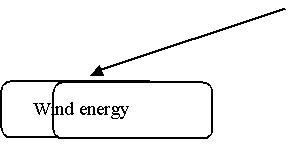

Energy
of sun Wave
energy
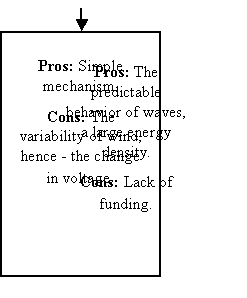

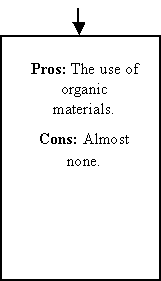
Table 1:
"Alternative energy sources"
Many countries today are actively working in the field
of application of these energy sources in practice. For example, the
International Scientific Exhibition "- EXPO 2017» will be held in
Kazakhstan in 2017. Implementation of the international specialized exhibition
EXPO-2017 in Astana is one of the key projects in Kazakhstan, which will be
held under the slogan "Energy of the Future", will light one of the
most topical issues of concern to the international community - alternative
energy sources. The initiative of organizing such a large-scale event in the
capital of our country belongs to the Head of State. [8]
Alternative energy sources - our near future. And now
that these problems have attracted increasing attention from scientists,
industry and consumers, the pace of progress are growing by leaps and bounds.
In the end, we put up with the fact that reserves of energy resources are
limited, but boundless is the human ability to generate new ideas.
Literature:
1. The magazine "Popular Mechanics», №37, - 2005.
2. Protsenko A. "Energy of the Future", ed. "Young
guard". 1985
3. Wikipedia, https://ru.wikipedia.org/wiki/ветер
4. Alkhasov AB, "Actual problems of the development of renewable
energy." 2006.
5. Kozin LF, Volkov SV, "Hydrogen Energy and Ecology" 2002.
6. T. Byers, "20 structures with solar cells", 1988.
7. Wikipedia, https://ru.wikipedia.org/wiki/энергиясолнца
8.
"EXPO-2017», www.expo2017astana.com