Technical
sciences/4. Transport
Ph. D Muraviev V.V., Tapkov K.A.
Kalashnikov Izhevsk State technical university, Russia
Modeling of
the strain-stress state of the rail
Abstract. This
report contains the translations of main things of English-language articles
and literature, which are connected with railroad transport objects testing. In
first chapter translations have information about non-destructive testing of
strain-stress state of railroad rims and rails. In the second chapter it
translations describe the finite element modeling in the COMSOL program. In the
end of the report there is a glossary with the main terms, which one was found
in the literature during the translation process.
Key words: nondestructive
testing, rail, strain-stress state, modeling of strain-stress state, residual
stresses.
1 Introduction
Providing the
safety on railway roads is very important, which humanity has to decide since
the appearance of the railway transport. Due to wide spreading of the roads, increasing
of the velocities of the trains etc. the actuality of the safeness increased
too. One of the main reasons of the safety is the condition of the rails. Existence of different faults can cause dangerous accidents. It
is also the reason of the necessary of rails non-destructive testing and
developing of its methods and techniques [1]. Usually lifetime is done at the engineering
stage, but the influence of the corrosion, variable loads, high range of
temperature etc. play considerable role in decreasing of the lifetime of the
rail. At the beginning it was totally manual, and was done by human’s vision
and hearing. Nowadays there are a lot of testing devices, but methods and techniques
allow finding only big size faults, which is already in critical condition [2].
One of the main
reason of the destruction of metal objects is residual stresses. They appeared in
the time of rail’s operation, installing, welding and in the process of production
[3,4]. It is the reason why even small, not critical faults can cause the
increasing of the growing speed of cracks. With such cracks it is impossible to
use the rail [4]. So, exploring of the strain-stress state let understand
present lifetime of the rail.
2 Acoustoelastic method
One of the most suitable method for controlling
strain-stress state of the rails is acoustoelastic method. It has already been
used for controlling the stresses in railroad rims [4, 7]. For stresses, which
is controlled by its technique, there is following evaluation (1) [2, 5]:
 (1)
(1)
D=145 GPa – acoustoelastic coefficient, which was found
by experimental way, a0 – parameter
of acoustic anisotropy, Δt – time
delay of the receiving of acoustic waves, sec., t1 – time of the wave spreading along the rail, sec.
But officially
(GOST standart [6]) the universal method have following steps: you have to make
a notch in the rail 600 mm long, and in case if the head and pad of the rail
have relative displacement 2 mm or more, this rail is defective.
3
Modeling of the displacement of notch
For making
the model, it was decided to make the pair of forces, which press on different
parts of the rail. They create torque, which cause the displacement in Z-axis.
Modeling was
made in program Comsol Multiphysics. For studying it was used Solid mechanics module.
Evaluations were made by finite-element method (FEM). As a fixed constant it
was choosed the plane surface on another side of the rail. The results of the
modeling is shown on the fig. 1.
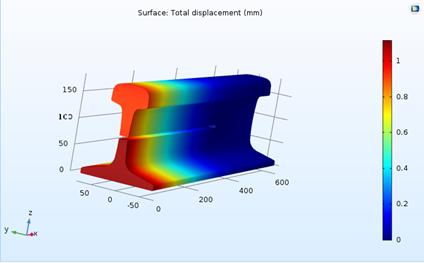
Fig. 1 Displacements with notch
This value of
the displacement was get in case of power 56 MN/m2.
4 Results of modeling
strain-stress of the rail
On the figure
2 it is shown the stresses in the rail, which were calculated by von Mises
theory. As you can see, maximum volume of the stresses is situated in the middle
part of the rail, and consists nearly 80 MPa.
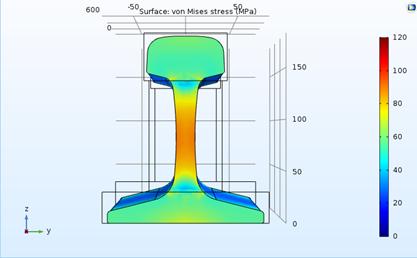
Fig. 2 Stresses in the rail
Also it was
made the modeling in X-axis (Fig. 3) and Z-axis (Fig. 4).
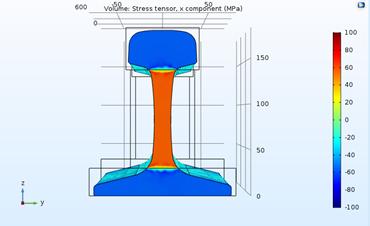
Fig. 5 Stresses in X-axis
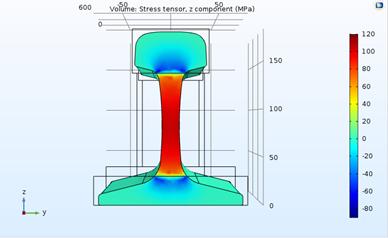
Fig. 6 Stresses in Z-axis
5. Conclusion
1. The model
of the rail was created. This model allows explore the influence of the
stresses on the displacement of the rail with notch.
2. It is
proved, that the biggest volume of the stresses is situated in the middle part
of the rail.
3. There are
stresses in all parts of rail in X-axis, but there are stresses only in the
middle of the rail in Z-axis.
Literature list
1. The strategy of the
development of Russian railway roads till 2030 // Russian wallpaper, №6358,
16.04.2014
2. Murav’ev V.V., Volkova L.V.,
Gromov V.E., Glezer A.M. Estimation of the Residual Stresses in Rails Using
Electromagnetic–Acoustic Introduction–Reception of Waves, Russian Metallurgy
(Metally), Vol. 2016, No. 10, pp. 1002–1005.
3. Stepanova L.N., Bekher S.A., Kurbatov
A.N. etc.
Studying of the stress-strain state of the rail with help of acoustoelastic
method. – University news. Engineering, 2013, №7, p.103-109.
4. Muravev V.V.,
Volkova L.V. Evaluation of the interference value for the treads of locomotive
wheels by the acoustic elasticity method. Russian Journal of Nondestructive Testing.
2013. Т. 49. № 9. С. 524-529.
5. Murav’ev V.V., Volkova L.V., Platunov A.V.
and Kulikov V.A. An Electromagnetic-Acoustic Method for Studying Stress-Strain
States of Rails. - Russian Journal of Nondestructive Testing, 2016, Vol. 52,
No. 7, pp. 370–376.
6. GOST 51685-2013 Railway rails.
General specifications. М., 2013. 101 p.