Burak T. V., Shikulo
O.S., scientific leader Martinovich V. G.
Polessky
State University, Pinsk
External
debt of the Republic of Belarus
Public
debt development is viewed as a main indicator of debt sustainability in
developed economies, while gross external debt is paid more attention to
emerging market economies. The main objective of foreigh loans is to implement
effective investment projects aimed primarily at improving the competitiveness
of the economy and its export potential.
There
is no uniform parameter of a safe level
of public external debt for all countries. Thus, the Treaty on the European
Union stipulates that the debt in the EU member country should not exceed 60%
of GDP. The figure within EurAsEC is set at of 80% of GDP. The agreement on
harmonized macroeconomic policy in the Customs Union between the Republic of
Belarus, the Republic Kazakhstan and the Russian Federation has this figure at 50% of GDP [2].
The
Republic of Belarus has stricter requirements to the level of public debt.
Thus, in accordance with the socio-economic development program for 2011-2015,
the ratio of public debt to GDP must not exceed 4%, and the ratio of external
debt to GDP 25%.
Belarus
gross external debt has recently exceeded the threshold of 55% of GDP set by
the national security concept. After the first January of 2012 it was equal to
62,7% of GDP. Ministry of Economy expects its increase up to 85% by the 2016,
because in 2013-2015 the Republic of Belarus expects a tense schedule of
payments on the external public debt payments due to the repayment of the IMF
standby loan and the debut Eurobond issue due to mature in 2015. In general, in
the next three years Belarus will need to pay approximately $5.5 billion.
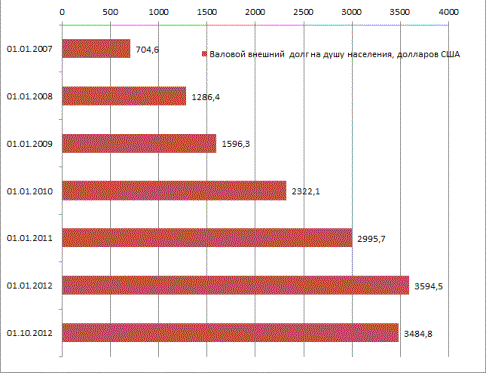
The picture - The gross
external debt per capita for the years 2007-2012, dollars
It
is far beyond both the officially set threshold and the world-wide accepted
critical level of 60% of GDP. So, there is a real risk of Belarus gross
external debt unsustainability, but the scale of this risk should be verified
by other indicators. For instance,
gross external debt to exports ratio is still below the safety threshold. It was 65,9% as of first
January of 2011 and is forecast to exceed the 100% level only in 2014. In other
words, Belarus opportunities to service gross external debt may be a bit better
than the debt to GDP ratio alone signals.
More
insight is given by indicators that compare short-term external debt and international reserves. Reserves
cover less than 30% of short-term debt, which makes Belarus subject to
liquidity constraints. It is result of traditionally low level of reserves and
fixed exchange rate regime that frequently demanded foreign exchange
interventions.
In
the year under review, the share of long-term liabilities in the structure of
gross external debt increased by 2.2 percentage points (from 55.3% to 57.5%),
that was due to the growth of the banks’ and non-financial sector’s
long-term debt.
Thus,
taking international practice into account, the “burden” of public external
debt of the Republic of Belarus is considered moderate.
At
2013-2015 the Republic of Belarus expects a tense schedul of payments on the
external public debt payments due to the repayment of the IMF standby loan and the debut Eurobond issue due to mature
in 2015. In general, in the next three years Belarus will need to pay
approximately $ 5.5 billion.
The
Finance Ministry of the Republic of Belarus sees no major problems with
payments for the external debt at peak times. According to the view of Minister
of the Economy Belarus has enough resources and tools to comfortably survive
these periods [2].
Literature:
1. Economy of Belarus, № 1, 2012.
2. Financial stability in the Republic of Belarus, 2012.