Associate professor, Ph.D Pasko O.
Sumy National Agrarian
University, Sumy, Ukraine
THE NEWLY INTRODUCED CONCEPT OF KEY AUDIT MATTERS IN INTERNATIONAL
STANDARDS ON AUDITING
The turning
point in transformation of the International Standards on Auditing in truly
global standards was so called Clarity Project. On February 27, 2009, the
Clarity Project reached its completion when the Public Interest Oversight Board
approved the due process for the last several clarified ISAs. Auditors
worldwide will now have access to 36 newly updated and clarified ISAs and a
clarified International Standard on Quality Control (ISQC)[1].
After its completion the IAASB decided for several years not to change pronouncements
in order to secure adaption and implementation of newly clarified ISA’s. Today
we have 2013 AD and growing activities of IAASB toward improvements of its
standards. In Handbook 2012 IAASB included two new revised standards, namely
ISA 315 and ISA 610. These standards introduced some minor amendments relating
to work of internal auditors. In active project IAASB by the time are changes
to ISA 700 and new ISA 701. Among all mentioned standards the biggest changes
is believed will be made to auditor’s report, through ISA 700 (revised) and new
ISA 701. In this paper we are going examine the newly introduced concept of key
audit matters, previously known as auditor commentary.
Let’s begin with the definition, given in
proposed ISA 701: кey audit matters - those matters that, in the auditor’s professional
judgment, were of most significance in the audit of the financial statements
[1,с.3].
Users of
the financial statements have indicated they have an interest in those matters
about which the auditor and those charged with governance had the most robust
dialogue as part of the two way communication required by proposed ISA 260 (Revised)
and have called for additional transparency about those communications. Key
audit matters are some kind of whistle-blowing of the matters which in the
cource of audit auditor discussed with THWG. Revealing such information “is
intended to provide users of the financial statements with additional information
to enhance their understanding of the audit” [1,с.2].
The auditor
shall communicate those matters in a separate section of the auditor’s report under
the heading “Key Audit Matters”, and include appropriate subheadings for each
of the key audit matters communicated.
ISA 701
emphasizes, what communicating key audit matters in the auditor’s report is not
intended to: (a) Express an opinion on individual accounts or disclosures; or
(b) Be a substitute for the auditor expressing a qualified opinion or an adverse
opinion when required by the circumstances of a specific audit engagement [1,с.6].
What is to
be included in key audit matters? Proposed ISA 701 clearly states what key
audit matters are, in all cases, a selection of matters communicated with those
charged with governance [1,с.3]. “The auditor’s decision-making process is therefore
designed to narrow the matters discussed with those charged with governance to
a smaller number of matters based on the auditor’s judgment about which matters
were of most significance in the audit» [1,с.6] (fig.1).
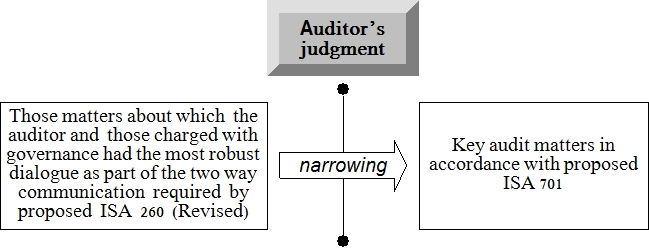
Fig. 1. The Auditor’s Process
to Determine Key Audit Matters according to proposed ISA 701
The matters
to be communicated are based on the auditor’s professional judgment and are influenced
by the nature and extent of matters communicated with those charged with governance
in accordance with proposed ISA 260 (Revised).
In determining
whether a matter is communicated as a key audit matter, the auditor shall use
professional judgment, taking into account the nature and extent of communications
with those charged with governance, including, at a minimum: 1) Whether the
matter was identified as, or is related to, a significant risk in accordance
with ISA 315; 2) The degree of difficulty encountered in obtaining sufficient
appropriate audit evidence about the matter; 3) The difficulty of the judgment
involved relating to the matter; 4) Whether the auditor identified a
significant deficiency in internal control relating to the matter (ІSA 701.11) [1,с.3].
Notwithstanding
ISA 701 applies to auditors of listed entities, it may be applied, adapted as
necessary in the circumstances, for audits of entities other than listed
entities. Auditors of entities other than listed entities may include a
discussion of key audit matters in the auditor’s report. In such circumstances,
the auditor shall discuss doing so as part of agreeing the terms of the audit engagement
in accordance with ISA 210. As states ISA 701: «Communication about the
possibility of including a discussion of key audit matters in the auditor’s
report at the commencement of the audit ensures that management and those
charged with governance are aware of the auditor’s ability to do so» [1,с.14].
The number
of matters to be included in the auditor’s report is affected by the size and
complexity of the entity, the nature and conditions of its business, and the
facts and circumstances of the audit engagement. According to ISA 701 a range
of two to seven matters may generally be appropriate.
1. Proposed International Standard on
Auditing (ISA) 701 Communicating Key Audit Matters in the Independent Auditor’s
Report [Electronic resource] // International Federation Of Accountants. - Mode
of access: WWW.URL: http://www.ifac.org/sites/default/files/meetings/files/20130415-IAASB-Agenda_Item_2C-Proposed_ISA_701-final.pdf. - Last access: 2013. – Title from
the screen.