Alexander N. Podobry
Ulyanovsk State Technical University, Russia
Integration Method Design for Common Corporate Data
Warehouses
Any manufacturing enterprise is mainly concerned with the timely output of
finished products. Achievement of this goal requires tracking the product lifecycle
from conclusion of a development contract to testing and transfer of finished
products to the Customer. The cycle itself includes tracking of the requests for
material procurement, acceptance of the design and engineering documentation,
etc.
A problem arising when designing a computer-aided system for tracking the
product lifecycle is that the data storage sources are dispersed. The role of these sources plays corporate data warehouses [2].
A corporate data warehouse is the integrated gallery of data, which are structured
and collected from diverse information sources. It gives an opportunity to
analyze the data accumulated and forms the basis for designing decision-making
systems.
There are a lot of ready-made solutions which help to resolve this task in some
degree, e.g., PDM (Product Data Management) and PLM (Product Lifecycle
Management) systems [3,4]. As a rule, systems like these ones are
expensive and provide for a general task solution. Anyway, these systems to be
used at maximum, all corporate data warehouses shall be integrated in one
information space of the company.
The main approaches include the integration of: data, business-processes,
applications and user interactions.
The data integration gives a common
representation of all information objects within a company, at all production
and business-process levels.
The dispersed-application
integration level allows controlling the streams of events and application
management within the context of transactions, messages or data.
The business-process integration is to
define and implement processes of exchange and implementation of corporate data
between corporate date warehouses.
The user-interaction integration gives a common
interface for access to corporate data warehouses taking into account personal
and safe access level. This type of integration allows aligning users’
interoperation with a full range of the data given.
The data
integration forms a basis for all the integration approaches mentioned. It is
the basis which defines the integration success at all other levels of an
information system. The main methods for integration of corporate data are:
consolidation, federalization and dissemination [1].
When using the consolidation method, data are collected from
several primary systems and integrated into one permanent warehouse. Applying
the data- federalization method, a common information cyberspace appears
where data may be stored in different sources at that the requesting side has
no access to the information on the data location. Finally, it is the dissemination
method where data are transferred from one system to another.
Each method mentioned has the advantages
and disadvantages. When using the consolidation method, a time delay may occur
between the moment of the data update in primary systems and the time when
these changes appear in the final storage location. The advantage of this
method is in aggregating (aligning) of data during transfer of information to
the final warehouse. The advantage of the federalization method is that it
allows the access to the requisite data and excludes the need in data transfer
from one warehouse to another. The disadvantage of this method is the cost
associated with productivity and access to multiple data warehouses. A big advantage
of the dissemination method is that it can be used for data transfer in real-time
mode or close to it. Other advantages include the secured data delivery and
two-way data dissemination.
There is a
hybrid data-integration method which consists of some of the methods mentioned
above. This method is applied when an independent use of one method is
impossible.
The use of one of the methods mentioned within a
manufacturing enterprise doesn’t allow the integration problem to be fully resolved
for independent corporate-data warehouses. It depends on such factors as independence,
productivity, dissemination ability of corporate warehouses, etc. As a result, a
method is requested to combine all the methods mentioned and to allow integrating
corporate warehouses which are physically located in separate networks.
An option to resolve this issue is
the use of a hybrid method of consolidation, federalization and dissemination
(figure 1). The basis for this method relies on the metadata structure which
combines different independent corporate warehouses.
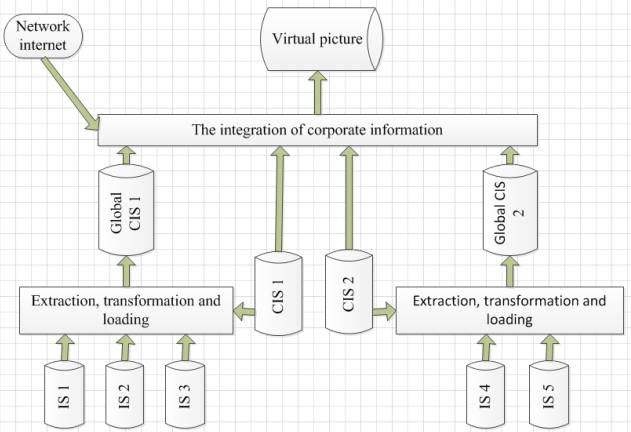
Fig.1. Hybrid Method for Integration of Corporate Data Warehouses.
The consolidation method is used to collect
data from child warehouses, and the dissemination method – to integrate with
warehouses which are geographically or physically located in different
networks. To communicate to the last ones, the xml-upload facility may be used (fig. 2).
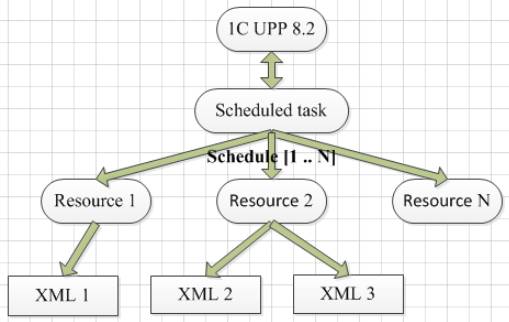
Figure. 2 Structure of Data Representation to Web-Resources
This facility is based on the
algorithm for uploading data in xml-format, which allows the data to be updated
and the structure of a corporate warehouse to be sinchronized. The xml-file
itself includes the
following:
- list of tables;
- list of table
fields;
- key fields of
tables;
- data loading
method;
- data set.
Thus, the suggested
method allows designing of a common data-storage structure due to the
integration of independent data warehouses into one information space within a company.
The xml-upload facility allows supporting the integration both with information
systems, where the access to the database is denied, and with remote data
warehouses, e.g. the Internet. It helps to track a product lifecycle and to promptly
respond to possible delays and problems with the product output.
BIBLIOGRAPHY:
1. Tanenbaum, Andrew S. Distributed systems: principles
and paradigms / Tanenbaum, Andrew S.; Steen, Maarten van. – Saint-Petersburg: “Piter”
Publishers, 2003. – 877 p.
2. Kudinov, Alexander. Data Warehouse as the Basis of
Corporate Integration. Edition: PC Week/RE.
Date: 2006,
Intersoft Lab
3.
Dubova , Natalia. Systems for Control of Production Data. “Otkrytiye Systemy”, 1996 , #3
4. Kevorkov, Sergey. Support of the Product Lifecycle / “Otkrytiye
Systemy”, 12, 2005