Педагогические
науки/5.Современные методы преподавания
V. Novikov,
associate professor of HAC;
G.Kalakova,
a senior lecturer of computer science and mathematics of Kostanay
State University named by A.Baitursynov;
B.Kalakov,
assistant professor of physics and
GTD Kostanay State Pedagogical Institute
Pseudo
solution of physical problems,
or why not
obtained an answer to the problem
In studying physics, we solve a lot of tasks for
consolidation of the material studied. There are also special lessons solution
computation tasks. Often, by solving tasks teachers checked our theoretical
knowledge of the material.
Not infrequently, the sums don’t lead to the correct answer.
This is because the assumptions students’ commonplace mistakes: incorrect
calculation, formulas misspelling, mistakes in the formula, not all values are recorded
in a single system of units and etc.
However, mistakes happen, and the higher order, the main
obtaining causes which, in our opinion, are the following:
-
Not
deep enough (comprehensively) analyzed the conditions of (to the task
situation);
-
in the
analysis of the conditions task is not taken into account all the phenomena of
magnitude, especially given in implicit form;
-
- the
substitution of physical concepts
(values) is produced, use something that is not in the problem, or are
looking for the wrong amount, you want to define;
-
not
all possible situations presented in a task verbally are examined at a
decision;
-
the
borders of applicability of laws of physics are violated.
Such errors happen,
mainly, at the decision of non-standard tasks that us offer teachers on
optional employments, or at preparation to the Olympiads, on Olympiads (their
different stages).
We will show it on the
examples of certain tasks that we decided during the last three school years.
Task 1 Two
plasticine balls are suspended on filaments so, that touching the centers of
gravity are at a distance of 1meter below the point of suspension, and
filaments are vertical. The masses of
balls 10 and 40grams. Smaller ball is taken aside so that the filament is
deflected from the vertical 900, and released. Determine at what height will be
a large ball after absolutely inelastic collision.
Decision of student
In relation to position
of equilibrium a smaller ball after the rejection of his filament on 900
possesses potential energy of mgh,
where h = l (length of filament).
This energy is then converted into its kinetic and in collisions with a large
ball grows into kinetic energy of both balls, and eventually in their general potential
energy of (M + m) gH, where H is the height of raising of balls.
But veritable answer: H = m2h/(M + m)2.
The resulting student
answer was incorrect because it was not taken into account the loss of
mechanical (kinetic) energy (turning it into a deformation energy of balls -
their internal energy) as a result of their perfectly inelastic collision.
After an inelastic
collision balls will move with speed of u,
determined by law of maintenance of impulse:
mv = (M +m)u, (1)
where v - speed smaller ball before the
collision, which can be determined by the law of conservation of energy for the
smaller ball:
mgh = mv2/2 (2)
From equalization (2) we will
get:  v =
v =  .
.
Putting this expression in(1), we
will get for u:
u =  .
(3)
.
(3)
By the law of
conservation and transformation of energy for a system of two balls have:
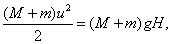
whence
H = u2/2g.
After a substitution(3)
we will get:
H = m2h/ (M + m)2.
The decisions of these
two tasks also due to the shallow analysis described in these situations have
been missed the conversion of mechanical energy into internal energy, which is
why students were received incorrect answers.
Task 2 In
the body of mass m1 = 990 g,
lying on a horizontal surface, gets a bullet mass m2 = 10 g and
gets stuck in it. Speed of a bullet v = 700 m / s is directed horizontally. Какой
путь s пройдёт тело до остановки, если коэффициент трения между
телом и поверхностью k = 0,05?
A veritable answer(g =9,8 m/ss) is a 50 m. students
received - 5,000 m, or 5 km. Some students do not even embarrassed unreality
obtained distance traveled, and those whom she was confused, looking for a
mistake in the calculations, rather than the analysis of the physical
situation.