Engineering sciences/ 10
Mining
Phd in technical sciences Fattakhov Irik Galikhanovich
Tovderjakov Marat
Jur'evich
SEI of HPE "Ufa State Petroleum Technological University"
branch in Oktyabrsky city, Russia
CLASSIFICATION OF METHODS OF NONSTATIONARY BED STIMULATION
Position of resource
base the Russian oil industry today is characterized by the worsening of the
structure and resource quality . Their development by usual techniques
ineffective. That's why the current state of oil pool development depends on the correct choice of an effective method of stimulation.
The effectiveness of a nonstationary stimulation is proved by various
theoretical research data, experimental and field tests.
However, in
determining the factors responsible for the adaptability and effectiveness of
the nonstationary stimulation in specific oil fields, there is the problem of
using a particular method of the work, and the foundation of the problem lies
in the lack of clear criteria for its classification and selection.
Nowadays technology
of nonstationary stimulation (NS) on the oil pool can be divided into three
groups [1]:
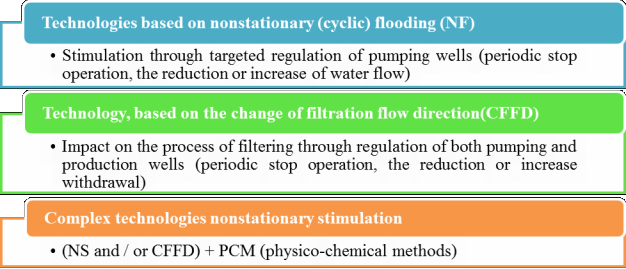
Fig. 1 - "The
technologies of nonstationary
stimulation on the oil reservoir"
In addition, the
organization of NS, based on the capabilities of technical support, apply
various modifications [2]:
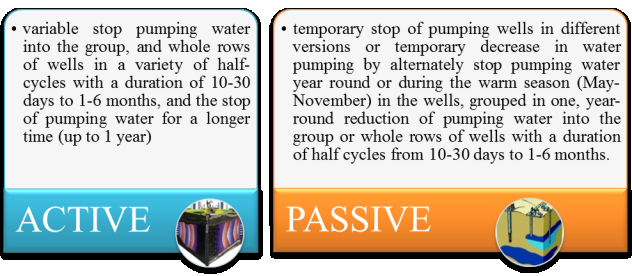
Fig. 2 -
"Possible modifications nonstationary flooding"
Groups themselves
should be considered from the perspective of efficiency chosen technology, low
cost of its application and how quickly we will get an increase the recovery
factor (RF). The following diagram (Figure 3), albeit conditionally, but
clearly it shows.
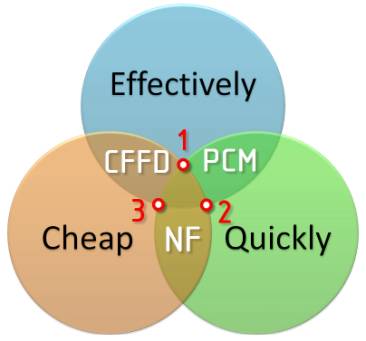
Fig. 3 - "The
concept of application of enhanced oil recovery in the NS oil reservoir
according to the criteria of the sample"
Technologies based on
nonstationary (cyclic) flooding (NF), the scheme presented overlapping zones of
"cheap" and "fast." They do not require significant
additional cost, easy to implement and can be applied to the oil pool at the
late stage of development. But the effectiveness of this technology will be up
to the beginning of the overlap zone "effectively." Thus almost
always NF used in combination with technology change of filtration flow
direction(CFFD) - point 3. This combination leads to a simultaneous increase in
waterflood coverage(both area and thickness). As a result, changing the flow
will change ratio of fraction in formation fluids in the production of
responsive wells.
Physico-chemical
methods (PCM) reservoir stimulation combines the efficiency and speed of use. However,
using only this type of stimulation, without resorting to the time-dependent
technology, we may not payback costs, because it is very expensive (the
criterion of "cheap" is completely missing). However, crossing the
technologynonstationary stimulation (CFFD or NC), we get the point 1 and 2,
respectively, thus partially entering the zone of "cheap." These
points determine the complex methods are becoming more popular today:
·nonstationary
flooding, combined with well-targeted treatment [3] pumping wells by pumping
mix chemicals to reduce the layered diversity, increasing coverage, the
intensification of oil displacement of low-penetrability sub-layers,
limit unproductive water pumping in washed, high-penetrability sub-layers;
·nonstationary
steam-cyclic flooding [4];
·physical
impact on the formation, combining nonstationary flooding and long wave
stimulation through the well bottom. [5]
Of course, the
optimal technology would overlap all three areas ("efficient",
"cheap", "fast"), borders, hence, with three effects (NS +
+ CFFD PCM ), then there is a triangle Δ123. However, this is not the
case. Offset in one or the other corner of the triangle always dictates the
economic feasibility and benefits of the measures, the rate of return. In
addition, the critical conditions have a specific oil fields. So today is
actively developed technology cyclic operation of producing and pumping wells
with the directions of preferable
fissuring (increased
penetrability) reservoirs [6], [7].
However, we must emphasize the fact that a sufficiently effective
technology production of stranded oil and, consequently, increasing oil
recovery, the oil industry in Russia does not yet have. This is due, above all,
with numerous features of the development of oil fields, with different types
of geologic structure. So many manufacturing companies producing oil in its
scientific and production activity volumes increase
research to improve methods of nonstationary stimulation and increase
the withdrawal hard to recover reserves. [8]
List of reference:
1. L. A. Vaganov «Povyshenie jeffektivnosti primenenija nestacionarnogo
zavodnenija v uslovijah zalezhej nefti verhnejurskih otlozhenij», Tjumen', 2012
2. R.G. Abdulmazitov, A.S. Sultanov, A.M. Evdokimov «Jeffektivnost' razrabotki mestorozhdenij
OAO “Tatneft'” pri nestacionarnom zavodnenii», zhurnal «Neftjanoe hozjajstvo»,
58 str., 2008
3. http://burneft.ru/archive/issues/2011-02/10
4. A.I. Artemenko, V.E. Kashhavcev, A.A. Fatkullin «Parociklicheskoe
vozdejstvie kak odin iz prioritetov dobychi vysokovjazkoj nefti», 2005
5. V.P. Dyblenko, V.S. Evchenko, S.N. Solonicin, O.L. Kuznecov, G.H.
Gabitov, Ju.V. Luk'janov, I.M. Nazmiev «Povyshenie nefteotdachi plastov s
trudnoizvlekaemymi zapasami s ispol'zovaniem fizicheskih metodov v pole
nestacionarnogo zavodnenija», 76 str., 2005
6. Patent 2191255, N.I. Hisamutdinov, 2002
7. Patent 2184216, N.I. Hisamutdinov, 2002
8. I.V. Vladimirov «Nestacionarnye tehnologii v razrabotke neftjanyh
mestorozhdenij: dissertacija», Ufa, 2005 c.