Bioscience/5.
Molecular biology
Candidate of Agriculture Beyshova I.S.
Postgraduate student of natural sciences
Kozhmukhametova A.S.
Kostanay State University named after A.Baytursynov,
Republic of Kazakhstan
Diagnosis of phytopathogenic Septoria fungi of the northern Kazakhstan
In the
Republic of Kazakhstan as in many other countries of the world Septoria blight
refers to a particularly dangerous disease of grain crops. This disease is
caused by Septoria tritici and Septoria nodorum fungi. The lesion of the upper
tiers of wheat leaves by Septoria fungi causes significant yield losses (up to
40-50% with epiphytotics). Weather and climatic conditions of the Republic of
Kazakhstan are favorable for the development and spreading of Septoria blight
reducing the profitability of grain production. According to the resolution of
the government of the Republic of Kazakhstan dated December 10, 2002, No. 1295
"On approval of the list of quarantine objects and highly dangerous
harmful pests" (as amended and added on 23/11/2005) Septoria blight of grain
crops was included into the "List of particularly dangerous pests and
diseases of agricultural plants".
According
to the Food and agriculture organization (FAO) of the UN the annual losses due
to pests and diseases of agricultural plants is about 20-25% of the potential
global yield of food crops. Therefore the role of plant protection in
increasing production and preservation of agricultural products is enormous [1].
The
system of monitoring and protection of plants against high-risk diseases
adopted in the Republic of Kazakhstan uses imperfect methods of field surveys
with visual diagnosis and does not cover even half of the cultivated area which
leads to incorrect diagnoses and reducing grain production profitability. A
number of biotic and abiotic diseases with identical symptom signs exist.
Traditional
methods of complex diagnostics which include selection of axenic culture,
selection of media and culturing conditions, obtaining single-spore isolates
and microscopy are time-consuming, labor-intensive and not enough effective.
Enzyme-linked immunosorbent assay takes several hours, but its derived
species-specific techniques, presymptomatic and quantifying determination of S.
tritici and S. nodorum in the wheat leaves and seeds are not sensitive enough
and do not always provide clear identification of these species.
Introduction
of Septoria blight rapid diagnostic methods based on polymerase chain reaction
(PCR) in Real-Time modification will allow to diagnose the disease quickly and
accurately.
Polymerase chain
reaction (PCR) method compared to the enzyme-linked immunosorbent method is
more sensitive and specific and its Real Time modification using hybridization
probe with fluorescent label allows to analyze the results quickly without
electrophoresis. The key feature of the real-time PCR is also monitoring and
quantitative analysis of the accumulation of polymerase chain reaction
products, automatic registration and interpretation of the results. Due to
saving of the production space, reducing of the number of staff and demand for
quantification of DNA/RNA this method has been used successfully in recent
years in the largest diagnostic and research centers of the developed countries
of the world.
Cereals
are still the main agricultural plants in the
Central Asia countries including the Republic of Kazakhstan.
In the
Republic of Kazakhstan Septoria blight was observed in the following provinces:
Shymkent, Zhambyl, Almaty, Kostanay, Akmola and in the North Eastern part of the
East Kazakhstan province. According to experts, in 2011 100% of crops at an
area of 3 million 900 hectares in the northern region of the Republic of
Kazakhstan were affected by Septoria blight, i.e. the most favorable climatic
conditions for Septoria blight are in the Northern Kazakhstan and Kostanay
province.
The goal of this work is to diagnose phytopathogenic septoria
fungi of the cereals in the Northern Kazakhstan based on polymerase chain
reaction (PCR) in Real-Time mode.
The
source materials used for selection of Septoria blight causative agent strains during
the study were infected wheat samples collected during sample surveys of the
2012 crops in the Northern Kazakhstan. The analysis resulted in picking out
Septoria fungi causative agents: S.tritici and S.nodorum.
The Septoria causative agent species composition was studied in Kostanay province. The fields in this area were surveyed to obtain a reliable picture of the disease spreading.The survey took place in May-July 2-3 times during the growing season, starting with seedling stage and ending with milk ripeness stage during mass development of the disease. Infected samples were selected according to the technique: 15-20 samples of 10-15 stems in each were taken in 25-50 steps. The samples were collected in a triangular route, stepping 25-50 m away from the edge, entering up to 200 - 300 m into the crop field, 2 leaves of the middle tier and flag leaf were analyzed. As a result the number of accounted stems in the sample was 200-250 pieces. As a result of the works a herbarium material was made (Figure 1).
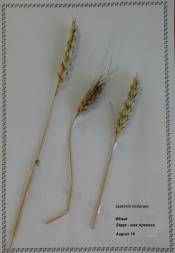
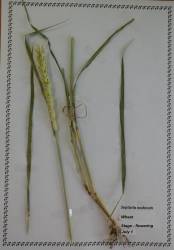
Figure 1 - Herbarium sample (the plants affected by Septoria fungus)The intensity of Septoria species development was determined according to modified scales of James and E.E. Geshele. Typical external signs of Septoria blight are spotting and pycnidia.Laboratory research for selection and study of biological properties of Septoria fungi were conducted in accordance with conventional techniques [2]. To determine what species the fungi belong to, conidia were microscopied from the fragments of the affected wheat plants taken during the surveys. To do this, small pieces (5m x 5mm) of the affected tissue with fruit bodies were placed in a drop of water for a few minutes on a slide plate, and then the substance was examined at low magnification (x10 objective). Size of the spores emerging from the pycnidia was determined using microscope "Biomed 5". The shape and size of pycnospores allow to determine what species the fungus belongs to, using the following determinants [3,4] (Figure 2,3).
|
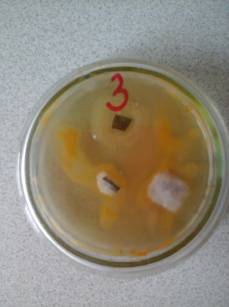
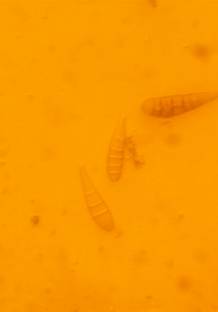
Before assessment of their cultural and morphological (CM) signs the monospore colony of S. nodorum isolates were grown under constant UV light, S.tritici colonies were grown in laboratory conditions without additional lighting.
The isolates of micromycetes were identified base on the relevant determinants [5,6].
The identified isolates of Septoria tritici and Septoria nodorum fungi were used to obtain the DNA of these pathogens for further studies during diagnosis on the basis of the PCR in Real-time mode.
To confirm the results of microscopy the isolates were identified on the basis of polymerase chain reaction in accordance with the manufacturer's – "Agrodiagnostika" LLC – protocol and the microscopy results were confirmed by the PCR (Figure 4).
|
|
Analysis settings |
Report on the results of the PCR DNA-TECHNOLOGY Method: Geometric (Cp)(BF), lf=12, ne=7, ci=9, vt=10, nf=20, calbr=1, tp=30, tv=5 |
|||||
|
Date: November 5, 2013, 14:03:04 Protocol No.: 5 Operator: Guest File containing the results: Протокол_№_5 Comment: |
|||||||
|
Test: septoria Amplification program: septoriа (35 μl) |
|
|
|||||
|
|
1. 80.0 °С - 00:30
2. 94.0 °С - 00:30 °С - 00:30 3. 94.0 °С - 12:10 AM °С - 12:30 AM 4. 10.0 °С - storage |
*5 *45 |
|
|
|||
|
Quality analysis |
|
|
|
||||
|
|
Hole No. |
Test tube identifier |
Ср, Fam |
Ср, Hex |
Result |
|
|
|
|
|
А1 |
Sample_1 (septoriа) |
35.5 |
32.2 |
+ |
|
|
|
|
А3 |
Sample_3 (septoriа) |
34.5 |
32.9 |
+ |
|
|
|
|
A4 |
Sample_4 (septoriа) |
33.7 |
|
+ |
|
|
|
|
А5 |
Sample_5 (septoriа) |
33.9 |
32.3 |
+ |
|
|
|
|
А6 |
Sample_6 (septoriа) |
36.5 |
32.2 |
+ |
|
|
|
|
A7 |
К+ (septoriа) |
30.3 |
|
+ |
|
|
|
|
А8 |
К- (septoriа) |
|
30.1 |
- |
|

Figure 4 - Report on the results of the PCR analysis
Thus the introduction of Septoria rapid diagnostic methods based on polymerase chain reaction (PCR) in Real-Time modification will allow to diagnose the disease quickly and accurately.
Reference list:
1. I. М. Polyakov, Y. М. Shumakov, article "Plant Protection" Great Soviet Encyclopedia. - М.: Soviet Encyclopedia. – 1969-1978.
2. Z. Kiray, Z. Klement, F. Shaymoshi, Y. Veresh Methods of Phytopathology. // M., "Kolos", 1974. 343 p.
3 M.N. Pidoplichko Parasitic fungi of cultivated plants. Determinant in 3 v. - Kiev: Naukova Dumka, 1977. - V. 1 - 295 p.
4 M.N. Pidoplichko Parasitic fungi of cultivated plants. Determinant. V 3. Pycnidia forming fungi, Kiev. "Nauka Dumka", 1978.- 232 p.
5 O.L. Rudakov Biological conditions for Botrytis fungi parasitism / О.L. Rudakov. Frunze, 1959. - 250 p.
6 V.I. Ulyanishchev
Determinant of rust fungi USSR. Part 2 / V.I. Ulyanishchev. L.: Nauka, Leningrad. department, 1978. - 384 p.