TAX LEVERAGE DURING FINANCIAL CRISES
Pasichnyk Yu. V. Doctor of Economics,
Professor.
Cherkasy State
Technological University
Overcoming
the financial crisis is a challenge for many countries. The results of the
global financial crisis that affected almost all countries during 2007-2009, can
be traced to this day. As for Ukraine, it influenced it substantially, causing
in 2009 GDP decline by 14.8 % compared to previous years.
Economic
science over the past two centuries has offered many "recipes" to
improve the economy, but they depend on the government regulation. American
President Barack Obama expressed his point of view as for this situation rather
exactly saying that you need to forget the myth of the "invisible hand of
the market".
It is evident
that one of the most effective means of regulation of economic processes is the
budget, including tax areas. In this context, the forming of the proper theoretical
structures is important - theories, models, mechanisms to determine the means
of state influence.
Western
scientists have developed specific methodological approaches to solving these
problems. But is it possible to mechanically apply these theoretical developments
in Ukrainian reality? Quite reasonably on this situation one Ukrainian
scientist Vladimir Andrushchenko expressed his position, "Scientists of a young
Ukrainian state cannot perform a study of the entire spectrum of financial
knowledge and the attempt to cover all would be the example of the primitive
and inefficient scientific provincialism. Therefore use of the achievements of
the global financial opinion is not a reason to avoid research at the national
level. However, the author takes into consideration the conviction that the
light of Western science should not blind us to the nearly complete self-indignity,
uncritical application of its recipes. Following the opinions of others, we
should still not be up to the intellectual self-denial" [1, p. 7].
Forming of effective
tax levers to regulate economic processes is a difficult task for almost any
country in the world. Considering the accumulated research experience the
principles of tax instruments in terms of reforming Ukraine's economy can be
formulated as follows:
focus on
common approaches;
differentiation
of amounts of tax depending on the value of taxable resources;
sharpness and
clarity of the calculation of tax payments;
relative
stability of tax rules and regulations ;
organization
of permanent public scrutiny involving professionals.
Usually
mainly fiscal means are used with a total tax credit analysis, which in some
cases is quite sensitive to the relevant taxpayer.
Summarizing
the known approaches to tax leverage they can be classified as follows ( Fig.
1).
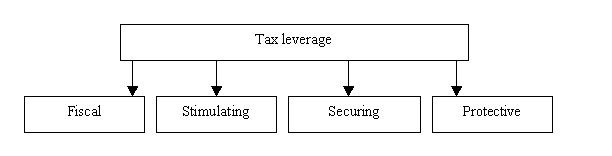

Fig.
1 Tax
leverages of economic processes regulation
The tax
authorities, using the corresponding normative-legal base depending on the
specific economic situation in relation to specific taxpayers use certain
levers or their combination.
Thus, during a
crisis to stimulate the development of small business tax incentive leverages
should be used with minor tax rates to maintain this type of economic activity
and a particular social group.
Usually during a crisis purely fiscal instruments to tax big
business are used, because here works the approach of social solidarity.
Combining these instruments it is possible to provide the preconditions of
economic stability.
References
1.
Андрущенко В. Л. Фінансова думка Заходу в XX столітті: (Теоретична
концептуалізація і наукова проблематика державних фінансів). – Львів: Каменяр,
2000. – 303 с.