Ganna Reshetova,
Postgraduate student in Finance
Taras Shevchenko National University of Kyiv
INVESTMENT OPPORTUNITIES IN FRONTIER MARKETS:
THE CASE OF UKRAINE
Scientific Advisor: Associate Professor Tetiana Hryshchenko, PhD
Under
running integration processes, economic globalization and financialization, the
frontier markets have become increasingly relevant in the world economy.
Foreign direct investments have grown six-fold, mainly driven by intra-regional
transactions. As the economies of these rapidly developing countries continue
to open up to global investors, this trend is expected to further accelerate.
As level of investments remains to rise, economies of frontier markets should
continue increase their weight, not only in the global economy but also in
terms of allocation to investors’ portfolios.
Frontier markets became the third
generation of global equity exposure
characterized by wide range of investment opportunities due to earlier stage of
life-cycle development comparing to both developed
and
emerging markets.
Exposure to frontier
markets
increases the breadth and diversity of
investing, over the capability provided by emerging
markets enhancing total return potential driven by active growth and providing
significant
benefits from the traditional asset
classes diversification. Specifically, frontier
markets are quite small, but
often lower priced than emerging markets,
which themselves trade at a P/E
discount to the developed economies.
Globalisation as
well as financialization are creating real multidimensional growth
in frontier markets – the emerging markets of
tomorrow.
Fledgling
frontier markets have a relatively low correlation with global peers, offer
high growth potential and, currently, attractively low valuations relative to
mainstream emerging counterparts. The very nature of the frontier markets means
the earliest stage of financial system development in particular country, which
is defined by low level of capitalization and liquidity along with limited
access for overseas investors.
Due
to foreign investor participation in developed and emerging markets,
diversification benefits and some extent alpha potential have declined. Hence, money
managers and sell-side strategists identify frontier markets as increasingly
attractive area for equity investments.
The
investment rationale is based on the following:
- High growth and return potential based on benefits from the structural
development of these pre-emerging economies and market;
- Potential for high alpha, because of
low sell-side research coverage in assessing these attractive
early-stage investment opportunities and institutional ownerships within these
markets segments are relatively low;
- Diversification benefits for clients and investors through asset
allocation based on low return correlation with developed markets. Diversification
allows spreading the risk across various asset classes and/or countries.
Historically, frontier markets have been among the least correlated to other
equity classes globally, making them attractive from an asset allocation point
of view. Frontier equities have exhibited much lower correlations with global
equities than mainstream emerging markets have. The additional diversification
opportunity is low correlated with commodity indices.
Due to Broad
Market Index for May 2012, Standard & Poor's classified Ukraine as a
country with frontier market with adjusted market capitalization of 2.88
billion dollars [2]. Frontier markets (FMs) are investable but have lower
market capitalization and liquidity than the more developed emerging markets.
The frontier equity markets are typically pursued by investors seeking high,
long term returns and low correlations with other markets. Figure 1 shows the
evidence of great growth potential for Ukrainian economy relatively to emerging
markets as well as developed ones. Comparing to developed economies of Germany,
Japan, France etc., Ukrainian market shows great potential in future growth. On
the other hand, the potential is not fully realized according to more than 6%
GDP growth in emerging markets. It means that the cost of investing into
economies of frontier market is much lower.
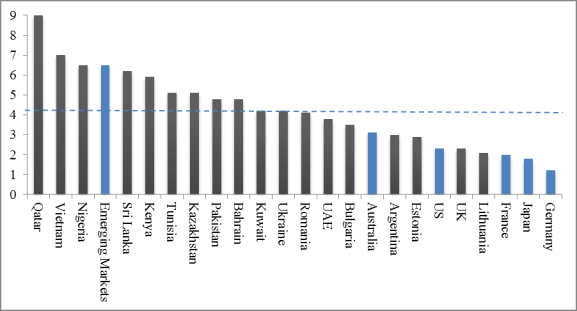
Figure 1. Expected GDP
growth rate in 2010-2015 [3].
In spite of
attractiveness of investing into frontier markets, systematic risks of such
economies should be considered. Frontier market investments are typically
perceived as being of higher risk than developed or emerging peers. This
systematic risk could be divided into two groups:
Group 1. Sovereign risk:
- Political instability and limited democracy.
- Protectionism and capital control.
- Early stages of the financial system development.
- Dependence on natural resources provides greater risk in certain
economic conditions.
Group 2. Structural
risk:
- High volatility of returns and extreme price movements.
- Markets can have differing levels of accessibility for participant
and/or investors.
- The costs of investing are high, trading infrastructure may be
inadequate and transparency is low.
- Limited fiscal or monetary tools to handle increasing inflation.
The case of
Ukraine shows the great impact of geopolitical decisions on economic situation
in the country. Due to irrational basis of decision-making financial
environment relies mostly on invers’ expectations. Creating the strong
background for profitable investing, the cost of capital is underestimated by
mentioned sovereign and structural risks.
As a result, considering investment opportunities, the key basic factors
are important for overseas investor:
-
Access
to frontier markets not included in developed or emerging
markets, largely untapped by institutional investors;
-
Opportunity
for early-stage investments in fast-growing economies;
-
Low
correlations with US and non-US developed equities;
-
Locally
driven economies result in low intra-market correlations among frontier market
countries [4].
The implication
of a country being labeled as frontier is that, over time, the market will
become more liquid and exhibit similar risk and return characteristics as the
larger, more liquid developed markets. The main advantage of investing in
frontier markets is a great potential of fast transaction into developed
economy.
References
1. Investing in Frontier Markets // HSBC Global Asset Management: https:// www.emfunds.us.assetmanagement.hsbc.com/investing-in-emerging-markets/content/investing-in-frontier-markets.fs
2. MSCI Frontier Markets Indices // http://www.msci.com
3. What are frontier markets? // Russell Investments, 2 Forum, March 2011: http://www.russell.com/AU/_pdfs/capital-markets-reserach/forum/2011-March
-What-Are-Frontier-Markets.pdf.
4. Why invest in Frontier Markets now? // Silk Invest Report: http://www.silkinvest.com/why-invest-in-frontier-markets-now#sthash.bGak26
cH.dpuf