Philosophy. Mathematics.
Popov V. V.
Doctor of Philosophy, professor, professor of chair of philosophy
Taganrog state teacher training college
Loytarenko M. V.
Graduate student,
Taganrog state teacher training college, philosophy chair
TRANSITION PERIODS IN
THE CONTEXT OF THE THEORY OF TIME: LOGIC-SEMANTICAL APPROACH
Summary. In article the philosophical judgment of the
post-nonclassical concept of truth in system of the interval theory of time is
represented. Is shown that in post-nonclassical science the conceptual device
and methods of modern philosophical logic are actively used. Formalizm are
rather widely applied. In a post-nonclassical discourse contradiction and truth
problems are discussed.
Keywords: post-nonclassical concept of truth, interval theory
of time, formalizm, assessment, truth, contradiction, philosophical logic.
I. Introduction. The standard understanding of rationality in
many respects decides by correlation of degree of the validity of human
representations on degree of their rationality. Meanwhile options of approaches
to understanding of rationality create ambiguity of its interrelation with the
validity of human knowledge. In this regard, for example, V. S. Stepin
allocates three main approaches to understanding of rationality [8]. Relevance
of article is connected with that in system of nonclassical rationality the
truth is represented as some basis of the social concentration, being characterized
a certain temporal parameter. Truth of nonclassical rationality has rather
certain temporary and social measurements. Such tendency of reconsideration of
universal truth concerning system of their social importance is priority within
nonclassical and post-nonclassical science. So, E.M. Sergeychik notes that
"the contradiction between the truth applying for generality, and freedom
assuming singularity of individual acts, is allowed in the course of the human
activity having communicative character. Acting as idealization of generality
of the human activity which is carrying out in certain cultural space and time,
the truth finds the embodiment only in real behavior of the person possessing
this or that degree of freedom. Therefore truth and freedom взаимополагают each other" [9,
477]. The problem of transitional states gained development in domestic
literature in the ratio with various dynamic concepts of time [1], [5].
Scientific novelty of article consists in research of a problem of the interval
concept of time in correlation with nonclassical understanding of essence and
types of a contradiction.
II. Problem definition. The research objective consists in
representation and the logiko-semantic analysis of the post-nonclassical
concept of truth in system of the interval theory of time. The following
problems are locally solved: 1 . Consideration of the semantic concept of truth
in the modern logiko-philosophical theory. 2 . Demonstration of conceptual
aspects of a ratio of truth and contradiction. 3 . Allocation of transition
periods and states in a context of the interval concept of time. 4 . Active use
of the device of modern symbolical logic in a context of post-nonclassical
science.
III. Results. From positions of submission
of the internal maintenance of a contradiction and its ratio with truth the
situation looks as follows: let the formula  mean "a changes", then the
validity concerning an interval of time of t* (
mean "a changes", then the
validity concerning an interval of time of t* ( t* is designated) can be defined so: U1. t * = 1,
if $ti(
t* is designated) can be defined so: U1. t * = 1,
if $ti( ti=1)
ti=1) $ ti’(
 ti=1), where ti and ti’
respectively initial and final subintervals of an interval of t*.
ti=1), where ti and ti’
respectively initial and final subintervals of an interval of t*.
We will
discuss substantially this condition. Actually there are three consecutive
intervals of time, however according to definition of an interval of change ti and ti’
intervals’ are own subintervals of an interval of t*. That is, if to accept a
formula  assessment on t* interval
interval t* extends and on part of ti
and ti’ though on the last the
formula
assessment on t* interval
interval t* extends and on part of ti
and ti’ though on the last the
formula  isn't estimated. In this
regard there is a number of questions: 1) whether the allocated three
consecutive intervals to one look belong; 2) in what distinction between the
validity of a formula consists in t* and in ti’;
3) whether allocation of own subintervals is expedient, meaning possible
simplification of a condition of the validity through ti
and ti’ to timepoints.
isn't estimated. In this
regard there is a number of questions: 1) whether the allocated three
consecutive intervals to one look belong; 2) in what distinction between the
validity of a formula consists in t* and in ti’;
3) whether allocation of own subintervals is expedient, meaning possible
simplification of a condition of the validity through ti
and ti’ to timepoints.
According
to the accepted definition of change all interval of t* (with subintervals)
needs to be considered as the closed interval. Timepoints to which conditions
of changing object correspond will be borders of this interval. The assumption
of impossibility of three consecutive closed intervals as in this case it is
necessary to face a problem of obvious allocation of some intermediate state on
all interval of t* will be natural. And this intermediate state will get the
independent status that will lead to a situation when all interval of change
will be reduced to the interval limited at the left to a starting point of all
interval of t* and on the right – the moment correlating with the allocated
intermediate state. The new interval of change, divisible again on three
consecutive intervals, and so on indefinitely turns out.
However, there is also other not less serious problem. If to consider
sequence of the closed intervals and to postulate in them change, inevitable
there is an existence of two strictly consecutive moments on a timeline. And it
conducts to an assumption of structure of time partially similar to those that
Zenon offered. Such assumption isn't justified on condition of the accounting
of emergence of known paradoxes of movement [3]. Therefore three consecutive
intervals, obviously, can't be the same look. If to assume that the initial
subinterval is limited only at the left, a final subinterval – only on the
right, and the interval directly changes t* (without subintervals) isn't
limited neither at the left, nor on the right, possibility of accurate
differentiation of three intervals disappears. Means, restrictions in all interval
of t* have to exist. The following main cases of such restriction are possible:
a) the initial subinterval is closed, a change interval – opened at the left
and on the right, a final subinterval – closed; b) the initial subinterval is
open on the right, a final subinterval – closed; c) the initial interval is
closed, a change interval – opened at the left and closed on the right, a final
interval – opened at the left; d) the initial interval is open on the right, a
change interval – closed, a final interval – opened at the left.
In a case (a) when initial and final subintervals of an interval of t*
are closed, it is lawful to postulate change in these subintervals, considering
their limitation two timepoints and respectively – correlation of conditions of
change with them. As a result the formula  has to be
estimated not in the range of t*, and in ti and ti’
intervals. So, instead of directly interval of change of t* there are two
separate intervals of change. In this case interval t* gets other value is
perfect. It becomes either an invariance interval, or temporal vacuum or
temporal "crack" in a chain of consecutive changes. In turn, ti
and ti’ subintervals’ get the independent status of intervals of
change. And as a result of this U1 completely loses meaning.
has to be
estimated not in the range of t*, and in ti and ti’
intervals. So, instead of directly interval of change of t* there are two
separate intervals of change. In this case interval t* gets other value is
perfect. It becomes either an invariance interval, or temporal vacuum or
temporal "crack" in a chain of consecutive changes. In turn, ti
and ti’ subintervals’ get the independent status of intervals of
change. And as a result of this U1 completely loses meaning.
In a case (b) each of three consecutive intervals has the right border
and only initial has also the left. This situation leads to that the interval
of change and the final subinterval subsequent to it have an identical
appearance. If to remain on a position that the formula  is estimated
on interval t*, with the equal basis it is possible to consider legitimacy of
its assessment and on ti’ interval’. U1 loses again sense. Besides,
in a case (b) definition of change will correspond to an initial subinterval,
instead of t* interval.
is estimated
on interval t*, with the equal basis it is possible to consider legitimacy of
its assessment and on ti’ interval’. U1 loses again sense. Besides,
in a case (b) definition of change will correspond to an initial subinterval,
instead of t* interval.
Analysis of a case (c) is closely connected with the questions posed 2
and 3. The interval of change of t * is closed, and it corresponds to change
process by definition. The assessment of  formula occurs
in this interval. In the initial and final subintervals opened respectively at
the left and on the right, the assessment is received by formulas Øa and a.
However it is important to answer a question in what essential distinction
between the validity of a formula a in the
range of t* and ti’ subinterval consists. The answer is obvious: in
t* change, is estimated at ti’ - No. But what is estimated at ti’
(as well as at ti)? It is possible to assume that the invariance of
initial (Øa) and final (a) of conditions of changing object is estimated. This
assumption can be considered as the quite reasonable. However U1 actually
doesn't impose any restrictions on the validity of formulas Øa and a as in
the interval of change of t*, and in any of its subintervals.
formula occurs
in this interval. In the initial and final subintervals opened respectively at
the left and on the right, the assessment is received by formulas Øa and a.
However it is important to answer a question in what essential distinction
between the validity of a formula a in the
range of t* and ti’ subinterval consists. The answer is obvious: in
t* change, is estimated at ti’ - No. But what is estimated at ti’
(as well as at ti)? It is possible to assume that the invariance of
initial (Øa) and final (a) of conditions of changing object is estimated. This
assumption can be considered as the quite reasonable. However U1 actually
doesn't impose any restrictions on the validity of formulas Øa and a as in
the interval of change of t*, and in any of its subintervals.
We will review the following example. Let a certain society at first be
characterized for a long time by social regress, and then again during
considerable time – social progress. Change of a condition of society results
from social cataclysm. But the last is not the instant act. It is transition
process. At the expense of what interval – regress or progress – this
transition is established? There is a possibility of unreasonable transfer of
an assessment of the validity of a formula on some parts of initial and final
subintervals. It is possible to refuse very quickly, of course, from similar
and further difficulties in change research, having accepted von Wrigt's model
where the internal part of process of change isn't analyzed. And it will be the
answer to the question posed about expediency of allocation of own
subintervals.
Really, if not to carry out this procedure, ti and ti’
subintervals become timepoints, we will tell mi and mj,
and process of change will be fixed only concerning an initial and final
condition of changing object without appeal to direct process of transition.
Such model of change has the right for existence, but, as shown above, it is
quite simple and doesn't mention the mechanism of change. Therefore we will
address to the further research U1 and its possible modifications.
U2.  t*=1, if
1) $t1
t*=1, if
1) $t1 ti=1 and 2) $ ti
 ti’=1 and
Ø $t*’(t*’Ì t*)
such that for it also is carried out 1) and 2).
This condition is rather strong, as in it переинтерпретируется the standard
concept of a podintervalnost. Literally considered condition means no other
than a formula assessment on the timepoint, t allocated on an interval *; other
part of the last will carry out only a role of temporal "crack" and
isn't the validity of  formula
necessary for an assessment. As a result there is an illegal correlation of
change to
formula
necessary for an assessment. As a result there is an illegal correlation of
change to  timepoint.
However this condition at small its modification will have absolute importance
for continuity and discretization modeling. The following condition is
required:
timepoint.
However this condition at small its modification will have absolute importance
for continuity and discretization modeling. The following condition is
required:
U2. а)  t*=1, if
1) $ti
t*=1, if
1) $ti ti=1 and 2) $ ti
 ti’=1 and $t*’(t*’Ì t*)
such that for it also is carried out 1) and 2). [2].
ti’=1 and $t*’(t*’Ì t*)
such that for it also is carried out 1) and 2). [2].
This condition assumes, on the one hand, a validity assessment  on some
or some internal subintervals of t* that blocks data of an assessment of change
on a timepoint, and on the other hand, assumes existence of the temporary
"cracks" reflecting possibility of a preryvnost of change.
on some
or some internal subintervals of t* that blocks data of an assessment of change
on a timepoint, and on the other hand, assumes existence of the temporary
"cracks" reflecting possibility of a preryvnost of change.
There is also one more important problem. The essence of this problem is connected with a condition of
U2(a) and is that the initial and final condition of changing object can be
considered as mutually denying. That
is, if to accept an initial state for р, and final for q, then in an initial subinterval of
an interval of t* the state will be described by a formula р Øq,,
and in final Øр
Øq,,
and in final Øр q.
q.
So, what occurs in the range of change upon transition from an initial
interval to the final? How to estimate in it formulas р and q? At first sight acceptance
of the following condition arises:
U3:  t*=1
t*=1
It can be proved by that in the range of transition an
initial state already as that doesn't exist and process is directed on
receiving a final state. Against it, however, there is a strong objection.
After all if we estimate a formula  on any subinterval in interval t*, this assessment will concern
incomplete transition. And it does illegal postulation of a condition of q in
the allocated subinterval as q in it doesn't exist yet. And it belongs to any
subinterval of an interval of t*. Means, the validity of a formula
on any subinterval in interval t*, this assessment will concern
incomplete transition. And it does illegal postulation of a condition of q in
the allocated subinterval as q in it doesn't exist yet. And it belongs to any
subinterval of an interval of t*. Means, the validity of a formula  should be estimated or at the last minute an interval, or at the
first moment of a final subinterval of ti’. Anyway again there is an
illegal correlation of change with a timepoint. On the other hand, the
assessment of this formula on an interval of time to become in general
excessive [4], [5].
should be estimated or at the last minute an interval, or at the
first moment of a final subinterval of ti’. Anyway again there is an
illegal correlation of change with a timepoint. On the other hand, the
assessment of this formula on an interval of time to become in general
excessive [4], [5].
The case when we deal with a formula  in the range of transition is represented more adequate in this regard.
Otherwise, as process yet didn't come to the end, lawful will be to tell that
there is no initial state any more р, but also
there didn't come a final condition of q.
in the range of transition is represented more adequate in this regard.
Otherwise, as process yet didn't come to the end, lawful will be to tell that
there is no initial state any more р, but also
there didn't come a final condition of q.
It is possible to propose and other solution of a considered problem.
So, the conjunction  stated
above can be divided into two conjuncts
stated
above can be divided into two conjuncts  and
and  and to
estimate them separately on a transition interval. But then "
and to
estimate them separately on a transition interval. But then " " won't mean change, and gets other sense,
namely:
" won't mean change, and gets other sense,
namely:  substantially
means "stops being р",
respectively
substantially
means "stops being р",
respectively  –
"q" starts being. In both cases we deal with unfinished processes
that conducts to qualitatively other level of research: from change – to change
tendencies, and from life changing – to life becoming.
–
"q" starts being. In both cases we deal with unfinished processes
that conducts to qualitatively other level of research: from change – to change
tendencies, and from life changing – to life becoming.
Using the definition of a situation given above, we will distinguish
classical, nonclassical and inconsistent situations [10], [11]. The classical
situation represents such situation at which for any temporal point of a
reference the principles of Ø(p Øp) and
p
Øp) and
p Øp will
be carried out. We will understand a situation at which the law excluded the
third isn't valid as the nonclassical. In an inconsistent situation the
consistency law doesn't work. Considering semantic results, we will address to
internal structure of an interval of change in relation to which its
discrepancy is considered.
Øp will
be carried out. We will understand a situation at which the law excluded the
third isn't valid as the nonclassical. In an inconsistent situation the
consistency law doesn't work. Considering semantic results, we will address to
internal structure of an interval of change in relation to which its
discrepancy is considered.
Let ti – a subinterval of some recorded interval of change of
t* and р – any
condition of changing object. Then  ti=V means state existence р in a subinterval of ti
and respectively possibility of an assessment р on the validity (or falsehood);
ti=V means state existence р in a subinterval of ti
and respectively possibility of an assessment р on the validity (or falsehood);  ti=V- means lack of a
state р in ti
and as a result – impossibility of its assessment. For the analysis of a
problem of a contradiction in the range of change that fact that direct
dependence between existence in ti of a condition of p and not
existence of a condition of Øp is
denied is basic. That is the impossibility of an assessment of the validity,
for example states р, quite
allows an assessment of a condition of Øр. These provisions are a
consequence of withdrawal from classical situations within which carrying out
formalization of processes is inefficient as research is initially programmed
on observance of the principles excluded the third and consistency.
ti=V- means lack of a
state р in ti
and as a result – impossibility of its assessment. For the analysis of a
problem of a contradiction in the range of change that fact that direct
dependence between existence in ti of a condition of p and not
existence of a condition of Øp is
denied is basic. That is the impossibility of an assessment of the validity,
for example states р, quite
allows an assessment of a condition of Øр. These provisions are a
consequence of withdrawal from classical situations within which carrying out
formalization of processes is inefficient as research is initially programmed
on observance of the principles excluded the third and consistency.
From independence of an assessment of states р and Øр in a subinterval of ti
follows possibility of their joint assessment in ti without what it
is impossible to consider discrepancy of change concerning structure of an
interval of t*. Joint assessment of states in ti we will designate  ti. For couple р and Øр the following options take place:
1.  ti=V,
ti=V,  ti=V,
ti=V,  ti=VV
ti=VV
2.  ti=V,
ti=V,  ti=V-,
  ti=VV-
3.  ti=V-,
  ti=V,
ti=V,  ti=V-V
4.  ti=V-,
  ti=V-,
  ti=V-V-
It is obvious that for nonclassical situations options 2 and 3 will be
fair only. On the other hand, in the
nonclassical or inconsistent situation presented, for example, by a subinterval
of ti, it is possible to have  ti
ti  ti=V, but never -
 ti=V.
ti=V.
We will address to the recorded interval of change of t*. Let it consist
of several consecutive intervals of time, each of which will allow to present
some features of structure of discrepancy of change and its assessment in t*
interval. We will enter the following types of a contradiction: 1) the weak
contradiction assuming that for some subinterval of ti will be carried out by  ti=1 and
  ti=1 for some state; 2)
the strict contradiction assuming that for some subinterval of ti will be
carried out by
ti=1 for some state; 2)
the strict contradiction assuming that for some subinterval of ti will be
carried out by  ti=1 for some state р; 3) the superdiscrepancy assuming
that for some subinterval of ti will be
carried out by
ti=1 for some state р; 3) the superdiscrepancy assuming
that for some subinterval of ti will be
carried out by  ti=1 for any state р; 4) the contradiction as the
logical chaos, assuming that for some subinterval of ti will be carried out by
ti=1 for any state р; 4) the contradiction as the
logical chaos, assuming that for some subinterval of ti will be carried out by  ti=1 for any state р, and to the place of p
substitution as р, and Øр is
possible; respectively t
ti=1 for any state р, and to the place of p
substitution as р, and Øр is
possible; respectively t ti=1 and
  ti=1 for all p is
accepted.
ti=1 for all p is
accepted.
We
structure process of change of t*. mi initial and final mj
the change moments with which correlate conditions of changing object will be
its borders. Laying aside a historical problem "undivided moment", we
will consider that borders of an interval of change where there are mi
and mj moments and states corresponding to them, from one state to
another aren't included in internal process of transition. Then, considering
that all recorded process of change can be presented as transition from some
state р to other state, other than it
and presented as Øр, the initial and final
moments of change are compared with formulas р and Øp. From this it follows that
at the initial moment of change the condition of river has an assessment only.
The condition of Øp can't be
estimated as mi doesn't join in
transition process. Means, the initial moment of change will be adequately
presented: from the point of view of an assessment – a formula 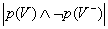 mi; joint assessment
formula
mi; joint assessment
formula  mi=VV-; the validity – a formula
 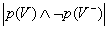 mi=0. Respectively at the final moment of change
representing it result, an assessment has only a condition of Øp. The
condition of p which hasn't been included in process of transition, isn't
estimated. As a result the final moment
of change it will be adequate it is presented:
from the point of view of an assessment – a formula
mi=0. Respectively at the final moment of change
representing it result, an assessment has only a condition of Øp. The
condition of p which hasn't been included in process of transition, isn't
estimated. As a result the final moment
of change it will be adequate it is presented:
from the point of view of an assessment – a formula 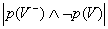 mj; joint
assessment – a formula
mj; joint
assessment – a formula  mj=V-V; the validity – a formula
 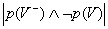 mj=0.
mj=0.
We will
order sequence of subintervals of an interval asymmetric temporal conjunction
of T. Use of such conjunction is necessary as the relation of strict and mild
temporal precedence will present the time scale assuming possibility of
designation of points of a reference in the form of the moments as borders of
subintervals. In a similar case non-standard situations lose meaning as a
result strict fixation of borders of subintervals will divide the general
interval, replacing it with a number of changes in it. If to consider
discrepancy of change in relation to each similar change, that, following
essence of non-standard situations and considering abstraction of infinity,
division of each subinterval of change into a new number of changes – and so on
is fair, in turn. Thus, the idea of research of discrepancy isn't realized. On
the other hand, refusal of discrepancy consideration in relation to
subintervals of an interval of t* will lead to classical to situations and to
action of the principle of consistency. Therefore temporal conjunction which,
from one party, defining sequence of subintervals is necessary, allows to keep
for the discrepancy analysis structure, and with another – its application
won't be connected with the obligation of observance of strict transitions from
one subinterval to another.
Leaning on the types of contradictions entered above, we will divide
interval t* into the following subintervals: 1) interval of an entrance to a
transition state; 2) subinterval of logical chaos; 3) exit subinterval from a
transition state.
The subinterval of an entrance to a transition state of ti,
as well as two other subintervals, associates with a formula р Øр. According to a non-standard
situation and strict understanding of a contradiction the assessment of
conjuncts of this formula is represented in the form of a formula
Øр. According to a non-standard
situation and strict understanding of a contradiction the assessment of
conjuncts of this formula is represented in the form of a formula 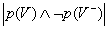 ti’, a joint assessment in the form of a
formula
ti’, a joint assessment in the form of a
formula  ti’=VV- and,
at last, the validity – in the form of a formula
ti’=VV- and,
at last, the validity – in the form of a formula 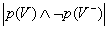 ti=1.
ti=1.
For an exit subinterval from a transition state of ti'’
according to a non-standard situation and a severe looking of a contradiction
the assessment of conjuncts of a formula р Øр is represented to in the form of a
formula
Øр is represented to in the form of a
formula 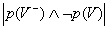 ti’’, the validity – in the form of a
formula
ti’’, the validity – in the form of a
formula 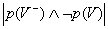 ti’’=1; joint assessment – in the form of a
formula
ti’’=1; joint assessment – in the form of a
formula  ti’’=V-V.
For a subinterval of logical chaos according to a non-standard
situation, with a weak contradiction and a contradiction as logical chaos the
assessment of conjuncts of a formula р Øр is represented in the form of a
formula
Øр is represented in the form of a
formula 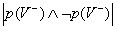 ti*, a joint assessment – in the
form of a formula
ti*, a joint assessment – in the
form of a formula  ti*=V-V-;
the validity – in the form of a formula
ti*=V-V-;
the validity – in the form of a formula 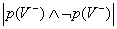 ti*=1.
Allocation of three types of subintervals of the general interval of
change allows to consider discrepancy in relation to three fragments of
transition – to an entrance, logical chaos and an exit. Association of these
fragments gives a general concept of process of transition which will differ
from the end result of the change which is a condition of changing object in a
timepoint.
The discrepancy general concept reflects in the given subintervals
directly transition without the fixed conditions of change. Such general
concept in relation to association of subintervals (tU) is
expressed, naturally, too a formula р Øр.
Øр.
According to a non-standard situation and superdiscrepancy the
assessment of conjuncts of this formula is represented in the form of a formula
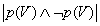 tU; joint assessment – in the form of a
formula
tU; joint assessment – in the form of a
formula  tU=VV; the validity – in
the form of a formula
tU=VV; the validity – in
the form of a formula 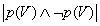 tU=1.
tU=1.
IV. Conclusions.
Scientific novelty is in non-standard representation of a contradiction with
time scale use that gives the chance to pass to creation of new systems of the
dynamic logic capable more adequately to reflect procedural nature of reality.
Theoretical and practical value consists in establishment of the following
postulate: proceeding from the discrepancy analysis in the non-standard
situations, the most adequate for the description of inconsistent nature of
processes of any type will be two-dimensional semantics in which classical
situations are combined with nonclassical and the two-sortable temporal
ontology, that is both the concept of interval time, and the moment concept is
used.
Literature.
1. Karpenko A.S.
Fatalizm and accident of the future: logical analysis. M, 1990. 200 p.
2.
Mikeshina L.A. Openkin M. Yu. New images of knowledge and reality. M, 1998. 235 p.
3. Narsky I.S. Problema
of a contradiction in dialectic logic. M, 1969. 182 p.
4. Popper K. Logika of
social sciences//philosophy Questions. 1992. No. 10. p. 91-101.
5. Popov V. V. interval
semantics for systems of DL and DLQ//Modern logic: Problems of the theory,
history and application in science. SPb. 2000. p. 239-245.
6. Popov V. V.,
Solodukhin O. A. To a logical problem of changes in time//Philosophical
sciences. 1991. No. 5. p. 174-181.
7. Resher N. Granitsa of
a cognitive relativism//philosophy Questions. 1995. No. 4. p. 35-58.
8. Stepin V. S.
Spontaneous systems and post-nonclassical rationality // philosophy Questions.
2003. No. 8. p. 5-17.
9. Sergeychik E.M.
Filosofiya of history. SPb. 2002. 520 p.
10. Prior A.
Past, Present and Future. Oxford, 1967, 217 p.
11. Popov V.V., Leibniz
and The Modern Logical theory of Time // Leibniz: Tradition and Actuality.
Hannover, 1988. p. 761-765.