Филологические
науки/7. Язык,
речь, речевая коммуникация
Магистр педагогики
и психологии, Байбосынова
А.С.
Таразский
государственный педагогический институт
г.Тараз, Казахстан
Using stories in
language teaching
The present economic hardships
facing most developing nations and especially our country have resulted in the
lack of basic teaching and learning materials. Thus, there is a need for
teachers to be more innovative in their teaching and embrace techniques that
will help them make the most of their teaching circumstances. By using stories
teachers can build up a considerable number of simple reading books for their
classes. There is no doubt that by using various types of stories at the
lessons teachers can develop learner’s speaking, listening, writing and reading
skills. Stories are also excellent for reinforcing new vocabulary and grammar.
Many stories have natural rhythmic qualities that are useful for working on
stress, rhythm and intonation. The cultural elements of stories help both
bridge common ground between cultures and finding out cultural differences,
develop cultural awareness that is essential if we are to learn, or to think in
another language and understand the people who speak it. Stories used at the
English lesson can develop communicative approach that focuses on teaching
language while communicating meaning. Learning English through stories provide
a nonthreatning atmosphere for all students.
We can see a clear link between
stories and success in language teaching from investigation of Bettelheim
Bruno, who stated, “stories and fairy tales are inherently interesting to
children. They speak to the “I” of the child” /1, 57 / Morgan and Rinvolucri
present the view that storytelling can be a major component in an acquisition
based language teaching approach. She goes further and suggests the ways of
selecting stories, “unpacking” their language potential, adapting the stories
to syllabus needs, and finding ways to tell them to foster comprehension,
involvement and participation. /2 , 65/
In dealing with stories, learners have a various
feeling for the past and an oneness with various cultures of the present as
they gain insight in the motives and patterns of human behaviour. Stories have numerous
affective benefits for social and emotional development. A story session is a
time to share feelings. A relaxed, happy relationship between storyteller and
learner is established, drawing them together and building mutual confidence.
Stories help learners to know themselves and to know others so they can cope
with the psychological problems of growing up. As Augusta Baker and Ellin
Greene assert” while listening to stories learners have an experience with the
powerful real language of personal communication, not the usual “teachers” of
the foreign language classroom”. /3, 77 /
We are sure that oral stories
develop listening skills in a unique way. The listeners benefit from observing
non- polished speech created on the spot, while
using oral stories there will be a direct
communication between teacher and learner. The learner easily understands the
message of the story and becomes communicatively competent. E.Garvie writes
“communication succeeds if both the learner and the storyteller are good language
users” /4,119 / In her terms a good language user possesses an awareness of
linguistic, psycholinguistic, discoursal, communicative, sociallinguistic
strategic, cognitive and semantic features of the language.
Since the student is unlikely to be
a good language user, teachers should provide a classroom environment that will
stimulate thought and feeling while cultivating listening and speaking skills.
Stories contribute to establishing that kind of environment. We can theorize
that storytelling is experience. The story mirrors the surrounding world and
constructs a reality of it’s own, meeting the cognitive, psychological and
emotional needs of the learner.
The Russian psychologist
Zaporozhets pointed out that,”using stories is very important, it gives a child
a play-like experience” /5,45 / He called child’s mental participation “active
participation”, believing that it enabled the child to enter the story,
identify with it’s character and actively participate in all of it’s events.
The experience that storytelling offers is not only personal experience, it is
a universal experience encompassing world cultures. Any story offers a cultural
experience. Fairy tales are part of the ordinary folk; modern stories mirror
personal and national experiences. A fresh book in the 1980’ s at the
interconnection between culture and language has opened up a new dimension for
foreign- language teaching methodology. “Language has come to be viewed as a
major means to acquire ‘cultural literacy” this term was popularized by
E.D.Hirsh /6, 13 /. In early language teaching storytelling can be one of the
main tools for children to become culturally literate.
Like learning a foreign language,
stories create a new image of the world. The methodologists K. Malan points out
“ If we accept the premise that narrative is a child’s main mode of making
meaning about the world, storytelling can be a powerful force in language
teaching / 7, 112 /
We see that using stories in
language learning is very important, as it improves learner’s attitude towards
language learning, which appears to help them learn more effectively. An
effective learning is done well if the learners are able to make meaning from
verbal and non- verbal information. Non -verbal information may include
background knowledge based on past experience or visual information. To
understand how students comprehend oral text, we must discover what “clues
“they pick up in the flow of speech to form a mental representation of the
story. As Rixon asserts, “if there is a construction or rather reconstruction
of meaning on the part of the learner, that story will make nonsense” / 8, 73,
/
The point is to teach children “how
to mean” in a foreign language. They cannot construct or reconstruct meaning
without prior experience with life and
language
and they need language to cope with new experience. With storytelling we should
teach strategies for text comprehension.
According to the investigations of O.Kopylenko, he
sees storytelling as a coding - decoding process. He says “Comprehension occurs
if the text is organized to enable the listener to decode it in the same way
that the speaker - storyteller encoded the story. 9,15 I
There is variety of opinions regarding coding and
decoding information. Garvie suggests “the idea of identifying main points”
which she calls “staging posts» to facilitate comprehension. We agree with the
idea, but the teacher needs some assistance to know what these “staging posts”
are, since they depend on child’ s personal experience with language and life.
Garvie sees the following stages of development in a learner’s ability to
comprehend:
*
The learner picks up “clues”
*
Th learner develops coping skills
*
The learner gets the gist of the messages and much
of the supporting details.
As we see during the first stage when the student’s
linguistic field is limited,
she/he
should be led to understanding by “guided comprehension” wherein words and
pictures help the child reconstruct meaning. In this process, each learner
should construct his/her own story.
There are many other reasons why we want to use
stories in our classes. Stories provide students with opportunities to listen
to language in context rather than in bits and peaces. Stories also introduce
new vocabulary and language forms within rich networks of associations. Equally
important, stories can have a deep impact on a person’s construction of
knowledge and self.
Stories, a form of narrative, help us to make sense
of our world. Even in academic research, they have lately been given a higher
status. Aki says that stories have the power to reach deep within us into areas
that regular teaching may not visit, thereby validating the language learning”
/ 10, 11 / In his work Murphy proved the importance of storytelling. He
described some ways to help teachers deepen the impact of storytelling through
language and thinking activities that include shadowing, summarizing, student
retelling activities. The activities described here require that learners do
more than just write. Learners should interact and cooperate as they work
toward completing the task. This is important in language learning because the
learners are involved in “comprehending, manipulating, producing, and
interacting in the target language, while their attention is principally
focused on meaning rather than form” /22, 55 /
Apart from interacting in target language the
learners also draw upon their resources from such areas of language as grammar,
vocabulary, speaking, and reading, and nonlinguistic resources such as drawing
and designing. Norman, Levihin, and Hedenquist stress the importance of
engaging as many senses as possible in learning activities because such
activities stimulate both hemispheres of the brain, thus resulting in better
learning. /9,18/
Another important factor in the teaching procedure
described is the functional value of the reader. The fact that the learners
know that something tangible is being produced from a learning task serves a
very strong motivating factor. This supports Princas’s who believes” that for
all levels of learners, motivation is increased if writing is placed in a
realistic context” /10,21/. Teaching that quotation marks in direct speech are
started on a new line and that the sentence is intended would be boring and
very technical when presented in a grammar lesson. However, within the context
of folktales, where the hare speaks and the lion responds, learning becomes
enjoyable. Brumfit asserts that,” having learners work in small groups, rather
than having each learner write his/her own folktale, involves students in communication,
thereby enhancing the quality of language being used” /11,37/
So, we consider that storytelling should be viewed
as an essential part of language teaching. It gives a student rich and
versatile experience with language and culture. While telling stories students
are mostly encouraged and involved into classroom activities.
Literature:
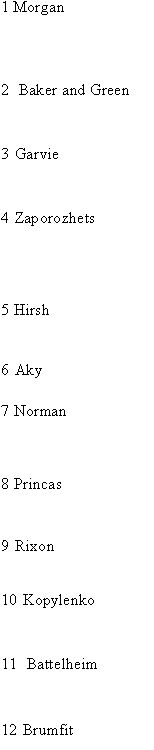 1.Morgan.J.
Rinvolucri. Once upon a Time. Using Stories in
Language Classroom. Cambridge. 1983-p.65,66 (3rd
ed.) 1988-p.l25
1.Morgan.J.
Rinvolucri. Once upon a Time. Using Stories in
Language Classroom. Cambridge. 1983-p.65,66 (3rd
ed.) 1988-p.l25
2. Baker.A.
and Green.E.Storytelling: Art and Technique. New York. R.R.Bowker 1997-p.77,91
3. Garvie.E.Teaching
English to young Children. Cleven.Multicultural Matters.
1990-p. 119,120
Zaporozhets. A.
V. “Perception of fairy tales by a pre-school
child. Doshkolnoye Vospitanie,5 p.45,48
5.Hirsh.E.D.
Teaching English as Communication. Oxford University Press.1978-p. 13
6.Aky.T.The
deep impact of storytelling”Forum: (№3 October) 2001 -p.l 1
7. Norman.D.U.Levihn
and Hedenquist. Communicative Ideas: An approachWith Classroom Activities.
1986-p. 18,19.64
8. Princas.D.
Sorytelling Process and Practice. Littelton. 1986-p.21
9. Rixon.D.
English and other languages for
children: Practice and
Theory in a Rapidly
10. Kopylenko.O.
The role of Text Structure in Text Comprehension. Leningrad.
1975-p.75
11. Battelheim.
B.The uses of Enchantment.
New York. A.A.Knopf.
1996-p.l 12
12. Brumfit.C.J.
Theoretical Implications of Language Teaching. 1984-p.37,41
13. Krashen.S.
Burt,Dulay. “Principles and practice in second language acqusition” Oxford:
Pergamon. 1983-p.81
 14. Malan.K.Children
as Storytellers.
14. Malan.K.Children
as Storytellers.
PETA. 1991 -p. 112
15. Magure.J.Creative
Storytelling.Highstown. N.Y.1985-p.46
16. Murphy.T.Activating
metacognition with actin logs.’The language teacher”,23,5,p.55
17. Forum
(№ /January) 1995-p.38, 39 (№2/April) 1996-p.lO, 11
18. Г.В.Рогова, Т.Е.Сахарова” Методика обучения иностранным языкам в средней школе”, Москва “Просвещение” 1991