Koketai T.A., Tussupbekova A.K., Baltabekov A.S., Imangaliyeva N.N.
Karaganda State University
named after academician Ye.A.Buketov
STUDY
OF RECOMBINATION PROCESSES IN METAPHOSPHATE
OF POTASSIUM CRYSTALS
In
crystalline and vitreous metaphosphate of potassium,
recombination processes are associated with the decay of the same radiation
defects. A change in the type of structure leads to a change in the sign of the
recombination process: in the crystalline process, the hole process; in the
glassy sample – electronic [1]. The influence of impurity ions usually leads to
the appearance of new peaks of thermally stimulated luminescence (TSL) and a
change in the accumulation of light densities in peaks of recombination
luminescence of the matrix.
The
most important result of the study of recombination luminescence in crystalline
and vitreous Currol salts is the establishment of a
change in the mechanism of recombination from hole to electron, respectively.
Impurity ions of transition metals are traps for electrons.
A
study of the role and effect of other ions of transition metals (Co2+
and Ni2+) on recombination processes in potassium metaphosphate was carried out on crystalline samples.
Figure
1a shows the X-ray luminescence spectrum for a crystalline Currol
salt, activated with nickel sulfate. It can be seen from the figure that there
is a pronounced maximum at 3.54 eV. The radiation
characteristic of a matrix with a maximum at 3.1 eV
manifests itself as a "shoulder" on the longwave
wing of the main emission band. In addition, a weak luminescence is observed in
the region of 2.6 eV, which we associate with the
presence of impurity sulfate anions in samples. The spectral composition of the
TSL peak, measured in the temperature range 100-110 K, consists of the same
three emission bands 2.6 eV, 3.1 eV,
and 3.54 eV. The last emission band is obviously due
to the presence of nickel impurity ions in the crystals. The influence of
nickel ions on recombination processes in the crystalline salt of Currol is similar to that observed in samples activated by
manganese ions. This allows us to conclude that impurity Ni2+ in
potassium metaphosphate are also traps for electrons.
This is associated with an increase in the rate of accumulation of the light
sum in the peaks of TSL. The appearance of a luminescence with a maximum at
3.54 eV indicates a hole character of the
recombination processes in this temperature range. The ions of manganese and
nickel, captured by irradiation of samples with X-ray quanta, are the centers
of recombination. Therefore, in the Currol salt,
depending on the nature of the activator, emission bands of 3.46 eV and 3.54 eV appear, which
disappear in the spectral composition of the TSL peaks in glassy samples.
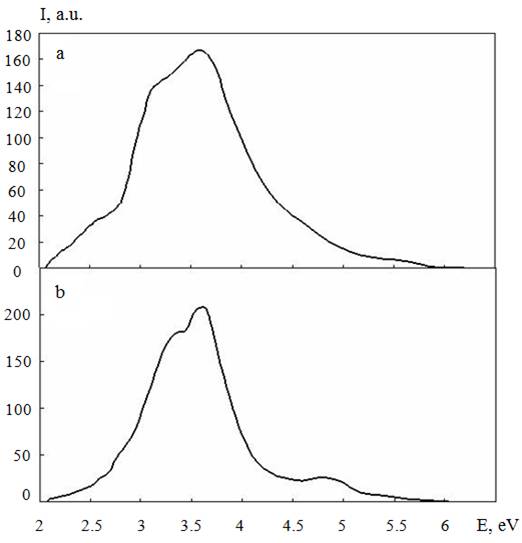
Fig. 1 - X-ray luminescence
spectra for crystalline KPO3-NiSO4 (a) and KPO3-CoSO4 (b) salts measured
at 80 K
The
spectral composition of X-ray luminescence for a KPO3-CoSO4
crystal is shown in Fig. 1b. The dominant emission band in this sample is the
band with a maximum at 3.61 eV. In general, the spectral
composition of X-ray luminescence and TLC peaks in all crystalline samples
activated by ions of transition metals is similar. An exception is the change
in the position of the radiation band, which we associate with the
recombination of holes at the Me + centers. In samples activated by
manganese ions, it is at 3.46 eV, nickel ions - 3.54 eV and cobalt ions - 3.61 eV.
An
analysis of these results allows us to state that transition metal ions in Currol salts are traps for electrons. Depending on the type
of structure, the role of radiation-induced impurity centers of recombination
processes changes. In the crystalline salt of Currol,
the defects of Me+ are the centers of recombination, which lead to
the appearance in the spectral composition of the peaks of TSL, a new band of
radiation whose positions depend on the nature of the impurities.
In
a glass-like sample, the centers of Me+ become electron donors. In
this case, in the spectral composition of the TSL peaks, the emission band
associated with the recombination of holes on radiation-induced in impurity
centers disappears. In addition, a new peak of TSL appears, the temperature
maximum of which depends on the nature of impurity ions of transition metals.
References
1.
Baltabekov A.S., Koketaitegi
T.A., Kim L.M. The influnce of impurity ions of
transition metals on radiation induced prosseces //
Eurasian technical journal. - 2010. - Vol.7, №2(13). – P.12-18.