Технические науки/12. Автоматизированные
системы управления на производстве.
Ladiyeva L., Dovbnia S.
NTUU «Igor Sikorsky Kyiv Polytechnic Institute»
Mathematical
model of the contact membrane distillation of desalination process
The aim is to study the potential for membrane distillation
desalination, particularly developed detailed mathematical model allowing to
investigate membrane distillation for the purpose of control.
In order to promote this model is considered three separate sections of
the process before bring them together (Fig. 1). The process was divided into
paroridynnyy distribution, mass transfer, heat transfer [1].
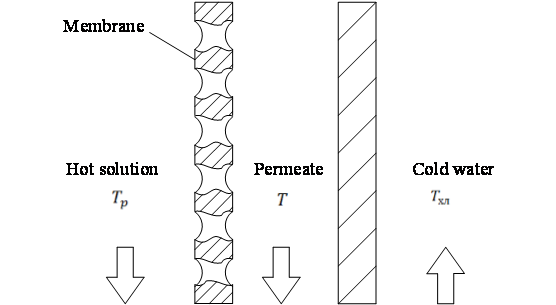
Fig. 1. The contact membrane distillation
 – The temperature of the hot solution;
  – Temperature permeate;
  – Temperature of cold water.
Powered following formulas Description: (1) the equation channel
solution, (2) permeate channel equation, the equation cold water channel
respectively [2].
 , (1)
, (1)
 , (2)
, (2)
 , (3)
, (3)
 ,
,  – the cost of input solution and cold water, respectively;
 – Flow solution at the outlet;
 ,
,  – Concentration of the solution at the inlet and cold water, respectively;
 ,
, – Concentration of the solution at the outlet and cold water,
respectively;
– Concentration of the solution at the outlet and cold water,
respectively;
 ,
,  – Temperature at the inlet solution and cold water;
 ,
,  ,
,  – The temperature of the solution, the permeate and cold water outlet,
respectively;
– The temperature of the solution, the permeate and cold water outlet,
respectively;
 – The flow of vapor through the membrane;
 – The rate of transmission through the membrane;
 – Transfer coefficient through the wall.
In membrane distillation hydrophobic membrane for water vapor. The
membrane ensures the passage of only a couple but not the solution. This leads
to the presence of steam-liquid distribution on the inputs and outputs of the
membrane pores, in the place where the liquid and vapor in contact with each
other. [3]
Evaporation and condensation of liquid vapor is a function of
temperature, pressure and the corresponding concentration of water and salt.
Mathematical equations representing this part of the process have been
developed based on the equation coefficients and Antoine.
Mass transfer in membrane distillation is a number of the following
stages: water from the volumetric flow of sea water must pass through a very
thin boundary layer on the side of the supply membrane to evaporate on the
surface of the membrane, the steam then passes through the pores of the
membrane, and condenses on the surface of the membrane to permeatniy side of
the membrane . Then the condensate must move through another boundary layer
before connecting the permeate flow rate and gather as a product. There have
been developed mathematical equations describing this part of the process based
on the theory of boundary and model dusty gas.
Heat transfer in membrane distillation rozbyvavsya by heat exchange
between the different sections of membrane distillation. This part of the
process modeled by developing mathematical equations that describe the amount
of heat transferred between each section and then combine them.
We found concordance between the results of the model and the actual
results of the experiment. Using this model we can calculate the contours of
regulation. In the future, thanks to cheap energy and membrane distillation can
get a clean, cheap water wherever it is needed.
References:
1. Close E. Modeling of direct contact membrane
distillation for desalination / Edward Close, Eva Sorensen // 20th European
Symposium of Computer Aided Process Engineering, 6–9 June
2010 : abstracts and
presentations. – Naples : Elsevier, 2010. – P. 534-539.
2. Ettouney, H. M. Fundamentals of Salt
Water Desalination, Elsevier :
textbook / H. M. Ettouney, H. T. El Dessouky. –
Amsterdam : ELSEVIER SCIENCE B.V., 2002. – 670 p.
3. Termpiyakul, R. Heat and mass transfer
characteristics of a direct contact membrane distillation process for
desalination /
R. Termpiyakul,
R. Jiraratananon, S. Srisurichan // Desalination. – 2005. – Vol. 177, №2. – P. 133-141.