Kuzurman M. V., Candidate of Biological Sciences Sultangazina G. Zh.
A. Baytursynov Kostanay state university, Kazakhstan
The eco- coenotic analysis of ferns
of the State National Park "Burabai"
Identification
and studying of flora of any territory has a huge value as under the influence
of the amplifying adverse factors there are global changes in the environment.
First of all it depends on activity of a human being.
Distribution of
types across the territory occupied by them intimately is bound to its
eco-coenotic conditions.
The massif of Burabai is characterized by existence of the most various habitats such as sands developed in the field of deltas of hollows of an ancient drain, both gravelly and rocky outcrops, and the salted areas, and also a large number of fresh and salty lakes, steppes on chestnut and black soils. All these features define diversity of ecological structure of flora of this territory.
During the period
from 2010 to 2014 we surveyed the territory of the State National Park
"Burabai".
During floristic
survey the detailed and route method in combination with method of selective
tests of concrete, local florae which allowed to study information on specific
structure of the surveyed territories and to reveal (or to specify) an
eco-coenotic belonging of the higher plants was applied. There was an attempt
to examine all the ecotopes.
According to the
research results the eco-coenotic analysis of the ferns found in the territory
of the park was carried out on the bases of four ecological factors: humidity,
soil fertility, irradiating and relation to a substratum.
Availability of
moisture traditionally belongs to the most important ecological indexes for
plants [1].
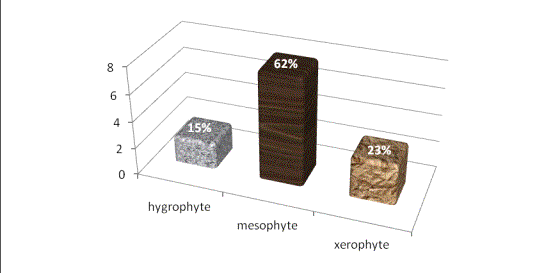
Figure 1 – Distribution
of ferns in relation to humidification
According to
figure 1 considerable proportion of ferns of the national park are the plants
growing in conditions of sufficient and excess humidification.
Table 1 – Range
of ecological groups on humidification
|
hygrophytes |
mesophytes |
xerophytes |
|
Thelypteris palustris |
Polypodium vulgare |
Pteridium aquilinum |
|
Athyrium
filix-femina |
Cystopteris fragilis |
Asplenium septentrionale |
|
|
Gymnocarpium dryopteris |
Gymnocarpium jessoense |
|
|
Matteuccia struthiopteris |
|
|
|
Woodsia ilvensis |
|
|
|
Dryopteris carthusiana |
|
|
|
Dryopteris filix-mas |
|
|
|
Dryopteris cristata |
|
|
%, of total number |
||
|
15 |
62 |
23 |
Mesophilic
pteridoflora has the biggest percentage. 8 species of ferns belong to mezofit group that made 62% of all ferns in
the park. The large number of lakes in the studied territory caused the
development of habitats with the increased, congestive humidification: two
species of ferns belong to gigrofit group that made 15% of total number of
found ferns. The quantity of kserofit makes 3 species, i.e. 23% of total number
of ferns (see Table 1).
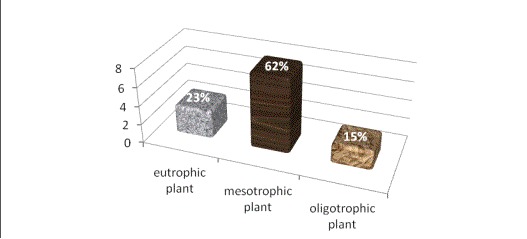
Figure 2 – Distribution
of ferns in relation to feeding
According to figure 2 in relation to richness of the soil there are eutrophic, mesotrophic and oligotrophic plants among ferns of the park [2].
Table 2 – A range
of ecological groups in relation to feeding
|
Eutrophic
plants |
Mesotrophic
plants |
Oligotrophic
plants |
|
Thelypteris palustris |
Polypodium
vulgare |
Pteridium aquilinum |
|
Gymnocarpium dryopteris |
Asplenium
septentrionale |
Woodsia
ilvensis |
|
Matteuccia
struthiopteris |
Athyrium filix-femina |
|
|
|
Cystopteris fragilis |
|
|
|
Gymnocarpium jessoense |
|
|
|
Dryopteris
carthusiana |
|
|
|
Dryopteris filix-mas |
|
|
|
Dryopteris cristata |
|
|
%, of total number |
||
|
23 |
62 |
15 |
The group of
mesotrophic plants includes the greatest number of fern species (8 species)
that makes 62% of total number. Eutrophic plants amount to 23% (3 species); and
oligotrophic plants make 15% (2 species) of total number of found ferns (see
Table 2).
In accordance
with figure 3 there are heliophyte, hemisciophyte and sciaphyte among ferns of
national park in relation to irradiating.
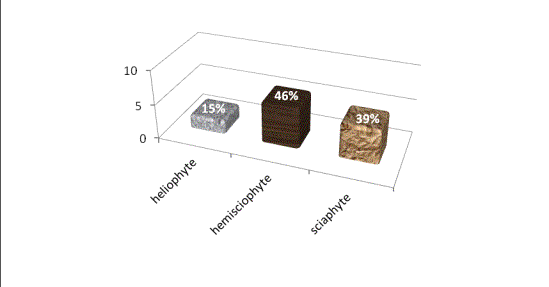
Figure 3 – Distribution
of ferns in relation to sun light
The greatest
number of ferns is shade-enduring species. We found 6 fern species of this
ecological group that made 46%. There were 2 species of photophilous ferns
makes 15%. 39% (5 species) of total number of the ferns found in this territory
fall to the share of sciaphyte (see Table 3).
Table 3 – A range
of ecological groups in relation to irradiating
|
Ecological groups |
||
|
Heliophyte |
Hemisciophyte |
Sciaphyte |
|
Thelypteris palustris |
Polypodium vulgare |
Athyrium filix-femina |
|
Gymnocarpium jessoense |
Pteridium aquilinum |
Cystopteris fragilis |
|
|
Asplenium
septentrionale |
Gymnocarpium dryopteris |
|
|
Matteuccia struthiopteris |
Dryopteris carthusiana |
|
|
Woodsia ilvensis |
Dryopteris filix-mas |
|
|
Dryopteris cristata |
|
|
%, of total number |
||
|
15 |
46 |
39 |
The analysis of
floro-coenotic structure of flora allowed allocating the following eco-coenotic
groups: forest, marsh and petrophyte. On the basis of supervision and
geobotanical descriptions every specie was carried to one group.
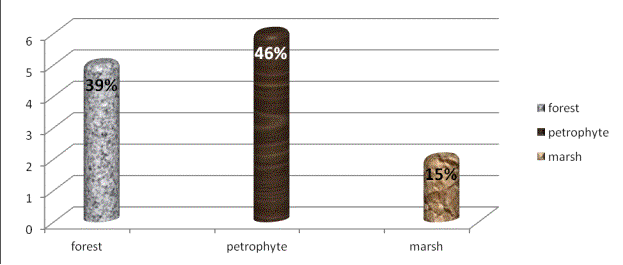
Figure 4 – Dispersal of
ferns according to eco-coenotic
groups
According
to figure 4 the largest eco-coenotic group is petrophyte group. Total number of
rocky ferns is 6 species (46%). They are: Polypodium vulgare, Asplenium
septentrionale, Cystopteris fragilis, Gymnocarpium dryopteris, Gymnocarpium
jessoense, Woodsia ilvensis.
Table 4 –
Dispersal of eco-coenotic groups of plants in relation to irradiating
|
Irradiating
|
Eco-coenotic group |
||
|
forest |
petrophyte |
marsh |
|
|
Heliophyte |
|
Gymnocarpium
jessoense
(Koidz.) Koidz. |
Thelypteris palustris Schott |
|
Hemisciophyte |
Dryopteris cristata (L.) A. Gray Pteridium aquilinum (L.)
Kuhn Matteuccia struthiopteris (L.)
Tod |
Polypodium vulgare L. Asplenium septentrionale (L.) Hoffm. Woodsia ilvensis (L.) R.Br. |
|
|
Sciaphyte |
Athyrium filix-femina (L.) Roth. Dryopteris filix-mas (L.) Schott |
Cystopteris fragilis (L.) Bernh. Gymnocarpium
dryopteris (L.) Newman |
Dryopteris carthusiana (Vill.) H.P. |
Practically all
these types are shade-enduring, shade-loving, mesophytic and xerophytic plants,
except for Gymnocarpium jessoense
which prefers habitats with the sufficient level of irradiating and grows
mostly under rocks and in shady cracks of granite rocks of mountains the
Sinukha and Zheke Batyr, along streams Tas-Bulak and Imanay, and also in
vicinities of lakes Maloe Chebachye, Lebyazhie, Maloe Karasu and the drying-up
river Arykpai (see Table 4). 4 species (Polypodium
vulgare, Cystopteris fragilis, Gymnocarpium dryopteris, Woodsia ilvensis)
are mesophytes, and two species (Asplenium
septentrionale, Gymnocarpium jessoense) are capable to bear the
considerable lack of humidity - a soil and an atmospheric drought, i.e. they
are xerophytes (see Table 5). The considerable proportion of these ferns are
belong to soils with average security with mineral elements (Polypodium vulgare, Asplenium
septentrionale, Cystopteris fragilis, Gymnocarpium jessoense), one
specie (Gymnocarpium dryopteris) is widespread mainly on fertile soils and
only Woodsia ilvensis needs a small
amount of foodstuff (see Table 6).
Table 5 –
Dispersal of eco-coenotic groups of plants in relation to humidification
|
Humidification |
Eco-coenotic group |
||
|
Forest |
Petrophyte |
Marsh |
|
|
Hygrophytes |
Athyrium filix-femina (L.) Roth. Koidz. |
|
Thelypteris
palustris Schott |
|
Mesophytes |
Matteuccia struthiopteris (L.) Tod Dryopteris cristata (L.) A. Gray |
Polypodium vulgare L Cystopteris fragilis (L.) Bernh. Gymnocarpium dryopteris (L.) Newman Woodsia ilvensis (L.) R.Br. |
Dryopteris carthusiana (Vill.) H.P. |
|
Xerophytes |
Pteridium aquilinum (L.) Kuhn Dryopteris filix- mas (L.) Schott |
Asplenium septentrionale (L.) Hoffm. Gymnocarpium jessoense (Koidz.) |
|
The territory of
State National Park "Burabai" is characterized by the development of
various forest communities that causes the prevailing of forest eco-coenotic
group. The pine woods grow here at day stone of granites. Besides and the boggy
birch woods which are found along streams and in hollows of lakes are
interesting and various. [3]. 5 types of ferns belong to a forest eco-coenotic
group (Pteridium aquilinum, Athyrium
filix-femina, Matteuccia struthiopteris, Dryopteris filix-mas, Dryopteris
cristata) that makes 39% (see Figure 4). These species of ferns do not
demand intensive irradiating and have a wide ecological amplitude; in relation
to humidification they belong to the pine birch woods in vicinities of lakes
Lebyazhie, Maloe Karasu, along the Imanayevsky stream, and also on slopes of
mountains and the Sinukha and Zheke-Batyr. Thus, 3 species (Pteridium aquilinum, Matteuccia
struthiopteris, Dryopteris cristata) are shade-enduring plants, and Athyrium filix-femina and Dryopteris
filix-mas grow in conditions of low illuminating intensity and do not bear
the full irradiating (see Table 4). 2 species (Matteuccia struthiopteris, Dryopteris cristata) grow in the
conditions of an average (i.e. sufficient, but not exuberant) humidifications, Pteridium aquilinum and Dryopteris filix-mas
are capable to bear the considerable lack of humidity - a soil and atmospheric
drought, Athyrium filix-femina is hygrophyte (see Table
5). Forest ferns are widespread mainly on fertile soils and belong to soils
with an average security with mineral elements, except for Pteridium aquilinum which needs a trace amount of mineral elements in the soil. Dryopteris filix-mas, Athyrium filix-femina and Dryopteris cristata are mesotrophic
plants, Matteuccia struthiopteris –
eutrophic plants (see Table 6).
Table 6 –
Dispersal eco-coenotic groups of ferns in relation to feeding
|
Feeding |
Eco-coenotic group |
||
|
Forest |
Petrophyte |
Marsh |
|
|
oligotrophic plants |
Pteridium aquilinum (L.) Kuhn |
Woodsia ilvensis (L.) R.Br. |
|
|
mesotrophic plants |
Dryopteris filix-mas (L.) Schott Athyrium filix-femina (L.) Roth. Dryopteris cristata (L.) A. Gray |
Polypodium vulgare L Asplenium septentrionale (L.) Hoffm. Cystopteris fragilis (L.) Bernh. Gymnocarpium jessoense (Koidz.) Koidz. |
Dryopteris carthusiana (Vill.) H.P. |
|
eutrophic plants |
Matteuccia struthiopteris (L.) Tod |
Gymnocarpium dryopteris (L.) Newman |
Thelypteris palustris Schott |
Marsh
eco-coenotic group includes species growing on the sphagnum bogs and also in
pine and birch swamp-subor. Bogs within Bohr mountain forest area meet on coast
of the growing lakes Svetloe, Karasie, Schuchie, Borovoe, Maloe Chebachye, besides in boggy flood plains of
streams Tasbulak and Imanayevsky [3]. 15% of total number of species of ferns
fall to the share of marsh eco-coenotic group (see Figure 4). Dryopteris carthusiana and Thelypteris palustris concern to them. These
types fall into to photophilous and shade-loving plants. Thus, Thelypteris palustris grows better and
develops at the full illuminating intensity (see Table 4), and the ecological
optimum of Dryopteris carthusiana is
in the area of weak illuminating intensity. Dryopteris
carthusiana and Dryopteris cristata
grow in the conditions of an average (i.e. sufficient, but not exuberant)
humidification (see. Table 5), prefer fertile soils (Thelypteris palustris) and average amount of mineral elements (Dryopteris carthusiana) (see Table 6).
Literature:
1. Лархер В. Экология растений М.: Мир 1978 г.
283-324c.
2. Горышина Т.Н. Экология растений уч. Пособие
для ВУЗов, Москва, В. школа, 1979г. 63-102с.
3. Султангазина Г.Ж. Флора национального
природного парка «Бурабай» / Г.Ж. Султангазина, И.А. Хрусталева, А.Н.
Куприянов, С.М. Адекенов; отв.ред. А.Н. Куприянов; Рос. Акад. Наук, Сиб.
отд-ние, Ин-т экологии человека [и др.]. – Новосибирск: Изд-во СО РАН, 2014. –
242 с. ил. ISBN 978-5-7692-1381-6