Kossinov K.I, Iskakova A.O.
L.N.Gumilyov Eurasian National University, the Republic of Kazakhstan
Linguo-cross-cultural
approach in English language learning

(Adapted from
http://900igr.net)
Abstract: This article provides information
about the basic principles of the linguo-cross-cultural approach in English
language learning. Initially, the concept to be revealed is “approach in
teaching” and authors of the article examine the concept’s main features and
peculiarities. The second part is dedicated to the essence of the
linguo-cross-cultural approach and the place of linguo-country studies in the
approach. The third part of the article describes the importance of the
interaction of language and culture during EFL class. At the end the authors of
the article accentuate on the necessary use of the approach during EFL classes,
for not only is the approach pivotal to enhance students’ English language
level and English culture knowledge, but also it is an overriding mode of
raising students’ own cultural awareness.
Key words: approach in teaching,
culture, linguo-cross-cultural approach, interaction of language and culture,
cultural awareness.
Introduction
In recent years there has been
growing awareness of the importance of learning English language. It has become
lingua franca and predominantly been used in manifold fields of human being’s
life. Therefore, undoubtedly, teachers of English language and language
scholars are always thinking of the most effective approaches, methods and
techniques. Nowadays we are bewildered what the most appropriate approach for
teaching English as a foreign language is. There is no right answer to this
question, as it will depend on many factors: the age of the children, class
size, and the competency of the teacher, availability of resources, the school
context and the framework constructed by bodies that create the educational
landscape for the locality [3].
In our modern-day and diverse
community we can be confused with various cultures and their social norms.
Therefore, in order to begin learning a foreign language we, assuredly, need to
delve into cultural idiosyncrasies of the country which language we aim to
acquire. Nowadays the approach based on language learning through country
studies plays pivotal role. It is due to the fact that cultural misapprehension
can trigger unalterable negative consequences, such as collisions between
cultures. Not only is it necessary to utilize materials pertaining to country
studies and culturology during academic process to investigate the very
country, but it also makes sense when the enhancement of English language level
is the centrepiece of discussion.
The proliferation of approaches and
methods is a prominent characteristic of contemporary second and foreign
language teaching. To some, this reflects the strength of teacher’s profession.
Invention of new classroom practices and approaches to designing language
programmes and materials reflects a commitment to finding more efficient and
more effective ways of teaching languages [1].We are inclined to think that one of the feasible effective approaches
is considered to be linguo-cross-cultural approach. Why? It is due to the fact
that motivation is one of the vital instruments of teachers. Owing to the
approach which will be described in the article teachers can raise students’
motivation. Simple lesson procedures can be substituted by enthralling
imitation of real-life travelling, edutainment via country and culture studies.
Perhaps, lessons based on linguo-cross-cultural approach are necessarily held
to capture students’ attention, raise their self-esteem and boost
self-confidence while communicating with native speakers.
The nature of approach in teaching
To begin with, we need to figure out
what the approach denotes within teaching. Undoubtedly, the perspectives of the
approach in language teaching are diverse; nevertheless, from our personal
perspective it is viable to take into consideration one of the well-known
viewpoints on the issue. According to Edward Anthony, an American applied
linguist, “an approach is a set of correlative assumptions dealing with the
nature of language teaching and learning”. He claims that an approach is
axiomatic. Thus, it describes the nature of the subject matter to be taught.
Edward Anthony asserts that an approach is the combination of the specified
beliefs about language learning and language itself. Following Anthony, approach
refers to theories about the nature of language and language learning that
serves as the source of practices and principles in language teaching [1].
We can infer from Anthony’s attitude
to an approach that it denotes teacher’s personal ideas and philosophy of how
to present the materials to students properly. An approach can vary a lot and
depends on the competences we would like to evolve in students (for instance,
communicative, task-based, linguo-cross-cultural competence and etc.). When we
cook a meal, whether vegetarianism or meat-eating can be our approaches. This
is true in terms of language education, because we inform our students in
different ways and, therefore, various approaches are utilised.
One of the needs of hodiernal
generation is to acquire and develop communicative skills which are crucial in
so-called cross-cultural communication. The linguo-cross-cultural approach is
aimed at coping with the abovementioned preference. Not only does it promote
the knowledge of the history, country’s social norms of the target language,
but also there is one of the modes to delve into the language itself and
enhance its level.
Methodology
But we are puzzled with the question
what the linguo-cross-cultural approach means. First of all, one should point out
that one of the overriding features of the linguo-cross-cultural approach is
the linguo-cross-cultural competence. Linguo-cross-cultural competence is the
knowledge of sociocultural peculiarities of the target language’s country and
ability to maintain the communication with native speakers on the ground of the
language grammar and semantics knowledge. This competence is comprised of
proper language and cultural knowledge, as well as communicative and
non-communicative skills and abilities.
Along with basic knowledge of
socio-cultural development of the target language’s country,
linguo-cross-cultural approach also includes ability to perform the written
communication according to it.
The linguo-cross-cultural component
can be illustrated in the following figure:
Linguo-cross-cultural component


Skills and abilities Knowledge
Language and non-verbal
behaviour


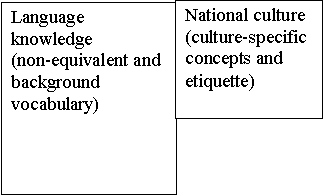
Thus, we can say that the
linguo-cross-cultural component implies the correct students’ speech in English
language in terms of content and formulation of thoughts.
One of the linguistic peculiarities
of the linguo-cross-cultural competence lies in the selecting of the proper
language materials which reflect the culture of English culture. Ethnically
cultural materials are contributed to linguo-cross-cultural approach.
Therefore, to acquire the linguo-cross-cultural competence students can refer
to cultural phraseology of the English language, its proverbs, verse and
fiction. The linguo-cross-cultural competence is a prominent feature of the
approach and deemed to be the result of effectiveness of the
linguo-cross-cultural approach whether the competence is acquired by students.
As a feature of the
linguo-cross-cultural component, non-equivalent vocabulary should be taken into
consideration while choosing the materials for classes. At this point, we need
to define the abovementioned feature. According to Vereshagin and Kostomarov,
non-equivalent vocabulary implies lexis which cannot be explained by
translation and does not have counterparts in other languages [10]. In other
words, non-equivalent vocabulary is presented with words which content cannot
be observed in foreign languages and interpreted by foreign lexical concepts.
Thus, we can firmly assert that non-equivalent vocabulary is not limited by the
loss of equivalents in foreign languages, but also means that the words reflect
the culture of the country.
Second overriding feature is presented by the
culture-specific concepts. Non-equivalent vocabulary reflects national
culture-specific concepts. The importance of these concepts in culture and
language learning is disputable. Words, peculiar to the only culture and without
analogies in other ones, are vitally essential to linguo-cross-cultural
approach. What does the culture-specific concept denote? The culture-specific
concept means a name which is germane to cultural and historical heritage of a
nation even including heroes and mythological creatures [11].
The relationship between the language and the
culture can be clearly shown via culture-specific concepts. The main
discrepancy which can be found between culture-specific concepts and other
words of the language is the link of national and historical course of time
with culture-specific concepts.
According to Edward Sapir's profound insights,
“language [is] a symbolic guide to culture” and that “vocabulary is a very
sensitive index of the culture of a people”. On the ground of this perspective,
AnnaWierzbicka in her book named “Understanding cultures through their key
words” states that there is a very close link between the life of a society and
the lexicon of the language spoken by it. This applies in equal measure to the
outer and inner aspects of life. And, as one of various English
culture-specific concepts, a special word for orange (or orange-like) jam
(marmalade) is exemplified [9].
Having examined the abovementioned
component it is imperative to mention the linguo-country studies. Inevitably, students
studying English language need to closely scrutinise the linguo-country studies
discipline in order to acquire the linguo-cross-cultural competence properly.
At this point we need to reveal the subject matter of the linguo-country
studies.
In his work entitled “Linguo-country studies, what
does it mean?” Tomakhin states that studying target language country’s culture
has been one of the main objectives of language learning since classical times.
He also asserts that classical languages’ teaching does not make sense without
investigation of culture [11].
The term “linguo-country studies” was first used by
Vereshagin and Kostomarov in their collaborative work called “The linguistic
issue of Russian language teaching to foreign students via country studies” in
1971. The appearance of the abovementioned term is connected to the release of
the book entitled “Language and culture” written by Vereshagin and Kostomarov.
The gist of the book relies on the use of materials related to linguo-country
studies during the academic process, where the object of the discipline is the
techniques with the help of which students delve into new culture. According to
the authors, this discipline should be implied as a subject due to which students
familiarise with the past and present of target language’s country, national
culture via the very communication in the target language [10].
Following Tomakhin, the very term “linguo-country
studies” points out that not only does this discipline include proper materials
about target language’s country, but also language learning itself. The
adherents of the idea, Shukin and Azimov, deem that the term includes practice
of target language’s learning and theoretical methods of its teaching [11].
The relationship
between culture and language
The interaction of language and
culture is a prominent feature of contemporary English language lesson.
Teachers are aware of the importance of such relationship between premises, for
these concepts are interrelated to each other. Culture cannot be perceived
without its appreciable component in the nature of language. Language performs
the function of a transmitter when the cultural heritage is transmitted from
one generation to another.
It is viable to present the
definition of culture by E.B.Tylor who is in favour of the idea that the
culture is “that complex whole which includes knowledge, belief, art, morals,
law, custom, and any other capabilities and habits acquired by man as a member
of society” [7]. It is said by the scholar that language is a component of
culture because it is impossible to comprehend the nuances of the very culture
without knowing its language properly.
In his collaborative work with
Benjamin Lee Whorf, Edward Sapir, takes into account the close interaction
between language and culture, concluding that “it was not possible to
understand or appreciate one without knowledge of the other” [5]. Nevertheless,
Wardhaugh identified three claims to the interaction between language and
culture:
1.
The structure of a language
determines the way in which speakers of that language view the world or, as a
weaker view, the structure does not determine the world-view but is still
extremely influential in predisposing speakers of a language toward adopting their
world-view;
2.
The culture of a people finds
reflection in the language they employ: because they value certain things and
do them in a certain way, they come to use their language in ways that reflect
what they value and what they do
3.
A ‘neutral claim’ which claims that
there is little or no relationship between the two [8].
Thus, for culture and language are
deeply connected with each other, we, teachers of English language, should
respect the cultural values of English language and teach our students to act
as we do. Following Englebert, “…to teach a foreign language is also to teach a
foreign culture, and it is important to be sensitive to the fact that our
students, our colleges, our administrators, and, if we live abroad, our
neighbours, do not share all of our cultural paradigms.” [2].
It is suggested that owing to the
linguo-cross-cultural approach teachers could attain the desirable goal of
apprehension of English language culture.
Conclusion
Having examined the peculiarities of
the linguo-cross-cultural approach it is viable to single out the reasons of
its utilising:
1.
Enhancement of English language
knowing (especially, the enrichment of students’ vocabulary) through studying
cultural specific concepts and non-equivalent vocabulary;
2.
Development of students; own
cultural awareness via compare and contrast of culture of mother tongue
language and foreign language’s one;
3.
Creating technique which can help
students be involved in the academic process via enthralling modes of lessons
We are inclined to think that the
usage of linguo-cross-cultural component facilitates the initiation of interest
towards the English language, motivation in learning English language,
development of thinking in foreign language and more conscious acquisition of
English language as a means of communication.
Based on the quotation of the
outstanding German writer and philosopher Wolfgang von Goethe “Those who know
no foreign language know nothing of their mother tongue” (Wer fremde Sprachen
nicht kennt, weiß nichts von seiner eigenen), we can say that not only is
the linguo-cross-cultural approach attributed to help students learn English
language and discover its culture, but also it can be used to fortify students’
native language knowledge, tolerant attitude to other cultures and reinforce
their own cultural awareness.
References
1. Approaches and Methods in Language Teaching, Jack c. Richards and
Theodore s. Rodgers, Cambridge university press;
2. Englebert, Character or Culture? An EFL Journal,24(2), 2004;
3. Innovations in learning technologies for English language teaching Edited by Gary Motteram, British Council 2013 Brand and Design/C607;
4. Porter E (Foreign involvement in China’s colleges and universities: a
historical perspective. International Journal of Intercultural Relations, vol.
11, 1997, 369;
5. Sapir, Edward, Language: An introduction to the study of speech. New
York: Harcourt, Brace and company, 1997
6. Savignon S. J. Communicative Competence Theory and Classroom Practice.
Graw-Hill: 2001;
7. Tylor, E.B, Primitive culture: researches into the development of
mythology, philosophy, religion, art, and custom, 2000;
8. Wardhaugh. R, An introduction to sociolinguistics (Fourth Ed.). Oxford:
Blackwell Publishers, 2002;
9. Wierzbicka Anna, Understanding Cultures through Their Key Words, New York
Oxford University Press 1997;
10. Верещагин Е.М.,
Костомаров В.Г. Язык и культура: лингвострановедение в преподавании русского
как иностранного. 3-е изд. М:, 1993 (in Russian);
11. Томахин Г.Д.
Лингвострановедение: что это такое? // ИЯШ, М.,57 9 (in Russian);