To the question of teaching
professional-oriented foreign language at nonlinguistic faculties
Тлеужанова Г.К., Тлеужанова К.Т., Садырбаева А.З.
Карагандинский государственный университет имени Е.А.Букетова, г.Караганда, Казахстан
Abstract. In article the problem of
the professional-oriented training in a foreign language of students of nonlinguistic
specialties of higher education institutions which acquires special relevance
in connection with the increasing role of foreign-language communication in professional
activity of modern experts is considered.
Relevance of a research is that the
professional-oriented approach to training in a foreign language at nonlinguistic
faculties of higher education institutions provides formation at students of
ability of foreign-language communication in concrete, professional, business,
scientific spheres and situations taking into account features of professional
thinking, that is – the professional-oriented training. Understand the training
based on the accounting of needs of the students for a learning of foreign
language dictated by features of future profession or specialty which, in turn,
demand his studying as the professional-oriented training. The term "the
professional-oriented training" is used for designation of process of
teaching the foreign language at nonlinguistic higher education institution
focused on reading literature in the specialty, studying of professional vocabulary
and terminology, and recently and on communication in the sphere of
professional activity [1].
Today competitiveness of the modern specialist is
determined not only his high qualification in the professional sphere, but also
readiness to solve professional problems in the conditions of foreign-language
communication [2]. The state general education standard of formation of the
Republic of Kazakhstan requires accounting of professional specifics in case of
a learning of foreign language, its orientation to implementation of the
challenges of future professional activity of graduates [3]. In this connection
special relevance is acquired by the professional oriented approach to training
in a foreign language in nonlinguistic higher education institutions which
provides forming at students of a capability of foreign-language communication
in specific, professional, business, scientific spheres and situations taking
into account features of professional thinking, that is – professionally
oriented training.
The purpose and the maintenance of the
professional-oriented foreign language are defined by the Concept of
development of foreign-language formation of the Republic of Kazakhstan
developed by The Kazakh Ablai Khan University of International Relations and
World Languages approved by the Ministry of Education and Science of the
Republic of Kazakhstan: training in the professional-oriented communication
within concrete specialty with use of a foreign language for the special
purposes (LSP) [4]. Acquirement the professional and communicative abilities by
students assumes purposeful formation of a conceptual terms framework of
specialty, expansion of information base of authentic texts, acquirement the
strategy of the doctrine, abilities to interpret, conduct a discussion, to reason,
solve the standard professional oriented tasks. Achievement of the designated
tasks is impossible without modeling of the professional and contextual
situations which are most connected with future professional activity of
students.
At the E.A.Buketov Karaganda state university the
subject "The Professional-oriented Foreign Language" was entered into
the curriculum in 2012. Since then it is taught at all faculties of university
as an obligatory component. Preparation in the subject "The Professional-oriented
Foreign Language" is performed by department of "Foreign
languages" of our university. At nonlinguistic faculties the subject is
studied 1 term (45 hours) on 2-3 courses after studying of the subject
"Foreign language". Today our teachers already created various
educational and methodical work books, education guidances, practical works,
electronic textbooks, terminological dictionaries on the studied specialties.
Scientific and methodical seminars on problems of teaching the professional
oriented foreign language are also constantly held.
We have studied an educative process status in the
professional-oriented language at nonlinguistic faculties of our university. Survey
among students of nonlinguistic specialties has been conducted for this
purpose. Questioning of students aimed to find out the next moments:
1. Language level of students of nonlinguistic
faculties before studying of the subject "The Professional-oriented
Foreign Language"
2. The main problems arising when studying the subject
"The Professional-oriented Foreign Language".
The contingent of interviewed was made by students of
2-3 courses of nonlinguistic specialties of higher education institution. We
have also interviewed teachers of a foreign language regarding identification
of the pedagogical technologies which are most often used by them in
educational process. In total 20 teachers of a foreign language have been
interviewed. During the research we have used various scientific methods:
analysis of scientific literature, questioning of students and teachers, method
of the statistical analysis. The questionnaire has been developed both for
students, and for teachers.
What additional training in foreign language do you
have?

In questioning of students questions have been
directed to identification of level of knowledge and preparation on a foreign
language before studying of the subject "The Professional-oriented Foreign
Language", and also a problem which students most often face when studying
the course "The Professional-oriented Foreign Language". The analysis
of results of questioning has shown that 40% of students learn a foreign
language on various courses, 10% learn language at individual lessons with
teachers, and 50% of students have no additional preparation on a foreign
language.
Within this framework, one may say, that extent of
knowledge of English students when studying of the professional-oriented
foreign language different that creates difficulties during the work in such
groups. Also it is observed when questioning teachers of a foreign language.
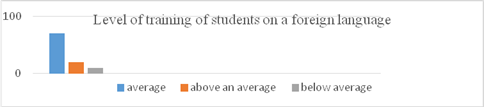
70% of teachers note that level of training of students on a foreign language
is an average. 20% define above an average and 10% below an average.
The question of the
available problems which students when studying professional-oriented foreign
language face and teachers when teaching professional-oriented foreign language
was a subject of our further analysis. Most of students note that they
understand language, but can't speak in it. In many groups students have
different levels of knowledge of a foreign language and it complicate training
process. As it was told above, studying professional-oriented foreign language students
have to own already the B2 level on a foreign language. But at many faculties
the level of knowledge of students doesn't correspond to this level. And many
of these students don't try to increase the level of knowledge of foreign
language independently. All this brings to split-level groups. Also teachers
note that most of students possess terminology and information on the future
profession insufficiently. This results from the fact that by curricula students
at many faculties study professional-oriented foreign language in the 3rd
semester. And subjects by their specialties they study on the 3rd course.
Process of training of professional-oriented foreign language is complicated by
that, on some specialties of faculties shortage of specialized literature in a
foreign language is observed.
The analysis of results of a research
allowed us to draw the following conclusions:
1. The requirement of time and the
labor market is training, able to use adequately a foreign language in the
professional activity that staticizes foreign-language training of future
specialists in the conditions of higher education institution.
2. In this regard the role of the
subject "The Professional Oriented Foreign Language" in the
conditions of high school preparation increases that assumes comprehensive
consideration of the questions directed to efficiency of training process and
to a resulting effect.
3. Revealed within questioning of
students and teachers of a problem of training process of professional-oriented
foreign language (shortage of specialized literature, split-level language
knowledge of students, etc.) require the further solution.
Literature:
1. Образцов П.И., Иванова О.Ю. Профессионально-ориентированное
обучение иностранному языку на неязыковых факультетах вузов. Орел: ОГУ, 2005.
114 с.
2. Государственная программа развития
образования Республики Казахстан на 2011-2012 годы. г.Астана, 7 декабря
3. Государственный общеобразовательный
стандарт образования Республики Казахстан, 2009.
4.
Концепция развития иноязычного образования Республики Казахстан. — Алматы,
2004. — 20 c.