Математика/4.Прикладная математика
O.F. Ryaboshtan, Ph.D. A.M. Milenin, Ph.D. S.M. Skofenko
Kharkov National Technical
University of Agriculture after P. Vasilenko
Construction
surfaces of gas turbine blades of the plurality of the envelope for the given
conditions
Let be a set of surfaces
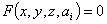 ,
,  (1)
(1)
Surface corresponding to the given
initial conditions, constructed overlay  links to the parameters and conduct of the envelope
obtained
links to the parameters and conduct of the envelope
obtained  surfaces.
As initial conditions (differential
geometric elements and conditions) will be considered:
- curve (surface must be incident to her);
- surface (the desired surface must be tangent to it);
- linear strip (surface must be incident to the curve
carrier strip and normal equipment must be normal to the surface);
- band II order (except meet the requirements of the preceding
paragraph must match the second partial derivatives of the strip and the
surface).
If the initial conditions as curve
 ,
,  ,
,  (2)
(2)
It is necessary to fulfill two
conditions. Conditions incidence requires that equation (2)
satisfying (1), ie,
 =0, (3)
On the other hand, the tangents to
the curve (2) should be perpendicular to the surface normal (1)
 , (4)
, (4)
where the  ,
,  ,
,  - partial derivatives
  calculated under the condition (2).
  ,
,  ,
,  - derivatives on
  . Equation (4) is equivalent to differentiation (3) with
respect to
. Equation (4) is equivalent to differentiation (3) with
respect to  , the ones
  . For surfaces
  - parameter set (1) is necessary from the equations
(3) and (4) eliminate the parameter and determine a constraint equation
- parameter set (1) is necessary from the equations
(3) and (4) eliminate the parameter and determine a constraint equation
 , (5)
, (5)
so that  curve gives
  equations (5) of which is dependent
  parameters of one and the envelope is determined.
If the initial conditions given
surface
 , (6)
, (6)
which should cover the desired
surface, the equation for the relationship between the parameters must be based
on the condition that the coordinates of surface normals (1) and (6) along the
line of contact, ie,
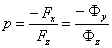 ,
(7)
,
(7)
where the  and
and  - coordinates of the normal vector.
According to the scheme of Monge
equations (1) and (6) and (7) are excluded coordinates  ,
,  ,
,  the contact point. Obtain
 . (8)
. (8)
It is easy to see that the surface
of a variety of (1) can be provided to the touch  surface, which gives
  (8) between
  parameters. As before, we find the dependence
  one parameter, for example,
  , substitute them into (1) and define the envelope.
Suppose that the initial conditions
are given as a linear strip, e.g., the curve (2) in which each point is given
the normal to the desired surface.
 ,
,  , (9)
, (9)
where the  and
and  satisfy linear strip
 . (10)
Linear belong lane surface if the
curve - the carrier belongs to the surface that gives an equation (3), and
surface normals, i.e.
 ,
,  . (11)
Thus, each fitted curve gives the
relationship between equations 3 and the parameters for the surface from  - parametric set (1) must have
  linear strips, which is possible in the odd
  .
.
For example. With a plurality of
 (12)
(12)
get a surface incident strip 
 ,
,  ,
,  . (13)
The solution.
1. The condition of the incidence
curve  the desired surface
 (14)
(14)
2. Match the normal coordinates
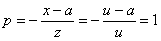 ,
,  , (15)
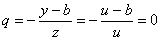 ,
,  . (16)
3. From (14), (15) and (16)
 . (17)
4. Equation (12) with (15), (16)
and (17) has the form
 . (18)
5. A one-parameter set (18) fully
satisfies the conditions of existence of the envelope. Therefore, differentiating (18) with respect  and are excluded from the equation and (18) the
parameter
and are excluded from the equation and (18) the
parameter  we have the final equation of the required surface
 (19)
(19)
Note that the initial conditions in
the form of linear strips may be formulated somewhat differently: by using the
set (1) to construct a surface tangent to the surface  along line
 ,
,  (20)
(20)
In this case, the curve (20) is
overridden in parametric form (2), and the coordinates along the normal curve
determined using surface  .
.
Let the initial conditions are
given band II order, ie, curve (2) equipped with normals (9) and second partial
derivatives
 ,
,  ,
,  (21)
(21)
in equations of the second order
band
 ,
,  . (22)
For obtaining a surface of a plurality
of (1) using a procedure II band necessary incidence of band I of the order
that gives the equation  and
and  , the differential conditions II. This means that equation (4) under the condition (2),
(9) and (21) it is necessary to eliminate the parameter
, the differential conditions II. This means that equation (4) under the condition (2),
(9) and (21) it is necessary to eliminate the parameter  using one of equations (4) or (11) obtain
  .
.
As you can see, the job-order band
II allows to make 3 constraint equation parameters  ,
, 
 , so that for a plurality of surface
(1) must be set
, so that for a plurality of surface
(1) must be set  bands II order that it is possible for the values
 ,
,  . (23)
Similarly, we can as the initial
conditions set the band III of the order, but a special reason to do so, since
almost second order smoothness is sufficient for most tasks.
Note that equation (11) are
integral equations (4) and the equation (1) is an integral surface (more
precisely, a plurality of them) as (11), and to (4), so that the execution
conditions specified differential at the solution stated technique is
guaranteed.