Maussymbayeva D.K., Master of ecology
Innovative University of Eurasia, Kazakhstan
Constructed wetlands for wastewater treatment
Annotation.
The
constructed wetlands are used for wastewater treatment. There are surface flow
constructed wetlands, subsurface flow with horizontal flow constructed wetlands
and subsurface flow with vertical flow constructed wetlands. Wastewater is
treated by adsorption, filtration, ion exchange, denitrification and other
processes within aerobic, anaerobic and anoxic conditions found in the
wetlands. The constructed wetlands are proved as effectual tool for wastewater
purification of different influent quality.
Key
words: constructed
wetlands, wastewater treatment, surface flow, subsurface flow.
Wastewater is
inevitable part of humans’ life in cities, rural area, industry and
agriculture, which requires treatment. There are different methods for water
purification and one of them is constructed wetland. The advantages of the
constructed wetlands are that they can be constructed under various climatic
conditions and for different quality of the influent.
Constructed
wetlands imitate natural wetlands frame for wastewater treatment. The main
features of constructed wetlands are macrophytes, root media, soil and water.
Wastewater is treated by ion exchange, filtration, adsorption, absorption,
nitrification, denitrification, sedimentation, precipitation, oxidation and
reduction processes in the wetland [1].
Macrophytes are
able to promote the disintegration of wastewater, eliminate pathogenic
microorganisms and pollutants. There are different plants that possess such
property, however the ordinary reed (Phragmites australis) and the reedmace
(Typha latifolia) are specifically
efficient. Both plant species have a large biomass: aboveground and beneath the
soil surface. Roots develop well vertically and horizontally creating a big
surface area, thus, the spacious rhizome systems have a good ability to absorb
nutrients and ions. Aerobic microorganisms exist around rhizosphere in a root
zone and anaerobic microorganisms are located below those soil layers. Also,
those pollutants are extracted by natural filtration in the substrate media
[2].
There are
floating, submerged and emergent plants used in the wetlands. Soil or gravel
are utilized as a substrate for root growth of macrophytes in subsurface flow
wetlands. Pretreated wastewater passes substrate media by gravity, horizontally
or vertically, where it contacts with microorganisms living in conjunction with
the substrate and macrophyte roots [3].
Constructed
wetlands are effectual in treating different types of pollutants such as:
nitrogen, phosphorus, organic matter, organic chemicals and pathogens,
adsorption of heavy metals, through a complex interrelated system of
vegetation, bulk water, media and microorganisms.
Design of
constructed wetlands comprise surface flow constructed wetlands, subsurface
flow constructed wetlands with horizontal flow and subsurface flow constructed
wetlands with vertical flow, single or multi stage treatment plants.
Surface flow
wetlands reside flat basins where water streams at low velocities within and
atop the substrate, similar to natural marshes. The channels media usually
include a mixture of peat or clay based soils, gravel, shredded rock [2].
Wastewater run
vertically or horizontally through the substrate media, consisting of sand,
soil, gravel or artificial media in subsurface flow constructed wetlands
(Figure 1). 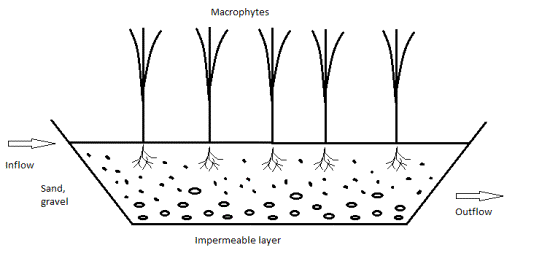
Figure 1-
Vertical subsurface flow constructed wetland chamber
According to the
figure, wastewater contact with the substrate media and plants rhizoshere where
treatment take place. Purification of water in subsurface flow wetlands is more
efficient than in surface flow systems at large dose [2].
The constructed
wetlands have a weakness of the system, which is a slow speed of operation
compare to a general wastewater treatment plant [2].
The roles of
emergent macrophytes in wastewater treatment in surface flow constructed
wetlands are the physical effects of plants (decreasing of wind speed which act
in precipitation of suspended sediments, averts re-suspension), filtration
response, supply of the media for bacterial colonisation and plant metabolism
(plant absorption and setting free oxygen from roots) [1].
Wastewater
purification from nitrogen and organics in ecosystems is particularly
significant due to the following reasons: guideless outlet of nitrogen into
natural watercourse contributes to eutrophication of lakes and rivers;
unpolished organic materials frequently attenuate dissolved oxygen
concentration in surface water channels, resulting in the death of hydrobionts.
Relevant literature demonstrates higher organics disposal fulfillment in
subsurface flow wetlands by contrast with surface flow wetlands, nevertheless,
such systems often demonstrate poor nitrogen removal rate [4].
The
characteristics of wetland media are also significant features which assess the
environmental condition (such as redox potential) within the porous media. To
promote deprivation of nitrogen and organics in constructed wetlands, the media
should hold the following characteristics:
- Ensure co-existence of aerobic and anaerobic or anoxic pores within the
matrix to enforce nitrification, denitrification and organics removal;
- Ensure a carbon source for denitrification.
Organics can be
demolished aerobically and anaerobically in subsurface flow wetlands. Aerobic
process can use oxygen from atmosphere, supplied through convection as wind
action, and macrophyte rhizoshere. Anaerobic process of organics degradation
can proceed within pores of the media, missing oxygen [4].
Different
constructed wetland design may be grouped for improvement of treatment process
efficiency within them, particularly for nitrogen. These combined systems are
often incorporate horizontal subsurface flow and vertical flow constructed
wetlands established in various practicable ways. Whereas nitrification is not
attained in horizontal flow wetlands due to its limited oxygen
transfer capacity, nitrification
of ammonium into nitrate can be proceed
in vertical flow wetlands. Subsequently, denitrifying bacteria can lower nitrate
into nitrogen gas amid anoxic conditions and in the
presence of an organic substrate [5].
Constructed
wetlands demonstrate their efficient treatment alternative for acid mine
drainage, hazardous waste wastewaters, oil refinery wastes, compost and
landfill leachates, agricultural wastes and pre-treated industrial wastewaters
[6].
REFERENCES
1.
Vymazal J. Emergent plants
used in free
water surface constructed
wetlands: A review. Ecological
Engineering (2013).
2.
Shutes R.B.E. Artificial wetlands
and water quality improvement. Environment International 26 (2001)
pp.441-447.
3.
Kadlec R.H. Comparison of free water
and horizontal subsurface treatment wetlands. Ecological engineering 35 (2009)
pp. 159–174.
4.
Saeed T., Sun G. A review on
nitrogen and organics removal mechanisms in subsurface flow constructed
wetlands: Dependency on environmental parameters, operating
conditions and
supporting media. Journal of Environmental Management 112 (2012) pp.
429-448.
5.
Avila C., Garfi M., Garcia J.
Three-stage hybrid constructed
wetland system for
wastewater treatment and reuse in warm climate regions. Ecological Engineering
61 (2013) pp. 43-49.
6.
Constructed wetlands to treat
wastewater. Wastewater gardens
information sheet IS20120105. pp. 1-26.