Snizhko Ye.M.,
Palamarchuk Yu.A., Botsva T.O.
Dnipropetrovsk
National University named after Oles Honchar
ENERGY
EFFICIENT ALGORITHMS BASED ON NODE STATE MANAGEMENT IN WIRELESS SENSOR NETWORKS
Introduction
Wireless sensor networks (WSNs) are ones
of the most widely used and rapidly developed technologies. Typically, WSNs are
distributed measurement systems consisting of a large number of measurement
units deployed over a wide area; each unit is a low-power device that
integrates processing, sensing and wireless communication functions. Units
acquire information from the
surrounding environment and, after a possible but generally not required local
processing, send arrays of
measurements to one or more collection points i.e. base stations for further
data interpretation. As one of potential scenarios, environment monitoring
application can particularly benefit from this technology as WSNs allow a long-term data collection at
those scales and resolutions that are
difficult
to achieve with traditional data gathering techniques. The number of WSN applications has increased and expected to increase even more in future. But energy consumption still
remains the major obstacle for
further exploitation of this technology, even though batteries can be possibly recharged (e.g. solar energy batteries).
Energy saving approaches for WSNs
generally assume that data gathering and processing have an energy consumption significantly lower
than that of communication (transferring data array to the base station) [1].
But numerous recent studies proved that this assumption does not work for a
number of practical applications, where sensors may consume even more energy than the radio [2]. Thus we need an approach for
power management on a node level that, however, still can support network-level
requirements such as fault tolerance. Dynamic management of a node state can
significantly decrease energy consumption in an idle mode, different
configurations of a sleep mode and all parts of the node duty cycle that don't
require maximum of performance.
Theory
A wireless node is battery operated and
thus energy constrained. To maximize the sensor node’s lifetime after its
deployment – the moment when the WSN becomes unattended, all it's life cycle
parts including circuits, architecture, algorithms, and protocols— must be
energy efficient. Energy savings can be reached by using dynamic power management (DMP) that generally means that the sensor node is shut down
if no events
(in particular, for sensing) occur. Such event-driven power consumption is
effective to maximize battery life. Also the node should have an energy
scalability - a possibility to extend the lifetime at a cost of sensing accuracy by decreasing either sensing
frequency or transmitting frequency (that lowers accuracy of the whole
network). Different energy-scalable algorithms and protocols exist for these
energy-constrained operating modes.
[3]
Sensing applications have a wide range of requirements that leads to an idea that protocols and
algorithms are to be modified for each
particular
WSN application. In this
article we propose an OS-directed power management technique to improve the
energy efficiency of sensor nodes without significant loss in performance, data
accuracy and fault tolerance.
Fig. 1 represents a WSN node and its
functional parts: embedded sensor, analog-digital converter, a processor (in
our modeling experiment we consider StrongARM SA-1100 as a hardware implementation), memory and the radio (both
transmitter and receiver). The node is running under a micro-operating system (μOS) that is responsible for power management. Also in
our particular case we consider a network with cluster topology and nodes with
a random uniform distribution.
The core point of dynamic power management approach is to create an array of node modes for each phase of a life cycle and a bunch of policies for mode-to-mode transitions. We should not only carefully distinguish sleep and idle modes, but also apply different energy grades for active/working state, considering that maximum performance and CPU load may not even occur through the whole duty cycle. Dynamic voltage scaling can be used to reduce operational frequency as low as enough to process the data array between two data gathering/transmitting phases.
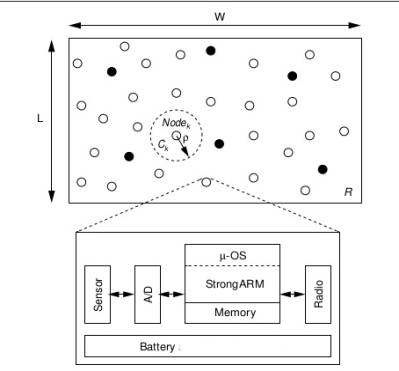
Figure 1. WSN node structural
parts
Modeling experiment
In this particular
experiment we focused on sleep mode usage for energy saving. We considered five
both possible and making practical sense for this particular implementation
distinguished sleep modes.
Table
1
Distinguished
sleep modes
|
Mode |
Processor |
Memory |
Sensor |
Radio |
|
SM1 |
Active |
Active |
On |
Transmitter, Receiver |
|
SM2 |
Idle |
Sleep |
On |
Receiver |
|
SM3 |
Sleep |
Sleep |
On |
Receiver |
|
SM4 |
Sleep |
Sleep |
On |
Off |
|
SM5 |
Sleep |
Sleep |
Off |
Off |
Also an event term is
introduced as a moment when a sensor receives a signal above some predefined
level and this event happens within the sensor visibility radius R.
It's obvious, that SM5 mode has the
lowest possible energy consumption but is also the only one with sensing
function turned off. Thus this mode should be eliminated for all real systems
where each and every event is critical (and should never be missed) and occurs
only once and within only one node R. In other cases a probabilistic approach
should be introduced for transitions to SM5 mode. The time for which the node K
is switched to SM5 is proportional to the probability that no event happens on
node K within this time frame. The probability equations are either
field-specific, predefined and known or calculated on μOS level based on
node K detection statistics.
Using TinyOS embedded simulation
framework a model for a WSN with N=1000 nodes uniformly distributed over area
with L=100 m and W=100 m (see Fig.1), R=10 m has been built. The event behavior
over the entire sensing region was as Gaussian spatial distribution centered
around (25, 75). A probabilistic algorithm for transitions from SM1 to SM5 mode
was applied.
Figure
2. (a) event distribution (b) energy consumption distribution over nodes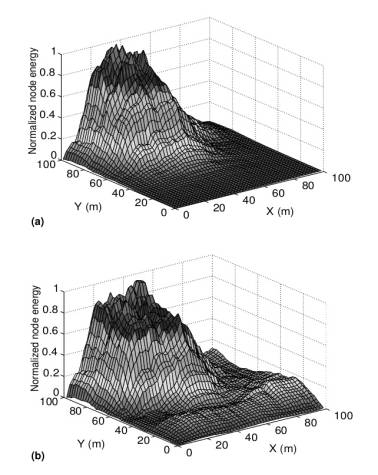
Without dynamic power management for all
nodes energy consumption would be equal.
Now consider the fraction of events missed (while node in SM5 mode) for corresponding energy consumption (normalized energy per one node) (Fig.3)
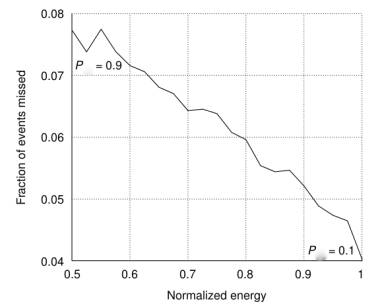
P stands for the probability to miss an
event on node K calculated on μOS level for Gaussian event distribution.
Those values for missed events are suitable for almost all environment
monitoring WSN applications [3].
Conclusion
Energy efficiency was reached by using
node-level dynamic mode management with probabilistic approach to mode
transitions. The results showed that this approach allows to adjust power
consumption to real sensing tasks without significant data accuracy decrease.
Distinguishing sleep modes more accurately and applying the same mode
transition policy we can reach minimal energy consumption for each particular
WSN duty cycle.
References
1. W. Heinzelman, A. Chandrakasan, H.
Balakrishnan, “Energy-Efficient Communication Protocol for Wireless Microsensor Networks”, Proc. Hawaii International
Conference on System Science (HICSS-33),
January 2000
2. Rezaei. Zahra, Mobininejad Shima.
“Energy Saving in Wireless Sensor Networks”, International Journal of Computer
Science & Engineering Survey (IJCSES) Vol.3, No.1, February 2012.
3. C. Alippi, G. Anastasi, C. Galperti, F. Mancini, M. Roveri, “Adaptive Sampling for Energy Conservation in Wireless Sensor Networks for Monitoring Applications”, Proc. IEEE International Workshop on Mobile Ad hoc and Sensor Systems for Global and Homeland Security (MASS-GHS 2007), Pisa (Italy), October 8-12, 2007.