М. FULOP1, О.KOLYUKH2, Yu.
GORYACHIKH3
Psychological
Peculiarities of a Woman’s Behavior in Crisis Situations
М. FULOP1 - Ph.D,
Professor, Eötvös Loránd University, Institute of Psychology, scientific director, Institute of Cognitive Neuroscience and
Psychology, Hungary, Budapest
О.KOLYUKH2
- candidate of
psychological science, Associate Professor of psychology and Pedagogy of
Pavlodar State University named after S. Toraigyrov
Yu. GORYACHIKH3 -
Assistant Professor, Pavlodar State University named after S. Toraigyrov
Woman’s behavior in crisis situations starts to be a point of great
interest in psychological science. A wide range of notions that characterize
life difficulties such as: extreme situation, difficult situation, crisis
situation, critical situation, traumatic event, tense situation are used while
performing psychological analysis of an event.
Each of the abovementioned notions focuses on specific content of
characterized phenomena [1, 149].
B.D. Karvasarskiy considers “crisis” as an acute emotional state that
emerges while blocking hormic activity of a man as a discrete moment of
personal development [2, p. 233]. It is
characterized by inability of a man to overcome the crisis by the ways known
from his experience.
The manner of going through life crisis together with normative and
age-specific ones depends directly on character formation of a person. The character formation defines the way a
person choses to cope with his need.
Development crisis and life crisis for a woman are connected with the
peculiarities of existence and constant changes in her life. New physiological and psychological qualities
often demand changes of the whole organism together with the changes in
personality and it is in itself can be difficult and painful.
It is hard when a person doesn’t overcome subsequent stage of a crisis
and generates them instead. Unfortunately, multiple crises are usual things and
with a great probability they cause serious problems. Before adapting to the first stressor, further development of a
crisis demands resources but the problem is that these life recourses are
already exhausted.
With the purpose
of studying (researching) psychological condition of women in crisis (stressful
situations) 100 women at the age from 25 to 40 who sought for social and
psychological help at PSE with REJ “Pavlodar City Policlinic No.1” were
analyzed by us.
To research and define their crisis state we used characterological
questionnaire of K. Leonhard – H. Smishek [5, p. 97]. Accentuation of personality traits classification offered by K.
Leonhard was taken as a basic instrument for our studies [5, p. 78].
This method was taken as according to the theory of accentuated
personalities there are traits of character that can be developing in both
positive and negative directions. The character peculiarities in accentuations
manifest themselves only in definite situations and under definite conditions
apart from standard ones. Moreover
every type of accentuation has its own ways of behavior. If they are vividly
expressed than they make impact of a personality and furthermore they can bear
pathologic character destroying personality.
If the traits intensely expressed a person adjusts to life badly. However, these traits also define
person’s originality, uniqueness that makes him different from others. The accentuation types give the opportunity
to foresee the factors that can cause psychogenic reactions leading to
maladjustment that in its turn open the perspectives for future psychological
rehabilitation.
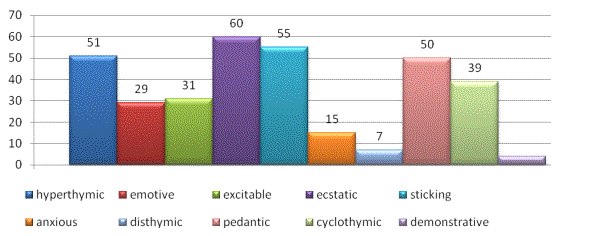
After revealing accentuations of traits that women can have the
following results available in graph 1 were
received.
Picture
1. The degree of expressiveness of traits accentuation in women, %
Studying the results indicated in picture 3 we can say that there are
three most expressive types of accentuations in women: ecstatic, sticking,
hyperthymic, pedantic.
Hyperthymic type of accentuation is expressed in 51% of women. These
women are often in elated mood even without influence of any external causes. They
are sociable, talkative, active and optimistic even facing obstacles. High spirits help them overcome
difficulties which they take easily considering them temporal and transient.
Sticking type of accentuation is
expressed in 55% of women. It is in their nature to have long-lasting emotional
experience together with long-lasting and exciting feelings towards their
success and failure. They are touchy,
sensible, susceptible, rancorous and sluggish. This type is characterized by
the following traits of character: unsociability, estrangement, low
communication needs, low emotional contact with other people, lack of internal
unity, coldness, restraint.
Pedantic type of accentuation is expressed in 50% of women. They are
characterized by carefulness; wish to order things, indecisiveness,
cautiousness, unwillingness and inability to accept swift changes. They
hesitate a lot and think everything over carefully before making decision. They are punctual, responsible,
farsighted and prudent.
Ecstatic type of accentuation is expressed in 60% of women. Their basic
characteristics are: inner
susceptibility, tendency to react emotionally on a situation; they are raptured
and saddened easily; they often argue but rarely bring the arguments to serious
conflicts.
Emotive type of accentuation is expressed in 29% of women. This group is
highly sensitive, soft-hearted, sympathetic and kind. They prefer in-crowd communication. Having set the contact with
people they like they are quick to understand them.
Anxious type of accentuation is expressed in 15% of women. These women
are shy, constantly alerted and timid. They are characterized by lack of
confidence and self-confidence, anxiousness towards their presumable failure,
strong emotions towards failures and undue fatiguability. It is expressed in
lack of communication as high level of anxiety prevents them from open and
frank communication and brings the element of suspiciousness and groundless
fears.
Cyclothymic type of accentuation is expressed in 39% of women. These
women are characterized by frequent changes in mood from happy to sad without
any reason so changes the way of communication with others. One can observe
alternate changes in working efficiency, life energy and mood.
Demonstrative type of accentuation is expressed in 4% of women. Ultimate
egocentrism, insatiable craving for attention to their personality, shallowness
of emotional expressions, external effect orientation, “posing” these are basic
characteristics of this type [7. p.49].
It is expressed in such traits of character as self-praising, vanity,
presentation of herself as a central figure in any situation.
Excitable type of accentuation is expressed in 31% of women. These women
are characterized by impulsiveness, willpower (need for power), inducement to flatter, hypocrisy,
sanctimony. They are rancorous, vindictive, quarrelsome, jealous, small-minded,
captious and peevish.
Dysthymic type of accentuation is expressed in 7% of women. These women
are focused on gloomy, sad side of life; they are pessimistic, highly fatigued
and irritable. They are characterized by lack of self-confidence, high tension
while overcoming difficulties. All these traits are manifested in behavior,
communication, self-perception, life and attitude towards other. Thus all
abovementioned data give the right to suppose that there is no stable ways of
women’s reactions in the process of intercommunication with others.
Also we studied women’s self-concept while in crisis situation. To study
the peculiarities of women’s self-concept we used method for studying
self-concept of personal qualities created by A.A. Rean (modified test of
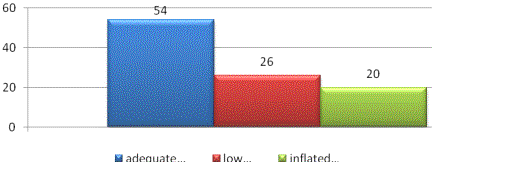
Budassy). We received the following results introduced in picture
2.
Picture
2. Peculiarities of women’s self-concept, %
As it is seen from the diagram (picture 2) 54% of women have adequate
self-concept. These women are realistic in assessing their abilities and
potentialities. They treat themselves critically setting real goals they can
fulfill. Their behavior is basically
unconflictive and constructive.
Twenty percent of women have inflated self-concept. It means they have
an idealized image of themselves. They have a clear concept about personal
traits they have; their perception of reality is emotional; all failures are
considered as someone’s mistake or unfavorable circumstances; fair criticism is
taken as finding-faults. In case of failure they try to make another attempt.
Twenty six percent of women have low self-concept. They are lack of
confidence, shy passive, excessively demanding to themselves, boring,
contentious. They see themselves only
as a person with lots of drawbacks, tend to overestimate their difficulties,
and try to avoid situations where they can approve themselves, lonely and
pessimistic.
Having studied peculiarities of women’s self-concept it also helped to
reveal psychological conditions of women in crisis situation.
With the help of “Personality profile of crisis” methodology we defined
personal profile of crisis the women were in together with complex character of
crisis they were experiencing as it touched their physiological and
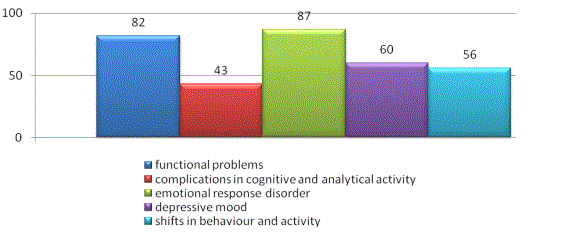
psychological aspects. The results of the diagnostics are introduced in a
diagram (picture 3).
Picture
3. Personal Profile of Crisis for Women, %
Thus as it is understand from the diagram in picture 3 we found out not
only personal profile of crisis experienced by women but also complex character
of its overcoming that touches women’s physiological and psychological
aspects.
So we see that the most vividly expressed indicators are emotional
response disorder (87%) and functional problems (82%). It proves that women
have vegetative system functional disorder, respiration disturbance and
gastrointestinal tract functioning disorder and difficulty sleeping together
with such emotional reactions as anxiety, wrath, shame, guilt, affective flattening,
pusillanimity and
emotionalism.
Such indicators as “depressive mood” (60%), “shifts in behavior and
activity” (56%), “complications in cognitive and analytical activity” (43%) are
less expressed. It means that depressive mood, such shifts in behavior and
activity as circumventing a problem, preoccupation with problems, problems with fulfilling household and
professional chores, together with such complications in cognitive and
analytical activity as attention, perception, thinking and memory disorders can
be registered in women.
Emotional
condition dynamics depends on needs and interests dynamics as these conditions
are functionally connected with them. Emotions beget
different types of behaviour strategy
of a person. Thus, studying personal peculiarities of women in crisis
situations make it possible to work out an effective program for correcting and
rehabilitating crisis situations.
References
1.
Бэрон Р., Ричардсон Д. Агрессия [Текст] : научное издание / Р.
Бэрон, Д. Ричардсон - СПб.: Питер Ком, 2008.
2. Малкина-Пых
И. Г. Психологическая помощь в
кризисных ситуациях [Текст]
: научное издание / И. Г. Малкина-Пых – М.: Изд-во Эксмо,
2005. – 960 с.
3. Малкина-Пых И. Г. Возрастные кризисы
взрослости [Текст] : научное издание / И. Г. Малкина-Пых – М.: Изд-во Эксмо, 2005. – 416 с.
4.
Бурлачук Л. Ф., Коржова Е. Ю. Психология жизненных ситуаций [Текст] : научное издание / Л. Ф. Бурлачук, Е.
Ю. Коржова - М.: Российское педагогическое агенство, 1998. - 263 с.
5. Познание человека человеком (возрастной,
гендерный, этнический и профессиональный аспекты) /Под ред. А.А.Бодалева,
Н.В.Васиной. – СПб.: Речь, 2005.
6.
Кочюнас Р. Психотерапевтические группы: теория и практика [Текст] : научное издание / Р. Кочюнас - М., 2000.