Mechanical engineering
INVESTIGATION OF STEEL 45
APPLIED LAYER PROPERTIES DURING ELECTRO-SPARK ALLOYING
S. Luzan, O. Gorbachevskaya
Kharkov National Automobile and Highway University
The
dependences of the mass transfer coefficient, roughness and thickness of the
coating during electro-spark alloying of the steel surface on the duration of
treatment are specified. A mathematical model of surface roughness change
during electro- spark alloying is obtained.
Key words: electro-spark alloying,
surface, electrode, anode, cathode, mass transfer, surface roughness, coating.
I. Introduction. Adhesion strength of the
flame coating with the substrate depends on the quality of sprayed surfaces preparation
and to a greater extent on its roughness. Based on the analysis of technical
characteristics of the main methods used for surface treatment prior to the
deposition of gas-flame coating there was selected the method of spark alloying
(ESA) [1]. In order to obtain the desired sprayed surface roughness providing
the predetermined adhesive strength of the coating with the part, one needs to
determine the dependencies of surface roughness on the modes and duration of
its processing.
Scientists
A. D. Verkhoturov, G.V. Samsonov, B. R. Lazarenko note that the nature of the
process of electro- spark alloying is determined by the properties of electrode
materials, namely their erosion resistance [2,3,4]. The intensity of anode
material deposition to the cathode and the alloying layer properties under
otherwise equal conditions depend on both the electrodes material
properties and the duration of
treatment. In addition, the dynamics of surface layers formation on the cathode
is characterized by the fact that the transfer rate of the anode material on
the cathode is maximal during the initial period of the process, and further –
is reduced. The surface of the applied layer has developed roughness consisting
of alternating projections and of the alloying material and recesses in the
substrate; provided that the nature of roughness varies depending on the
duration of treatment. The behavior of competing processes of formation and
destruction of layers with the prevalence of the latter with increasing of the
processing time leads to limiting of the formed layer thickness.
The
analysis of investigations results of the ESA process showed that the roughness
of the treated surface depends on a great number of factors and the most
reliable quantitative data for specific treatment modes can be obtained only
through experimentation.
II. Research objective: to investigate the
following properties of electric-spark coatings: surface roughness, thickness
of the deposited layer and micro-hardness. Determine the dependences of roughness
change on the duration of treatment during steel alloying by 45 different
materials. Define the rational modes and duration of spark alloying of steel
substrates before flame spraying.
III. Summary of the basic material. Study of ESA modes
effect on surface roughness, micro-hardness and thickness of the deposited
layer was performed using specialized installation "Elitron-50." The
processing of samples made of steel 45 was performed by a vibrating electrode
manually, the speed of electrode moving did not exceed 0,07-0,09 m/min. The
alloying electrodes were made of the following materials: nichrome H20N80,
St2kp, T15K6.
Table 1
shows the results of the study of the value of finished surface roughness
during 4 minutes depending on the ESA mode for different anode materials.
Table 1 – Modes of alloying and surface roughness (t = 3-4 min/sm2)
|
Modes |
The
operating voltage on the electrodes, V |
Power of short-circuit current, А |
Surface roughness Ra, μm |
||
|
Electrode- anode H20N80 |
St2kp |
T15K6 |
|||
|
Soft |
9-20 |
3,5-4 |
3,63 |
4,33 |
3,56 |
|
Average |
20-50 |
4-5,5 |
5,86 |
6,99 |
5,55 |
|
Hard |
50-90 |
5,5-10 |
6,25 |
7,53 |
5,87 |
Table 1
shows that the greatest surface roughness is provided by the "hard"
mode treatment, so further studies were carried out for this particular mode.
The
roughness and thickness of coatings are also determined by the nature and
intensity of mass transfer of anode material to the cathode and depends on the
duration of treatment. To determine the nature of roughness Ra change and the thickness δ of the coating layer were applied to samples with the
area of 1 cm2 during 1 min, performed repeated measurements for 8-10
times to determine the time interval of treatment within which there occurs
formation of a layer with maximum surface roughness. The surface roughness was
evaluated using the TR-200 device, the thickness of the deposited layer – by
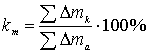
PMT-3 micro-hardness measurement device. The mass transfer coefficient was
defined as the ratio of the cathode weight gain to the anode mass change:
|
|
|
(1) |
 .
.
The
thickness and hardness of the alloy layer at steel surface treatment are shown
in Table 2. The hardness of the alloy layer is considerably higher than the
hardness of the framework made of steel 45 (HB 207), the surface hardening
coefficient  is defined as the ratio of the alloy layer hardness to the
hardness of the alloy layer
is defined as the ratio of the alloy layer hardness to the
hardness of the alloy layer  to the hardness of
the alloy material
to the hardness of
the alloy material :
:
|
|
|
(2) |
 .
.
Table 2 – Thickness of the alloy layer and the
ratio of surface hardening during alloying of steel 45 (t = 8-10 min/sm2)
|
The material of the anode- electrode |
Coating thickness, mm |
Micro-hardness of coating, kgf/ mm² |
Coefficient of hardening kу |
|
H20N80 |
0,061 |
240 |
6 |
|
St2kp |
0,052 |
170 |
4,5 |
|
T15K6 |
0,068 |
270 |
8,1 |
Figure
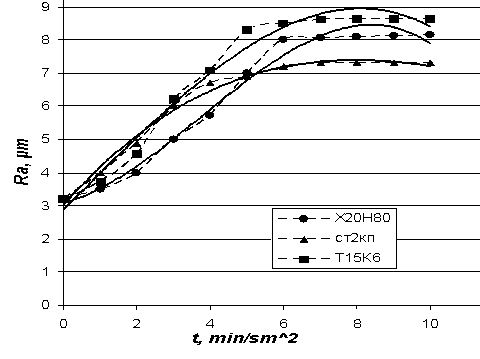
1a shows the roughness dependence during steel 45 alloying by different
electrodes- anodes on the duration of treatment. After fitting of the
experimental curves we obtain the equations representing the polynomial
functions of degree 3:
-
for steel 2kp
|
|
|
(3) |

-
for T15K6
|
|
|
(4) |

-
for H20N80
|
|
|
(5) |

The
correlation coefficients are: R1 = 0, 9796; R2 = 0, 9859;
R3 = 0, 9901. Expressions (3, 4, and 5) are mathematical models that
set the dependences of roughness of treated surfaces depending on the duration
of electric-spark alloying.
The
generalizing mathematical model of surface roughness change during ESA has the
following form:
|
|
|
(6) |

wherein
A, B, C, D – coefficients which are determined by the material of the
electrode-anode.
|
a) |
b) |
c)
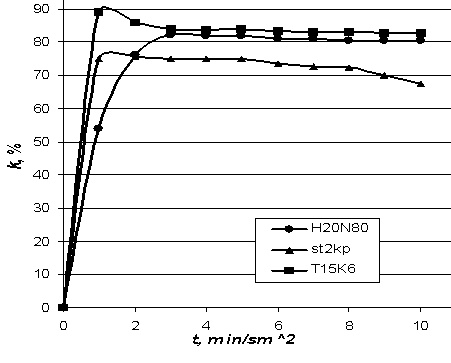
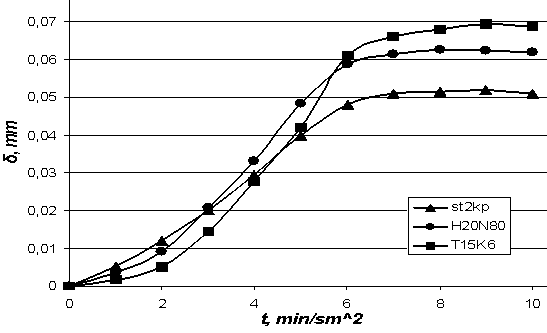
Figure 1 – The dependence of the surface
roughness (a), the mass transfer coefficient (b) and the thickness of coating
(c) on the duration of ESA
From
the analysis of experimental dependence (Fig. 1) one can see that the formation
of the surface layer during ESA for the investigated electrodes is similar and
consists of 3 stages. In the first stage of treatment (0-3 minutes) there
occurs bedding of surfaces and formation of a discrete alloying layer with low
roughness, nevertheless the increase in weight and thickness are insignificant.
The alloying layer is a combination of components of the substrate material and
the alloying electrode.
Next
there takes place the second stage (3-6 minute of treatment) when an intensive mass
transfer with formation on the surface of a uniform coating layer occurs. In
this case, the anode electrode does not interact with the substrate but for the
most part with the formed alloyed layer. This process continues until the third
stage (6-10 minutes of treatment) when the weight gain of the cathode is hardly
observed, there occurs over saturation of the surface with anode material and
partial erosion of the cathode, and further the surface roughness does not
change.
IV. Conclusions:
1. The
dependences of the change of roughness and thickness of coating during
electro-spark alloying of the steel surface with various materials on the
duration of treatment are specified.
2. It
was determined that the formation of the surface layer at ESA for the investigated
electrode materials is similar. The rational mode of alloying before the flame
spraying is the hard mode, which allows the surface roughness equal to Ra = to 6...9 mm, which meets the
requirements for spraying of gas-flame coatings.
3. The
most effective treatment duration is the interval of 3-6 min/sm2
when there is formed a layer with high hardness and high roughness Ra avoiding erosion of the base.
Sources:
1. Лузан С.А. Анализ способов подготовки поверхностей деталей для напыления
газотермических покрытий / С.А. Лузан, О.М. Горбачевская, В.М. Биша. //
Механіка та машинобудування. – 2012. –№ 1. – 124-128 с. 2. Верхотуров А.Д.
Технология электроискрового легирования металлических поверхностей. – К.:
Техника, 1982. – 181 с. 3. Самсонов Г.В. Электроискровое легирование
металлических поверхностей / Г.В. Самсонов, А.Д. Верхотуров, Г.А. Бовкун, В.С.
Сычев. – Киев: наукова думка, 1976. – 219 с. 4. Лазоренко Н.И. Электроискровое
легирование металлических поверхностей. – М.: Машиностроение, 1976. – 292 с.