Starovoytov Michael Karpovich,
Doctor of Economic Sciences, Professor,
Academy of Natural Sciences, President
of LLC "ORTEH"
Volgograd
e-mail: ortech@mail.ru
Starovojtova Yana
Candidate of
science.,
Associate Professor of Volgograd
State Technical University,
Volgograd
e-mail: felindra@mail.ru
The priority directions of development of the country’s economical potential.
abstract: The article examines the long-term development
of the Russian economy, the main results of the development of the industrial
sector, the reasons for the decline in industrial production of in 2012, assesses the industrial complex of
the Volgograd region, justified its main course of modernization and public
support, formed the main stratagems of industrial development of the Volgograd
region to 2020.
Key words: scenarios for
the Russian economy, modernization, the
mechanism of supporting of industrial production,
faster growth areas, clusters.
Unprecedented challenge of the
coming period Russia is the need for a short term solution to provide a number
of systemic problems in the field of macroeconomics, regional and industrial
development, social welfare. Until the middle of this decade, the country has
provided the establishment of basic legal norms and institutions of market
relations, achieved a high degree of openness of the Russian economy, including
through the WTO accession.
Implementation of the National entrepreneurial
initiatives - road maps in the regulation of customs administration,
construction, access to electricity, registering property, the development of
competition, export support has allowed to identify areas of strategic change.
Selecting a priority of further support innovation: technology platforms and
clusters of information, aerospace, medical technology, new materials,
radiation technology determined the country's competitiveness in the global arena.
The imperative of time - increasing the efficiency of budget spending, will be
achieved by amending the Federal Law number 94, the new public procurement
system management products and services cover the full cycle, from the planning
to the analysis of the results.
Given
the trends in the global economy, expected oil
prices, the Ministry of Economic
Development has developed three main
scenarios for long-term development
of Russia until 2030: conservative, innovative, and forced (Table 1). [3]
Table 1
The main scenarios of long-term development of Russia until
2030
|
Conservative |
Innovative |
Forced |
||
|
Active modernization of fuel, energy and raw materials
sectors, the use of imported technology and knowledge |
Increased investment
activity, the creation of a modern
transport infrastructure, competitive, high-tech industries, the development of the
knowledge economy |
Intensification
of all available factors of economic
growth, improved business climate, the
activation of national savings, increased
government spending on social
development, energy and transport
infrastructure |
||
|
The annual growth rate through
2030 |
||||
|
GDP at 3-3.2%, investment
in fixed assets
- 4.7%. |
GDP at 4-4.2%, investment
in fixed assets
- 5.9%. |
GDP at 5-5,4%, investment in fixed assets - 8.2%. |
||
|
Russia's share of
global GDP by 2030 |
||||
|
Fall to 3.6% |
Increase to 4,3% |
Increase to
5,3% |
||
*based
on site: www.economy.gov.ru.
To
solve the problems of the
country need to accelerate the
pace of growth of 5-6%,
increase productivity by 2 times in 10
years. The country has enough reserves. This availability: serious and gross national
savings (about 20%), industrial capacity (country exports of machinery and equipment by 27 billion dollars,
and can be several times more), small and medium business (which employs about 17 million people. and should
provide revenues 40%).
Today
there is a recession in Russian industrial production (according to the Federal State
Statistics Service, the annual increase in industrial
production in the Russian Federation in 2012 fell to 2.7%).
This is for obvious reasons. Some of the macro factors that adversely affected the functioning of the industry, analysts say: Presidential election campaign, the slowdown of the Chinese economy, the United States and
Europe, the lack of financial resources
for the development of the economy, high interest rates on loans, among mezofactors explaining the drop in industrial production
products to specific enterprises include: difficulty in
financing, lack of funding innovation
and capital investment.
Key
indicators of the
industry of the country in
April 2013goda point to a
clear deterioration of the situation: there
is a decrease
in demand and
an increase in
the share of
surplus stocks. At the same time,
the reserve capacity in the industry can
increase their load up to 30
percentage points.
The
problem of capacity utilization in
the Russian industry
has recently become a topic
of discussion at
the highest level. This
was facilitated by
several circumstances. First,
the most important indicator of industrial
statistics very imperfectly represented in the Federal
State Statistics Service
publications and
for this reason
is rarely used in
the analysis,
and secondly, the World Bank, the Central Bank of the Russian Federation until recently believed that
Russian industry
is working at
maximum capacity,
and measures to stimulate
demand for industrial products are
dangerous, can lead to hyperinflation. [4].
To
confirm the above information we
turn to the data. For example, in
2013, capacity utilization in the
Russian industry
fell in
the I quarter.
up to 64%, which is the
normal seasonal discharge indicator, but rose in
the II quarter.
Only up
to 67%.
At the same time, by industry reserve capacity
differ fundamentally, if the food industry, they account for 23 points (almost a quarter of the equipment stand), the light industry and forest industry may
increase loadig of
30%. Sufficiently large reserves
for growth in the iron (19%),
mechanical engineering (27%) and non-ferrous
metals (16%) [3].
The
current situation in the
economy also has a significant
impact on the industrial complex
of the Volgograd region. At
present, the region has about 4 million businesses
that employ them -
228.4 thousand people. In the structure
of industrial production by volume
of shipped goods of own production and services the largest share: the production of oil products (41.4%), manufacture of basic
metals, fabricated metal products (23.9%), manufacture of food products (10.3
%).
One
of the main problems of the industry in the country and the region is the low level
of productivity and modernization
of the production of certain goods[2].
In
order to create an
effective system of industry management in the region the
Government worked out the Concept of "Development of Industry of the Volgograd region and increase its competitiveness"
for 2013-2020. "As part of this concept provides the funding from the regional budget
of about 300 million rubles for:
- contribute to the modernization and
technological upgrading of enterprises
(interest rate subsidies on loans
to pay part of
the cost of leasing contracts, reimbursement
of expenses related to the modernization,
etc.);
-
improving the environment
for businesses, investment and
innovation in the production (the
creation of the center of the
cluster development, monitoring of existing production sites, forums);
-
providing businesses with
qualified personnel (formation of regional order for the training of workers, establishment of a regional
multi-center application qualifications, competitions "Best in
Profession").
Among
the innovative forms of development of the industrial potential of the region
included: the creation of zones of rapid growth (Volgograd agglomeration with
enterprises of the chemical complex, Kotelnikovo industrial zone with
enterprises on processing of potash ores, Eltonskoy economic development zone
for processing mineral resources), the formation of innovative industrial
clusters : textile, chemical, pharmaceutical, innovation and construction,
transport engineering [4]. Industrial enterprises in the region as priority areas for
development in 2013-2015 marked
projects aimed at improving the
environment, reducing the cost of
raw materials, energy.
At the level of Governments in the region
have been supported investment projects: the expansion of the production of
non-asbestos products - high-temperature thermal insulation fabrics and
reinforcement fabrics and meshes at JSC"Volga plant asbestos technical
products", the creation of the production of polyester tire cord and
industrial yarns, and the construction of a mini-power plant (gas) , the
creation of the production of geotextiles at JSC "Gazprom
khimvolokno", the reconstruction of the rotary kiln at Sebryakovcement
", the production of nanostructured magnesium hydroxide and oxide at
CJSC" NikoMag ", the development of innovation cluster for the
production of magnesium sheets and magnesia refractories based on JSC"
Caustic "and LLC "Volma", modernization of automatic control
units at the branch of JSC "RusHydro," Volga HPS ", the creation
of biological treatment facilities at OJSC" SUN InBev ";
modernization of power equipment for JSC" Volga-FEST ", the
development of hydrocarbon fields JV" Volgodeminoil ", the creation
of the production storage and deep processing of corn grain output of 500 tons
per day at JSC" Novoanninskii Bread Factory ", a comprehensive reconstruction
of production of LLC" LUKOIL-Volgograd ", the construction of ore
processing plant for the extraction and enrichment of potash capacity of 2.3
million tons LLC "EuroChem VolgaKaliy" etc.
Only in the industrial sector
of the economy of the region through to 2020 should be implemented 50 investment projects worth 177 billion rubles. [1].
As a result of the implementation of
investment projects planned to
increase industrial output in the
region (Table 2).
Table 2.
The industrial potential of the Volgograd region
|
|
2013 |
2014 |
2015 |
|||
|
RF |
Volg.reg |
RF |
Volg.reg |
RF |
Volg.reg |
|
|
The index of industrial production
should increase to the previous
year (%) |
3,4 |
4,4 |
3,7 |
4,9 |
3,7 |
5,2 |
To change the situation
in the Russian economy needs institutional reform, public
investment in real production. State
injections into the economy have
three economic objectives: simple
- saturation of the economy with money,
remote - increasing the efficiency of the economy through the development of infrastructure,
education, medicine, perspective -
stimulating technological innovation, the introduction of new scientific and
engineering developments. [6].
In modern conditions,
one of the main directions of development
of the industry is to increase
the efficiency of production, which
in turn may reach through increased productivity. The most important measure of economic efficiency, taking into account the expended resources in
economic activities, the achievements of science management, human capital development, engineering, technology
and science is a
comprehensive indicator of efficiency.
To form an effective system of
enterprise management is necessary not only to assess the criteria, but also in the framework of a balanced scorecard to make changes to the basic projections: finance, marketing, internal business processes, personnel. This
approach allows us to identify the organizational and administrative provisions of the basic
processes in each structural unit
of the enterprise, to provide innovative development.
Let's consider the specific examples.
Volgograd Scientific-Production Association "ORTEH- housing and
communal services" in the market for more than three years.
Among
the partners of the
company: "Lukoil", JSC Company
"EuroChem", the Government of the
Volgograd Region, the Administration of the republics of Chechnya, Ingushetia,
Dagestan, Sevastopol (Ukraine) The company specializes in the production of
equipment for the purification of potable water, industrial and storm sewers;
equipment for natural water purification for drinking water.
Together with the Volgograd State Agricultural University, Volga Polytechnic
Institute, research project of the North Caucasian Institute conducts research
and development company: to improve the operation of mechanical, biological
treatment, purification and disinfection, to identify strengths and weaknesses
of grids used in the model number of products Evrobion; implementation new
technology of sewage treatment and sludge treatment (for dewatering sludge),
the study of the advantages and disadvantages of aerobic and anaerobic sludge
treatment methods, to improve the technology for the production and
purification of natural water for drinking purposes with increased rigidity for
small and medium-sized cities, to improve methods determine the status of
sewage treatment plants in the cities, ways of modernization in Russia. [5].
In 2012 in the "NPO" ORTEH-housing and communal services "was a serial production plants for wastewater
treatment under the brand name EUROBION and EVROBION GRAND (up to 50,000
kub.m.v day), production of modular treatment plants natural water for drinking
purposes "Aquawell-3500" ORTEH-COB-UF-160 with capacity from 5 to 10
000kub.m. a day, prepared in cooperation with the company "Bauer
GmbH" project: "Conservation of technological complex for processing
waste from livestock farms then get fertilizer for crop irrigation."
Used to
install "Aquawell-3500" Membrane separation processes are innovative
water technology trends. Modular installation " Aquawell -3500" with
a capacity of 3,500 m3/day. can be operated in IB, IIA, IIIA, with an estimated
temperature of the outside air to -40 0C., in urban areas (up to 100
thousand.) Volgograd region and regions of Russia. Objects, equipped with
installations " Aquawell 3500" in picture 1.
The
most perspective way of dtveloping housing and communal sector of the country - is the development and implementation of
innovative Russian technology,
equipment.
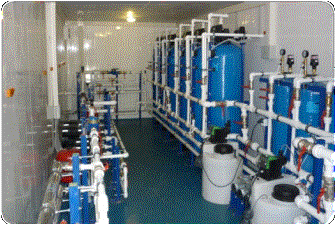
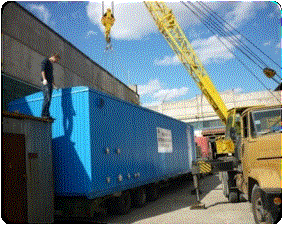
Pic. 1.
Installing modular for Sandibinskogo field
(Russia Tyumen region. Yugra)
According to the concept of
"Russia 2020" to the priority areas of the water sector in the long term include improving technology for potable water and
wastewater treatment, reconstruction, modernization and
new construction of water and sewer facilities, including the use of the most environmentally safe and effective agents for water treatment.
Another example of innovation Volgograd businesses - construction and
equipment company ZAO "ORTEH" in Kalmykia in 2011 ecological
livestock parking Table 3.
Table
3.
The approximate calculation of livestock eco-stop * (in prices
of 2011)
|
№ п/п |
Наименование
name |
Parameters,
characteristics |
number |
amount
of doll. |
|
1. |
Cowshed with free-range feeding-yard by 200
heads of cattle |
One- storied, and the size of 78,0 x12, 0m, |
1 |
78,62 |
|
2. |
Storage
of
feed. |
|
1 |
14,33 |
|
3. |
The covered parking
lot of mechanization |
|
1 |
11,15 |
|
4. |
Construction
of veterinary |
|
1 |
7,96 |
|
5. |
Storage
area for manure |
|
1 |
6,37 |
|
6. |
Residential
house with outbuildings |
single-family,
four-room |
1 |
101,9 |
|
7. |
Wind
Turbine |
10 кВт 10
kW |
1 |
42,35 |
|
8. |
Storage
batteries |
NDF 12V 155 |
42 |
15,51 |
|
9. |
Diesel-generator |
GEKO L12 |
1 |
6,98 |
|
10. |
Solar graphic
panels with bracket |
170 Вт, 24В 170W,
24V |
10 |
18,47 |
|
11. |
Solar
Water Heater |
SFCY-01+150-20 |
1 |
2,55 |
|
12. |
Water-storage
capacity |
20 куб.м 20
cubic
meters |
1 |
4,78 |
|
13. |
Installation
for
water purification |
|
1 |
35,03 |
|
14. |
Wastewater
Treatment |
UBAS-CLASSIC -8 |
1 |
3,89 |
|
15. |
Heating
an
apartment house |
system |
|
7,96 |
|
16. |
Fencing |
|
|
12,74 |
|
|
Total |
|
|
371,59 |
Thus, in the eco
– stop were included: a backyard barn-yard
feeding 200 head
of cattle, storage of concentrated feed, sheltered site parking mechanization,
construction of veterinary needs, a house with outbuildings, a local station for wastewater treatment. Engineering support livestock eco - stop fully autonomous,
which gives the opportunity to place
in any location, regardless of physical infrastructure. Power supply needed for lighting, heating,
cooking and household needs
as a dwelling house and barn building
comes from wind turbines, with a
capacity of 10 kW and solar panels
installed on the roof of a house. The complex wind turbine is accumulating
device, a backup source of fuel -
diesel generator.
Water is supplied from a well with a well-store. Water supply to the
dwelling house, barn and free-range - feed yards through pipelines with a
submersible electric pump. UNESCO experts who visited the livestock eco - stop in 2011, gave an "excellent"
mark. The development of such highly productive and environmentally sustainable
agro-ecosystems based on progressive technology of animals, comfortable
environment for families of farmers is, in fact, the basis for the future
creation of environmentally friendly energy systems in agriculture.
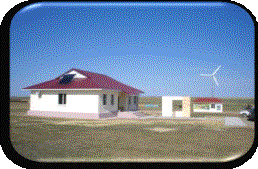
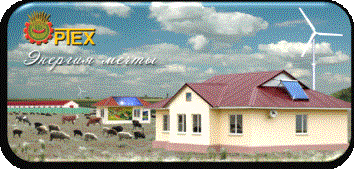 Pic.2. Animal eco – stop The Republic
of Kalmykia, Ketchenerovsky area reproducers "Shatta.
Pic.2. Animal eco – stop The Republic
of Kalmykia, Ketchenerovsky area reproducers "Shatta.
The competitiveness of a country largely depends on how
effectively organized its economic space, to what extent are rational forms of
territorial organization.
Strengthening the role of the regions in the dynamics and
prospects of development of the national economy, supporting the industrial
sector of the economy, will ensure a better quality of life [6].
REFERENCES
1. Starovojtova
Y.M., Medvedeva L.N.,
Berzina S.A., E.V.
Goncharova, Tymoshenko M.A. Management of territorial
units based on the increase of
investment potential, the formation of innovation
infrastructure and the creation of
logistics centers (methodology and practice) / /
VPI (branch) VolgGTU.
- Volgograd Volgograd
State Technical University Publishing House,
2012. - 268 p. monograph
2. Study McKinsey:
Industry of the Future: A new era of global growth and innovation. [Electronic resource] // Center for Humanitarian Technologies. URL: http://gtmarket.ru/news/2012/11/26/5188.
3. Russian industry in апрель
2013 / Bulletin of business surveys № 250 / / http://www.iep.ru
Medvedeva L.N. The
strategy of industrial upgrading of
the Russian regions // Scientific
Review. Series 1. Economics and
law. 2012. № 5. - P. 145-150.
4.
Medvedeva L.N., The
strategy of industrial modernisation of Russian regions /
/ Scientific Review. Series 1. Economics and
law. , 2012. Number 5. p. 145-150.
5.
Medvedeva L.N., Yasakin
V.V., Innovations in Housing: The Experience of proposals and implementations at the regional level, / / "Regional Development Alternatives (Shabuninskie
reading). The Collection of Abstracts
of the II International scientific-practical.
Conf. 7-8 October
2011 - p. 44
- 48. URL: http://
www.shabunin.info / members
6.
Yana Starovoytova Lyudmila Medvedeva The Strategy of Russian Territories
on the basis of accounting potential socio-economic modernization // «European
Applied Studies: modern approaches in scientific researches, 2nd
International scientific conference. ORT Publishing. Stuttgart. 2013.