Экономические науки / 14. Экономическая
теория
Fomina O.A.
Samara State University of Economics, Russia
Different Approaches to Distinguish Factors of Production: Some
Contemporary Views
It
is a matter of fact that three factors of production are described in classical
economic theory; they are land, labour and capital. But some modern economists
find these factors antiquated. They proclaim other primary factors: time,
information and capital. B. Gentile [1], for example, insists
on the diminished importance of land and labour in the contemporary economy
(except in such labor-intensive industries as energy production or mining).
From his point of view, they are replaced by time and information. As for
capital, it has always been and still remains of primary importance regardless
of the type of economy.
The
pace of technological advance is a major competitive factor in the modern
world. B. Gentile considers that success of any company is much determined by
the transformation speed of an idea into a final good, that is time as a factor
of production.
But
from my point of view time cannot be considered as a factor of production as
according to a definition a factor of production is an input to the production process. In itself time is not put into any production, it is not used
during the production process, it does not have intrinsic economic value, it
cannot be sold as its price is not fixed.
I
can define the ‘price of time’ as a certain amount of money that could be
earned if the results of the production process would be obtained immediately.
That is why it is difficult to determine time’s value, because its price
largely depends on the sphere of production: whether it is high-tech then the
price of time is high, or extractive industry then the price is relatively low.
Some
modern economists (e.g. B. Gentile, W. Kendall and R. Scott) also presume that
information should be added to the factors of production. In Gentile’s opinion
considering information as a factor of production nowadays is possible. He
draws attention to the importance of the 4 “V’s” of data: volume, velocity,
variety and veracity.
W.
Kendall and R. Scott [2] are sure that information should be included in the
list of factors of production. It is important that they also mention special
characteristics of information such as expansibility, compressibility,
substitutability, transportability, diffusibility, sharing. These have already
been outlined by Cleveland [3].
Now
let us move on to the next factor of production that is entrepreneurship. During
the XX century it has become really essential and now its influence on the
other inputs remains to be very strong.
Of
all the theories of entrepreneurship that exist I would like to concentrate on
Schumpeter’s theory. He introduces a Man of Actions (Mann der Tat) – someone
who does not accept reality as it is. He is also sure that an entrepreneur is
that very Man of Action in the area of economy and he does something
qualitatively new by means of new combinations of the existing resources. In
Schumpeter’s opinion an entrepreneur does not equal to an inventor as he only
brings in “new ways of using existing
factors of production”. That is “he who makes new combinations is an
entrepreneur” [4]. It is very important and at the same time easy for an
entrepreneur to introduce new combinations
It
is also noted by Schumpeter that the number of possible combinations of factors
of production is infinite. This means that it is impossible for an entrepreneur
to make a rational choice so it is mostly intuitive. And the right intuitive
choice separates a good entrepreneur from a bad one.
R.
Swedberg [5] notes that Schumpeter separates functions of an entrepreneur and a
capitalist. For example, the capitalist assumes the economic risks as he risks
his money and capital. But this is not quiet relevant today, as a great number
of venture firms have appeared all over the world and most of them are run by
entrepreneurs. So these entrepreneurs become more involved in money operations
and are, in fact, capitalists. But at the same time they remain to be
entrepreneurs as they analyze the existing market situation, search for the
prospective borrowers, consider them and whether invest their money or not.
Thus they are both capitalists (as the owners of capital and money in particular)
and entrepreneurs (as they risk and make decisions).
Randall
G. Holcombre [6] indicates that according to the neoclassics research and
development can be conducted only if factors of production are combined. But the
initial investments in R&D are not enough. If the research is successful it
is important to apply it, to innovate the production process or even to start a
new product line. And these all are the tasks of an entrepreneur.
Dr.
Kendall and Dr. Scott distinguish between managers and entrepreneurs. They are
sure that for competitive production managers should “use information
strategically and have the flexibility to respond to opportunities”. They also
stress on the importance of a combination of “right information with the right
opportunities at the right time”.
From
my point of view it is useless to divide managers and entrepreneurs, as
according to Jean-Baptiste Say entrepreneurs seek out inefficiently used
factors of production (land, labour and capital) and move them into more
productive areas. He also pointed out that entrepreneurs must recognize
opportunities and manage them
effectively. Thus, entrepreneur is a manager himself.
As
for Kirzner [7] he is also concerned that an entrepreneur is someone who is
eager to see opportunities and make good use of them. The peculiarity of the
entrepreneur is that he notices something that all the other can’t notice. It
is also important that some people have more potential to notice the
opportunities than others. The first and foremost is education and professional
training. If you are good at any specific sphere you are more likely to advance
in it, but not in any other.
Becker
[8] has distinguished between general and specific knowledge or training.
Obviously the general knowledge is the education a person gets at school and
universities. As for the specific knowledge it is all the information a worker
gets through his experience in a particular firm. Very often the specific
information can’t be applied outside the firm as it is mostly connected with knowledge
of the firm’s structure, peculiarities of the paper work or the knowledge of a
specific computer programme. Thus workers with high specific skills are less
likely to be redundant or leave their jobs.
Randall
G. Holcombre is quiet sure that entrepreneurship and knowledge are unrelated
and also that entrepreneurship does not require any expenses, so it is costless
as it does not use up resources. However entrepreneurs are affected by their
past activities. It is interesting that by taking an advantage of opportunities
a good entrepreneur creates new entrepreneurial opportunities, thus it is an
infinite process.
Roughly
speaking the experience obtained is as important as education in moulding a
perfect entrepreneur. And still I agree with Kirzner that the chance to notice
opportunities is indispensable.
I
can assume a schematic sketch of entrepreneurship as an input:
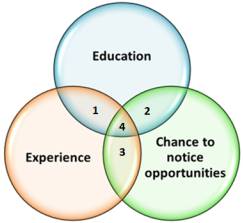
Here
you can see 4 product spaces that I can define as following:
1
– Ex+Ed – with perfect education and sufficient experience you can be a good
specialist, but still unable to make decisions
2
– Ed+CNO – an educated specialist can notice opportunities but his decisions
can be false without experience
3
– CNO+Ex – this formula is practically certain in respect of business matters
but not innovations or introducing new ideas
4
– Ex+Ed+CNO – is the entrepreneur himself. He is educated enough to be engaged
in some business, he has experience in a particular sphere and he is eager to
notice any changes and make use of them.
In
conclusion I can say that modern economy provides economists with opportunities
to define new factors of production and add to the classical economic theory. But
each new input should be proven as a factor of production.
Literature:
1.
Gentile, Brian The New Factors of Production and the Rise of Data-Driven Applications,
http://www.forbes.com/. Brian Gentile is a CEO of Jaspersoft, a provider of business intelligence software
2.
Kendall, Walter R. and Scott, C.
Richard Information As a Factor of
Production, Journal of Information Technology Management, Volume I, Number
2, 1990, pp. 39-42. Dr. Kendall, University of Northern Colorado, MBA in
Marketing and Transportation, doctorate in the field of Marketing. Dr. Scott,
Radford University, MBA and DBA degrees in Management, Marketing and Economics
3.
Cleveland, Harlan Information as a Resource, The Futurist,
Vol. 16, December 1982, pp. 34-39
4.
Schumpeter,
Joseph A. [1911] 2003 The Theory of
Economic Development,pp. 61-116 in Jürgen Backhaus (ed.), Joseph
Alois Schumpeter. Boston: Kluwer.
5.
Swedberg, Richard Rebuilding Schumpeter’s Theory of
Entrepreneurship, Conference on Marshall, Schumpeter and Social Science,
Japan, 2007. R. Swedberg, Cornell
University, Department of Sociology
6.
Holcombre, Randall G. Entrepreneurship and Economic Growth,
The Quarterly Journal of Austrian Economics 1, no.2 (Summer 1998), pp. 45-62.
Randall G. Holcombre, professor of economics at Florida State University
7.
Kirzner, Israel M. 1979 Perception, Opportunity, and Profit: Studies
in the Theory of Entrepreneurship. Chicago: University of Chicago Press
8.
Becker, Gary S. The Economic Way of Looking at Life, Nobel Lecture, December 9, 1992