Economic Sciences/9.
Economic industry
KHILINSKAYA I.V.
Financial university at Government of Russian
Federation,
Chelyabinsk branch, Russia
The simulation market sustainable
competition the
timber industry complex
Modern
development of socio-economic relations in Russia makes objective requirements
for the decision of a question of formation and realization of the control
system sustainable competition of the
timber industry complex.
The objective preconditions for that have been created
by the Forest code and ratified in 2012 Protocol on Russia's accession to the
WTO.
The experts [2] there are possible variations for
situations of Russia on the issue of WTO membership. The latter include: the
strengthening of integration of Russia into the world economy; the need to meet
high world standards of quality; the strengthening of the competition and its
results (reduction of costs, increase of efficiency of economy, the increase of
the assortment and nomenclature of the products; attraction of foreign investments
in the economy [2].
Taking into account the conditions on the domestic and the world market
and determining the point of economic growth in the long term timber
enterprises must take into account all these aspects in the implementation of
the programme of sustainable competition, using the existing economic
potential.
Russia has a powerful natural resources in General and forest potential,
in particular in 2011, the food and agriculture organization of the United
Nations (Food and Agriculture Organization of the United Nations - continue
FAO) published a major report of the global assessment of natural resources,
2010. This report was compiled on the basis of the statements 223 countries of
the world, including Russia.
According to the FAO in 2010, the area of forests in the Russian
Federation amounted to 49% of the land area, or 809090 ha. The annual rate of
change of forest area amounted to: year 2000 to 1990 levels increase by 0.04%,
2005 to the level of 2000 reduced by 0.01%, year 2010 to the level of 2005, an
increase of 0.04%. The permanent forest Fund makes 22% of the forest area, and
2% are forests in protected areas.
Describing the forests of Russia in comparison with some countries,
defined structure, in table 1[11]
Table 1
- Characteristics of forests, in % of the total forest area
|
Country, |
Untouched forest |
Forest restored independently |
Plantation |
|
Russian Federation |
32 |
66 |
2 |
|
China |
6 |
57 |
37 |
|
Finland |
0 |
73 |
27 |
|
Germany |
0 |
52 |
48 |
|
Ukraine |
1 |
49 |
50 |
|
Belarus |
5 |
74 |
22 |
|
Canada |
53 |
44 |
3 |
|
USA |
25 |
67 |
8 |
According to the table, the main share of forests in the Russian
Federation occupies the forest restored independently, and the share of
plantations significantly small.
The annual rates of change of the area of plantations amounted to: year
2000 to 1990 levels increase of 21.4 per cent, 2005 to the level of 2000 year
increase of 10.4 per cent, 2010 to the level of 2005, an increase of 0.2%.
Unfortunately, it should be stated that during the past five years, the area of
plantations practically does not grow.
The stock of trees in the forests amounted to 81523 million m3
is 100% of the commercial species, including: 75,5% is coniferous, and 24,5% of
deciduous species.
Of great importance to ensure конкурентоустойчивости of the timber industry complex has
a forest policy of Russia.
Forest policy is aimed at the preservation of the forests, the maximum
satisfaction of the needs of the population of the Russian Federation to the
quality of products, services and полезностях forests, increase of economic efficiency
of forest use, creation of a state level on the conditions ensuring sustainable
and dynamic development of the forestry sector [12].
For this it is necessary to implement the following goals in the
economic, social and environmental fields[12]:
-
in the economic sphere is- the achievement of the maximum gross domestic product
in the forestry sector, while balancing environmental and social interests,
competitiveness and modernization of forest sector;
-
in the sphere of environment - creation of- favorable environment for life of the population,
preservation of biological diversity of forest and other ecosystems,
introduction of resource-saving and ecologically safe technologies;
-
in the social sphere, improving the living- standards related to the forest people, creation of
new high-quality jobs, improvement of social security.
The objectives of forest policy are [12]:
-
the effective protection of and protection of forests;
-
providing- a
high-quality reproduction of forests;
-
increase the ecological potential- and the conservation of forest ecosystems;
-
development of deep chemical and- chemical-mechanical processing of wood;
-
increase in the production of- innovative products;
-
enhance the scientific-technical and technological- potential of the forestry sector;
-
the development of the internal market of- timber and paper products;
-
decrease of dependence of the Russian commodity- market of timber and paper products, imported from
abroad.
The priority issues in the formation of forest policy are issues of
state management of forests, reproduction and protection of forest Fund.
In Russia and foreign countries, there is a different approach to the
formation of forest policy and this is due primarily to the form of ownership
of the forests and the right to manage them - table 2.
Table 2
- Form of the ownership of the forests and the right to control, % [11]
|
Country |
Form of ownership |
The right holder in the
management of public forests |
|||
|
Public |
Private and other |
State administration |
Commercial structures |
Other |
|
|
Russian Federation |
100 |
0 |
83 |
17 |
0 |
|
China |
68 |
32 |
100 |
0 |
0 |
|
Finland |
32 |
68 |
100 |
0 |
0 |
|
Germany |
53 |
47 |
100 |
0 |
0 |
|
Ukraine |
100 |
0 |
91 |
0 |
9 |
|
Belarus |
100 |
0 |
100 |
0 |
0 |
|
Canada |
92 |
8 |
100 |
0 |
0 |
|
USA |
43 |
57 |
100 |
0 |
0 |
The table below shows that in the majority of countries represented a
form of ownership of the forests mixed, with the share of the private property
is 32% and above, while the management of forests on 100% are engaged in state
bodies.
In China in a private property is located 32% forest and at the same
time China is the largest producer of timber products. In Finland, about 68% of
the forests belong to private owners (about 128 thousand private owners), and
the state carries out the control over forest use: if within the period of five
years, the owner is not involved in reforestation or data work carried out
without ensuring compliance with applicable rules and standards of forest
exploitation, that such plots are withdrawn and transferred to the state
ownership.
In Germany the private owners owns 47% of the forests. The state
monitors compliance with the Federal legislative acts on the protection and
nature protection and the implementation of the forest policy is being
implemented with the support of the budgetary financing. In Canada, about 90%
of the forests are in public ownership, but forest management shall carry out
the province.
In the United States, slightly more than half of the forests belong to
private owners. The state allocates loans for the replenishment of seed funds
and monitors the observance of the legislation in the field of environmental
content of forest [3]. In many countries is successfully implementing the
programme of effective forest management and reforestation.
In its report the FAO identifies the priority functions of forests, for
which data for individual countries are presented in table 3[11]:
Table 3
- Priority functions of the forest, %
|
Country |
Manufacture |
Protection
of soil and water |
Conservation of biodiversity |
Social services |
Multi-purpose use |
Other |
|
Russian Federation |
51 |
9 |
2 |
2 |
10 |
26 |
|
China |
41 |
29 |
4 |
2 |
24 |
0 |
|
Finland |
87 |
0 |
9 |
н.с. |
4 |
0 |
|
Germany |
0 |
0 |
26 |
0 |
74 |
0 |
|
Ukraine |
46 |
31 |
4 |
19 |
0 |
0 |
|
Belarus |
50 |
19 |
14 |
18 |
0 |
0 |
|
Canada |
1 |
0 |
5 |
0 |
87 |
0 |
|
USA |
30 |
0 |
25 |
0 |
46 |
0 |
The table below shows that of the presented countries only two countries
(Germany and Canada) as a priority, the use of multi-purpose function of the
forest. The majority of countries, the use of the forest mainly for production
activities, which indicates the not complex
use of forest resources. This
raises a problem of their restoration, as the forest policy of Russia
determines not only the use of the forest, but also the preservation of the
forests.
As FAO notes that in Russia in 2006 was adopted the forest code, but
there is no national and territorial forest policy [11].
In the current forest code lays down the functions of management of
Federal centre and subjects of the Federation in order to increase the
investment attractiveness of the forest sector.
The regional authorities in order to improve the manageability in a
timber industry complex pursue a policy of consolidation of forest users[3].
The new forest code of the Russian Federation assumes the following
structure of the timber industry complex management [5]:
1. Federal authorities determine the content of the forest code of the
Russian Federation, normative acts, state forest inventory and forest
management, planning and delivery of subventions; carry out the control and
supervision of the execution of powers, the Russian legislation in the tax,
investment, innovation, external economic sphere; create public institutes of
development; specify the schedule of gradual increase of export duties on
unprocessed timber; establish the abolition of import duties on imported
high-tech equipment and export duties on the products of processing of wood,
forming the concept and requirements for the content and order preparation of
investment agreements, and develop forest management plans, forest Declaration,
activities on forest management.
2. Regional authorities determine the content of the regulations, the
execution of powers; form the forest plans, forest management regulations,
forest register; create a system of zoning of territories; establish the state
forest protection service, the laws of the subject of the Russian Federation in
tax, investment, innovation, external economic sphere, creating institutions
for the development of regional level, provide subsidies, tax benefits on
profit and property; shall exercise forest control and management functions,
activities on forest management, design work.
Changes in the nature of control caused the corresponding change in the
practices of management of the timber industry complex. It became obvious that
efficient management is possible only if such change of the system and methods
of control, which would allow to ensure an optimal level of controllability of
timber industry complex in the new economic and social conditions [5].
Examining the concept of «timber industry complex» it should be noted
that in its composition shall include the enterprises of the sector forestry
and the provision of services in this area, as well as forestry and logging and
the provision of services in this area [9].
The regional timber industry complex is defined as geographically
localized set of kinds of economic activities based on the use, preservation,
protection, reproduction of forest resources, as well as associated with him
manufacturing enterprises, state and public organizations in the process
economic activity [5].
The timber industry complex is an important factor of formation of socio-economic
development strategy of the Russian Federation, as closely linked with the
various sectors of the economy.
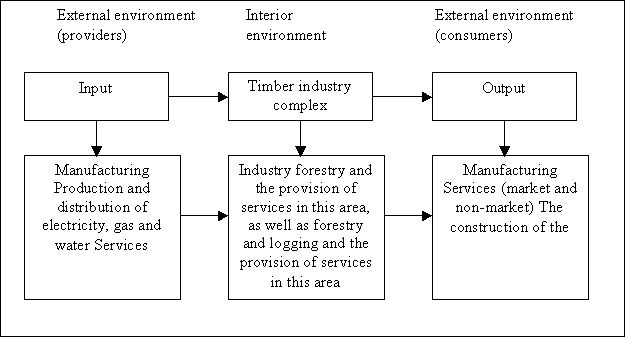
Picture 1 - the Relationship of the timber
industry complex with other sectors of the economy
All of the components of the timber industry complex must interact
harmoniously to achieve the maximum economic effect, and for the balance of
relations in the system «economy - environment - society». Not less important
than the impact of the timber industry complex has on the socio-economic
development of the region.
Forest resources of the Urals Federal district are presented in table 4
[10].
Table 4
- the Forest resources of the Ural Federal district
|
|
2010 |
2011 |
||||||
|
The area of
lands of the forest Fund and lands of other categories where forests are
located, thousand ha |
Wooded territories, % |
The total stock
of timber, million m3 |
The area of
lands of the forest Fund and lands of other categories where forests are
located, thousand ha |
Wooded territories, % |
The total stock
of timber, million m3 |
|||
|
all |
out of it
covered with forests |
all |
out of it
covered with forests |
|||||
|
Russian Federation |
1183682 |
797496 |
46,6 |
83454,0 |
1183257 |
797137 |
46,6 |
83386,3 |
|
Ural Federal district |
114845 |
70011 |
38,5 |
8107,0 |
115005 |
70137 |
38,6 |
8128,8 |
|
Kurgan region |
1877 |
1538 |
21,5 |
199,2 |
1878 |
1557 |
21,8 |
207,4 |
|
Sverdlovsk region |
16000 |
13348 |
68,7 |
2141,8 |
16007 |
13321 |
68,4 |
2138,9 |
|
Tyumen region |
94009 |
52524 |
43,52) |
5360,0 |
94159 |
52658 |
43,52) |
5370,4 |
|
including:: |
|
|
|
|
|
|
|
|
|
Khanty-Mansiysk Autonomous Okrug - Ugra |
50312 |
28767 |
53,8 |
3266,3 |
50430 |
28894 |
54,0 |
3283,9 |
|
Yamalo-Nenets Autonomous Okrug |
32279 |
16794 |
21,8 |
1167,5 |
32294 |
16801 |
21,8 |
1158,5 |
|
Chelyabinsk region |
2961 |
2600 |
29,4 |
406,4 |
2961 |
2601 |
29,4 |
412,1 |
When
assessing the dynamics of the forest resources of the Ural Federal district it
should be noted that for the period of availability of resources remained
practically the same level.
In terms of forest and timber resources Chelyabinsk region occupies the
last place in the Urals Federal district. The area of lands of the forest Fund
decreased by 360 thousand hectares, and timber reserves increased by 5.7
million m3.
On the territory of the subject of the Federation are 7 state nature
reserves area of 2529,7 thousand hectares, 3 national parks with the area of
193, 8 thousand hectares, which in total amounts to 1.5% of the total
territory.
An important basis of the effective work of the timber industry complex
is the reforestation and afforestation. (The data are presented in tables 5 and
6) [10]
Table 5
- Reforestation, thousand hectares
|
|
2008 год |
2009 год |
2010 год |
|
Russian Federation |
828,4 |
836,7 |
811,5 |
|
Ural Federal district |
63,9 |
61,6 |
63,8 |
|
Kurgan region |
4,7 |
4,7 |
4,6 |
|
Sverdlovsk region |
22,1 |
23,9 |
25,6 |
|
Tyumen region |
33,9 |
29,7 |
29,8 |
|
including:: |
|
|
|
|
Khanty-Mansiysk Autonomous Okrug - Ugra |
20,5 |
20,5 |
18,3 |
|
Yamalo-Nenets Autonomous Okrug |
4,8 |
4,8 |
4,8 |
|
Chelyabinsk region |
3,3 |
3,3 |
3,8 |
Over
the recent years in the whole of the Russian Federation reduced the area of
rehabilitated forests. As for the Urals Federal district, here the amount of
the restored forests increased by 3.5% compared to last year, and in the
Chelyabinsk region the growth was 15.1% to the level of the previous year. The
share of artificial reforestation in total area, which were carried out
reforestation work in 2010 in the Russian Federation amounted to 21.1%, in the
Urals Federal district 23,1%, and for the Chelyabinsk region 76,8%.
Table 6 - Afforestation, hectares
|
|
2008 год |
2009 год |
2010 год |
|
Russian Federation |
15072 |
3854 |
7941 |
|
Ural Federal district |
140 |
14 |
66 |
|
Kurgan region |
|
14 |
4 |
|
Sverdlovsk region |
113 |
- |
61 |
|
Tyumen region |
14 |
- |
1 |
|
including:: |
|
|
|
|
Khanty-Mansiysk Autonomous Okrug - Ugra |
14 |
- |
1 |
|
Yamalo-Nenets Autonomous Okrug |
13 |
- |
- |
In
2010, the area of plantations in the whole of the Russian Federation has
increased almost in 2 times, but has not yet reached the pre-crisis level of
2008. The same applies to the Urals Federal district. Here the area of lands
allocated under afforestation, has increased by almost five times, but did not
reach the level of 2008.
An important part of the work of forest management is the reforestation
(table 7) [10]:
Table 7
- the Protection of forests against harmful organisms in 2010, hectares
|
|
Protection of forest biological methods |
Protection of forests chemical method |
Area of pernicious organisms, requiring control
measures |
The area of the dead forest stands |
|
Russian Federation |
226555 |
48992 |
2574460 |
801594 |
|
Ural Federal district |
19285 |
7967 |
288765 |
28060 |
|
Kurgan region |
- |
14 |
83958 |
7665 |
|
Sverdlovsk region |
- |
- |
6045 |
7141 |
|
Tyumen region |
1161 |
- |
24730 |
12062 |
|
including:: |
|
|
|
|
|
Khanty-Mansiysk
Autonomous Okrug - Ugra |
1141 |
- |
678 |
4058 |
|
Yamalo-Nenets Autonomous Okrug |
- |
- |
- |
1055 |
|
Russian Federation |
18124 |
7952 |
174032 |
1192 |
No less
important is the activity of the industry «Harvest». In the Ural Federal
district in the industry work more than a thousand enterprises, which employ
about eight thousand employees (in the Chelyabinsk region about 150 and 700
respectively) (table 8), [10]:
Table 8
: Main indicators of the activity «Logging»
|
|
The
number of enterprises and organizations (on the end of the year) |
The
average annual number of employees, people |
Balanced
financial result (profit minus loss) of the activities of the organizations,
million rubles |
The
specific weight of loss-making organizations in the total number of
organizations,% |
||||||||
|
2005 |
2009 |
2010 |
2005 |
2009 |
2010 |
2005 |
2009 |
2010 |
2005 |
2009 |
2010 |
|
|
Russian Federation |
20825 |
17751 |
15635 |
247753 |
165574 |
156576 |
-2800 |
-6416 |
-5420 |
61,7 |
62,7 |
56,3 |
|
Ural Federal district |
1636 |
1370 |
1176 |
16628 |
8107 |
7717 |
-196 |
-227 |
-92 |
71,4 |
53,8 |
46,7 |
|
Kurgan region |
47 |
52 |
47 |
444 |
324 |
557 |
-0,0 |
- |
- |
100 |
- |
- |
|
Sverdlovsk region |
836 |
706 |
622 |
10746 |
4658 |
3986 |
-109 |
-86 |
-53 |
68,8 |
66,7 |
50,0 |
|
Tyumen region |
613 |
456 |
358 |
5166 |
2342 |
2448 |
-84 |
-142 |
-39 |
70,0 |
50,0 |
50,0 |
|
including:: |
|
|
|
|
|
|
|
|
|
|
|
|
|
Khanty-Mansiysk Autonomous Okrug - Ugra |
361 |
291 |
208 |
4064 |
1725 |
1978 |
-46 |
0,2 |
-21 |
71,4 |
- |
50,0 |
|
Yamalo-Nenets Autonomous Okrug |
28 |
10 |
2 |
135 |
25 |
26 |
-20 |
- |
1 |
100 |
- |
- |
|
Russian Federation |
140 |
156 |
149 |
272 |
783 |
726 |
-3 |
1 |
0,0 |
100 |
- |
- |
As can be seen from the table a large number of
enterprises in 2010 showed negative financial result of such enterprises is
about 50%. The enterprises, included into this industry should focus attention
on the issues of management of the costs and outcomes in order to ensure
competitiveness and sustained competitiveness.
Considering the volumes of production of unprocessed
wood, it should be noted that for this kind of activities The Ural Federal
district occupies the sixth place, and the Chelyabinsk region is the
thirty-first (table 9) [10]:
Table 9
- the Production of wood raw value (thousand dense cubic meters)
|
|
2009 |
2010 |
Position in the Russian Federation in 2010 |
|
Russian
Federation, million solid m3 |
100,7 |
112,2 |
|
|
Ural Federal district |
5515 |
5861 |
6 |
|
Kurgan region |
747,6 |
848,4 |
27 |
|
Sverdlovsk region |
2472 |
2559 |
14 |
|
Tyumen region |
1836 |
1861 |
15 |
|
including:: |
|
|
|
|
Khanty-Mansiysk
Autonomous Okrug - Ugra |
1381 |
1428 |
20 |
|
Yamalo-Nenets Autonomous Okrug |
14,1 |
13,5 |
68 |
|
Russian Federation |
459,4 |
592,7 |
31 |
Considering
sustained competitiveness of the timber industry complex, it should be noted
that by this term is understood as the ability to retain its position in the
future. There are various factors that have a significant influence on the
formation of the timber industry complex. To these are include: objectives and
tasks of the enterprises, the domestic environment, the external environment,
the capital of the timber industry complex.
It should be noted that in the external environment of
the timber industry complex consists of suppliers, consumers, state bodies and
subjects of Federation, and population.
Forming the market model sustained competitiveness, it
is necessary to take into account the competitive advantages of the timber
industry complex:
- general
characteristic of the market;
- the
presence of large stocks of forest resources;
- the
possibility of rapid penetration into the unoccupied market segments;
- normative-legal
protection and state support;
- high
level of development of the applied science and technology, which allows in the
shortest terms to solve the issues of development and introduction of
progressive technologies and equipment;
- availability
of information about vendors, customers, market infrastructure;
-
availability of labor resources.
The algorithm of modeling sustained competitiveness of
the timber industry complex includes basic stages:
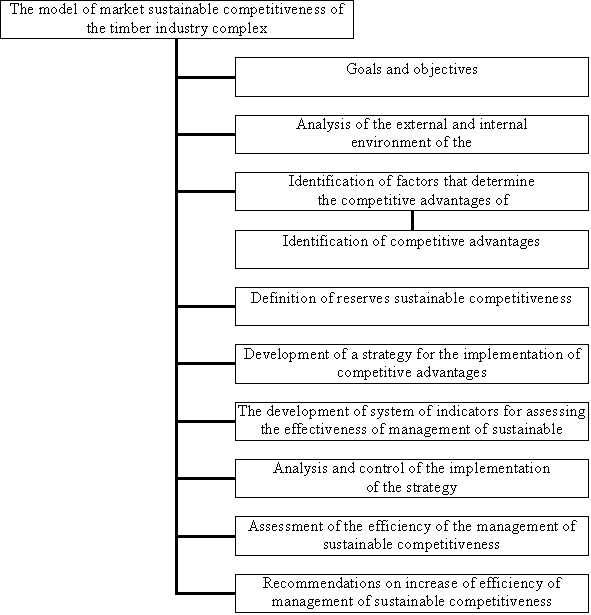

Picture 2 - is a Simulation sustainable competitiveness of the
timber industry complex
The
development of system of indicators for assessing the effectiveness of
management sustainable competitiveness of the timber industry complex implies
comprehensive, systemic approach, and is embodied in the integral indicator
that consists of indicators for the evaluation of efficiency of management of
financial stability, cost, and profitability, quality, investment activities,
the innovation activities.
Bibliography:
1. Forest
Code of the Russian Federation from 04.12.2012 g. №200-FZ-information retrieval
system Consultant plus
2. Barsukova
S.YU. The accession of Russia to the WTO: the inevitable losses and possible
acquisitions for agribusiness [Text]/ S.YU. Barsukova// Questions of
statistics. - 2013. - №3. - S. 76-81
3. Gryanko
S.P.. Trends and dynamics of development of the forest sector on the basis of
the relations between the government and business: the monograph [Text]/S..
Gryanko, O.I. Ageeva.- Perm: ФГБОУ VPO
Perm SAA, 2011.-200C.
4. Russian
statistical Yearbook - 2011 [Electronic resource].- Mode of access: http://www.gks.ru
5. Puchkov
V.V. Strategic planning of forestry complexes/ author's abstract of the
dissertation on competition of a scientific degree of the doctor of economic
Sciences: protected 26.10. 2010/ Beams V.V.// [Electronic resource].-Access: http://vak.ed.gov.ru
6. The
strategy of innovative development of the Russian Federation for the period up
to 2020 / Order of the Government of the Russian Federation from 08.12.11 -
№1227-p [Electronic resource] . - Mode of access: http://www.consultant.ru
7. Khodakovska
A.E.. Formation of the economic model of sustainable forest administration and
management. Author's abstract of the dissertation on competition of a
scientific degree of the candidate of economic Sciences: protected 24 may 2012
/Khodakovska A.E.//[Electronic resource]. - Access: http://ftacademy.ru
8. Internet-resource//
access//http://www.econom-chelreg.ru
9. Internet-resource//
access// http://gks.ru
10. Internet-resource//
access//http://chelstat.gks.ru
11. Internet-resource//
access//http://www.fao.org
12. Internet-resource//lp.vniilm.ru/viewtopic.php?f=6&t=1806