V. Dubovoy, Doctor of Sciences, Professor; I. Pylypenko, student
Vinnytsia National Technical University, Ukraine
Information technology of
decision-making in the management of branched-cyclic technological processes
Cyclic
technological processes are widely used in all areas of industrial production
[1]. They are characterized by a closed-loop process scheme in which the
process or any subprocess returns to initial stage. During one cycle of the
process the original form of the product may be transform to final and
intermediate form, which is suitable for further processing. At this stage you
should decide to move to the next stage [2]. The complexity of the
decision-making algorithm depends on the structure of the technological
process. In particular, unlike the treelike branching processes, in a cyclic
technological processes may be repeated loop to the fulfillment of certain
stages of the process.
The
effective management of branched-cyclic technological processes (BCTP) is actual
problem, because of complexity of monitoring and control in automated control system
of BCTP. Decision-making is an important task for the effective management of
technological processes [3].
The purpose of the article is to develop the
effective information technology (IT) of decision-making and improve the
quality of decisions in the management of branched-cyclic technological
processes.
Architecture
of information technology of decision-making in the management of BCTP is
represented as an algorithm of decision-making and UML-class diagrams. The constructed
algorithm of decision-making in the management of BCTP is based on [2] and
shown in Fig. 1.
Development
of the structure of classes is performed in several stages. We show classes of
primary stage that are realizing the basic use cases and the relationships
between them (Fig. 2). "Information technology» is a common multi-window
interface. «Access» is the class of access control to the system. «DataBase»
class consists of three main entities: options of BCTP structures, elements of
BCTP,
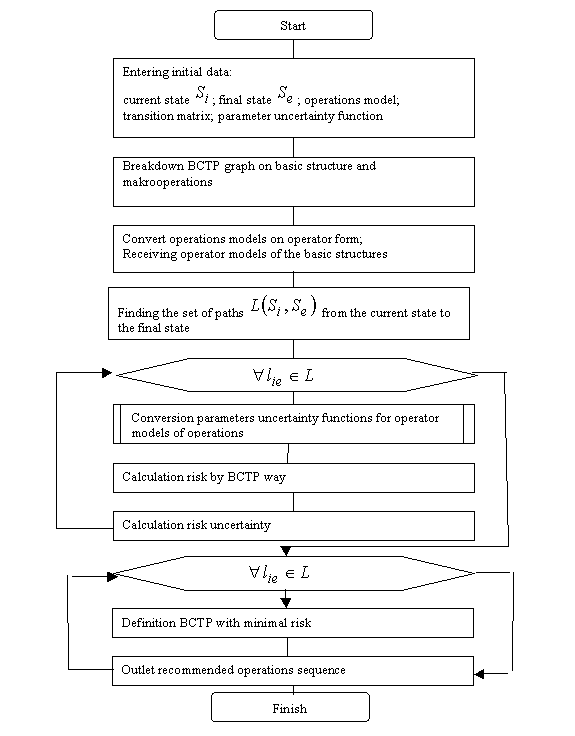

Fig.1. Algorithm of decision-making
in the management of BCTP
algorithms for data collection and knowledge base. «Model» class
consists of three basic operations: model transformation as a graph and
performance operation of model evaluation. The model includes parameters
uncertainty of the operations and inputs resources (raw of materials, etc.),
that is leading to uncertainty in the results of operations. «Risk» class
includes operations: calculation of static characteristics of technological
process operations, the calculation of transition probabilities between
operations, calculation of cost factors, the calculation of probability
characteristics of each alternative path of process, the calculation of total losses,
and the calculation of the overall risk of technological process. «Optimization»
class includes basic operations of
calculation of optimization criterion values and searching of the best way of
BCTP.
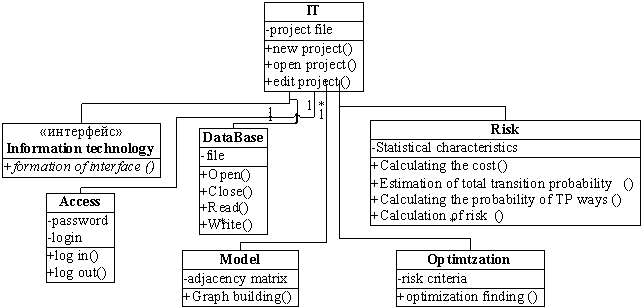
Fig.2. UML-class diagram of the
system
Conclusions. Method of
risk assessment of decision making in the management of BCTP is improved. The
main components of IT are implemented in «TP Build» DSS.
References
1. Krishna
B. Athreya. Branching Processes / B. Athreya Krishna, P. E. Ney. Dover
Publications, Incorporated. – 2004. – 287 p.
2.
Дубовой В.М. Оптимiзацiя параметрiв СППР при управлiннi розгалуженим
технологiчним процесом / В.М. Дубовой, I.В. Пилипенко – №24. – Т.2. – Вiнниця:
УНIВЕРСУМ Вiнниця. – 2012. – С. 131-136.
3. Fabricio Murai, Bruno
Ribeiro, Don Towsley, Krista Gile. Characterizing Branching Processes from
Sampled Data [Electronic resources]. – Access:
https://www.researchgate.net/publication/235702681_Characterizing_Branching_Processes_from_Sampled_Data