Технические науки/2. Механика
Gladskyi Maksym, PhD
National Technical
University of Ukraine “KPI”
Fatigue behavior of
notched tubular specimens under axial and torsion loading
The most common
cause for fatigue crack initiation in structural components is at stress
concentrators such as notches. Grooves and keyholes on shaft, holes, fillets,
thread, and welded joints are all notches. Even nominal elastic behavior may
effects in exciding of yield limit around the notch.
Atzori at al. [1] conducted a multiaxial
fatigue experimental study on V-notched specimens. They found that multi-axial
fatigue strength is significantly affected by the nominal load ratio, whereas
the influence of the load phase angle seems to be negligible. Yi-Ming and
Wei-Wei [2] investigated crack initiation life for solid cylinders with
transverse circular holes made from AISI 316 stainless steel under
in-phase and out-of-phase multiaxial loading. The crack initiation life of
notched specimens under out-of-phase multiaxial loading is shorter that that
under in-phase multiaxial loading due to additional cyclic hardening effect.
Gao at al. [3] studied fatigue behavior of V-notched shafts made of 16MnR steel
with sharp and blunt notch radii. They showed that significant notch size
effect on the fatigue life under different loading paths and notch effect is
more significant for higher loading cycle fatigue. Sun at al. [4] conducted
strain-controlled fatigue tests for GH4169 superalloy thin tubular and
V-notched specimens under in-phase and two different out-of-phase loading paths
at 650oC. As can be found from experimental results for notched
specimens, all of 90o out-of-phase fatigue lives are longer in
comparison with in-phase data. This effect may be also explained by sufficient
additional hardening for this material at the root of the notch due to high
plastic deformation. As a result, a fatigue damage parameter was proposed to
predict the fatigue crack initiation life for notched specimen. Many
engineering notched structures are also subjected to different combination of
cyclic and static loadings. These results show that the addition of static
compression to torsion cycling gives longer lifetime and static tension –
shorter fatigue life in comparison with pure torsion cycling due to notch-weakening.
In this paper correlation of predicted
and observed fatigue life of axial and torsion loadings of structural steel 20 are
presented.
Low-carbon steel 20 was used at this
study. The chemical composition of the material is as follows (mass%): C 0.24,
Si 0.25, Mn 0.45, Cr 0.2. The basic geometry for two different types of
specimens has 1.1 mm wall thickness, 22 mm inside diameter, and 40 mm gauge
length. One type was a tubular smooth thin-walled specimens, the other type was
the same thin-walled specimen with 3.4 mm circular through-thickness hole
at the middle of gauge length.
Fully-reversed sinusoidal axial and
torsion waveforms were applied for load/strain controlled constant amplitude
tests. The 5% load drop for uniaxial strain control tests and 5% strain and
rotation angle increment for uniaxial and torsion load control tests
respectively, as compared to midlife stable cycle for smooth specimens were
considered as a small crack initiation life.
Axial and shear applied strain and stress
amplitudes as well as cycles to failure,  for each constant
amplitude fatigue test of low-carbon steel 20 are listed in Tables 1.
for each constant
amplitude fatigue test of low-carbon steel 20 are listed in Tables 1.
From Peterson’s plot, the tensile and
shear stress concentrator factors are 3.29 and 3.98, respectively. Fatigue behavior
of notched components depends on not only elastic stress concentrator factor.
Materials strength is considered by fatigue notch factor,  . The fatigue notch factor takes 2.73 and 3.21 for axial and
torsion loading, respectively.
. The fatigue notch factor takes 2.73 and 3.21 for axial and
torsion loading, respectively.
The following shear form of the
Fatemi-Socie critical plane parameter was also used to correlate constant
amplitude fatigue data

where  and
and  , are elastic and plastic Poisson’s ratios.
  = 1.0 was assumed for studied steel. The shear
strain-life curve was generated based on von Mises criterion. The FS parameter
was associated with local stress-strain condition based on FE analysis results.
Correlation of constant amplitude data by the FS parameter is presented in
Figure 1. As can be seen from these Figures, FS parameter fits the experimental
data both for smooth and notched specimens very well. Based on FE analysis, the
critical shear planes locate at the notch root on 0°, ±180° under axial loading
and ±45°, ±135° for torsion loading. The same locations were found from
experimental results. In addition, the fracture surfaces for both cases of
loading associated with maximum shear plane. It explains FS parameter ability
to predict fatigue life very well.
= 1.0 was assumed for studied steel. The shear
strain-life curve was generated based on von Mises criterion. The FS parameter
was associated with local stress-strain condition based on FE analysis results.
Correlation of constant amplitude data by the FS parameter is presented in
Figure 1. As can be seen from these Figures, FS parameter fits the experimental
data both for smooth and notched specimens very well. Based on FE analysis, the
critical shear planes locate at the notch root on 0°, ±180° under axial loading
and ±45°, ±135° for torsion loading. The same locations were found from
experimental results. In addition, the fracture surfaces for both cases of
loading associated with maximum shear plane. It explains FS parameter ability
to predict fatigue life very well.
Table 1. Constant amplitude axial and
torsion fatigue tests of smooth and notched specimens
|
Control mode |
|
MPa |
MPa |
MPa |
MPa |
MPa |
Cycles |
|
Smooth specimens |
|||||||
|
Axial |
0.0100 |
411 |
- |
411 |
411 |
206 |
50 |
|
Axial |
0.0070 |
350 |
- |
350 |
350 |
175 |
135 |
|
Axial |
0.0030 |
277 |
- |
277 |
277 |
139 |
3,400 |
|
Axial |
0.0020 |
261 |
- |
261 |
261 |
131 |
13,120 |
|
Axial |
0.0015 |
232 |
- |
232 |
232 |
116 |
51,500 |
|
Axial |
0.0010 |
192 |
- |
192 |
192 |
96 |
>972,000 |
|
Axial |
0.0031 |
300 |
- |
300 |
300 |
150 |
2,050 |
|
Axial |
0.0016 |
230 |
- |
230 |
230 |
115 |
151,000 |
|
Torsion |
|
- |
190 |
190 |
329 |
0 |
8,573 |
|
Torsion |
|
- |
175 |
175 |
303 |
0 |
45,810 |
|
Torsion |
|
- |
149 |
149 |
258 |
0 |
242,000 |
|
Notched specimens |
|||||||
|
Axial |
|
269 |
- |
269 |
269 |
135 |
315 |
|
Axial |
|
250 |
- |
250 |
250 |
125 |
495 |
|
Axial |
|
200 |
- |
200 |
200 |
100 |
2,115 |
|
Axial |
|
144 |
- |
144 |
144 |
72 |
20,900 |
|
Axial |
|
106 |
- |
106 |
106 |
53 |
140,500 |
|
Torsion |
|
- |
149 |
149 |
258 |
0 |
5,407 |
|
Torsion |
|
|
149 |
149 |
258 |
0 |
5,910 |
|
Torsion |
|
- |
121 |
121 |
209 |
0 |
34,700 |
|
Torsion |
|
- |
87 |
87 |
151 |
0 |
120,000 |
|
Torsion |
|
- |
87 |
87 |
151 |
0 |
276,000 |
|
Torsion |
|
- |
65 |
65 |
113 |
0 |
>1,150,000 |


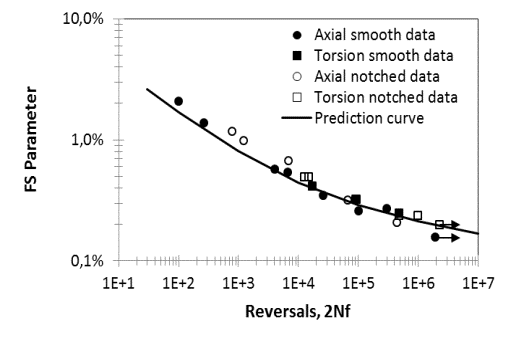
Figure 1. Correlation of axial and torsion data
by usingF-S parameter
References:
1.
Atzori B, Berto F, Lazzarin P, Quaresimin M. Multi-axial
fatigue behavior of a severely notched carbon steel. Int J Fatigue
2006;28:485-93.
2.
Jen YM, Wang WW. Crack initiation life prediction for solid
cylinders with transverse circular hole under in-phase and out-of-phase
multiaxial loading. Int J Fatigue 2005;27:527-39.
3.
Gao Z, Qui B, Wang X, Jiang Y. An investigation of fatigue
of a notched member. Int J Fatigue 2010;32:1960-9.
4.
Sun GQ, Shang DG. Prediction of fatigue lifetime under
multiaxial cyclic loading using finite element analysis. Materials and Design
2010;31:126–33.