Kraeva E.M.
Siberian State Aerospace University, Russia
А vortex zone in the channels of
high-speed
centrifugal pumps
High-speed
low-rate centrifugal pumps with rotor angular speed  up to 10000 rad/s are
wide used in structures of turbo-pump units of liquid-propellant engine of low
traction and energy installation of aircrafts. That is because they have wide
range of operating conditions. E.g., if the rotor angular speed
up to 10000 rad/s are
wide used in structures of turbo-pump units of liquid-propellant engine of low
traction and energy installation of aircrafts. That is because they have wide
range of operating conditions. E.g., if the rotor angular speed  rad/s, the value
  amounts to
  under Reynolds number
 . The feed decreases in such pumps simultaneously with rotor
angular speed increase leads to
. The feed decreases in such pumps simultaneously with rotor
angular speed increase leads to  decrease below value
 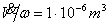 . It is rating value for closed-type impeller rotary pumps
[1]. Therefore high-speed rotary pumps with semiopen-type impeller are used
wide.
. It is rating value for closed-type impeller rotary pumps
[1]. Therefore high-speed rotary pumps with semiopen-type impeller are used
wide.
In
centrifugal impellers of semi-open and open types there is unevenness of flow
and vortex interaction along the radius of main fluid flow and in the lateral axil
of the pump. The vanes convey energy to the fluid flow, a portion of which is
moving with a lag from the main one in the lateral axil. In the result a flow
is formed as in the channel behind the bluff body. This flow is characterized
by the appearance of return currents and vortices. [2] This process is
determined by the ratio of width to length of the channel, the thickness of the
boundary layer on the walls and the relative height of the vane. The
interaction of flows in channels and axil leads to the appearance of
circulating currents in the area behind the vane.
Picture of
the flow between the rotating impeller with the end vanes and sleek hull is
quite complex. The liquid contained in the field of grooves is exposed to
direct power impact of the vanes. The fluid in the axial gap is twisted by the
forces of friction and slip relative to vanes of the impeller. Thus at the same
radius the particles of the fluid are moved with different speed in the
channels and the axial gap that causes a relative movement in the radial and
axial directions. In the area of vanes there is a radial expendable flow
towards the periphery.
Since the
coefficient of flow swirling φ <1, we always have a relative motion of
the fluid and the vanes of the impeller, that certainly leads to the formation
of circulation zone in the channels of the impeller as a result the flow wraps
around cavity.
One of the
characteristics of the vortex zone is the ratio of the circumferential speed  to the incoming flow speed
  at the outer border of the vortex zone
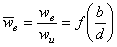 (1)
(1)
The analytical calculation of the variable  on the data of the work [2] for the channel of an impeller
gives the value
on the data of the work [2] for the channel of an impeller
gives the value  . However,
the experimental data presented in the same paper indicate a significant
difference between the calculated value
. However,
the experimental data presented in the same paper indicate a significant
difference between the calculated value  from
the experienced one, in the direction of increasing the experienced value. That
difference the author of [2] explains by the influence of boundary layers.
from
the experienced one, in the direction of increasing the experienced value. That
difference the author of [2] explains by the influence of boundary layers.
When testing a cylindrical fluid coupling on the water,
in [3] there is a marked clearly expressed vortex structures in cavities of the
rotating cylinder.
The analysis of experiments on determining the estimated
value  , as described in this paper, gives us
a basis to take it to our research by 0.3.
, as described in this paper, gives us
a basis to take it to our research by 0.3.
A typical picture of variation in flow speed through the
gap  and the inter-vane channel (at a ratio of width to depth of the
channel
and the inter-vane channel (at a ratio of width to depth of the
channel  ) (Figure 1) taking into account on
visualization tests confirmed the presence the three zones of flow: zone of the
flow 1 flowing over the channel; the mixing zone 2 and zone 3 of the circular
vortex flow in the channel region, where the speed
) (Figure 1) taking into account on
visualization tests confirmed the presence the three zones of flow: zone of the
flow 1 flowing over the channel; the mixing zone 2 and zone 3 of the circular
vortex flow in the channel region, where the speed  .
.
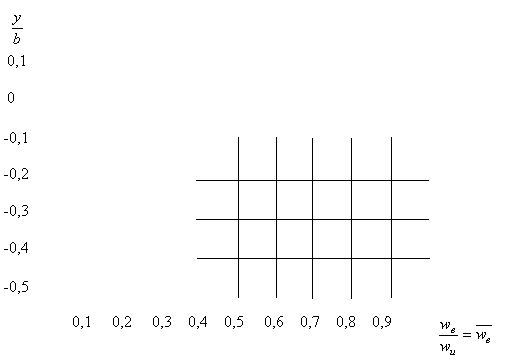
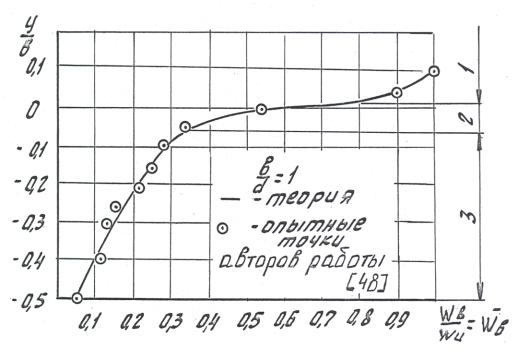
Figure 1 – Experimental and theoretical profiles of
the circumferential speed in the channel region along the radius of the vortex
zone: 1 – the zone of the flow in the axial gap; 2 – the
mixing zone; 3 – the zone of the vortex flow;
 - experimental points [3]
In order to clarify the main features of the hydrodynamics
in semi-open channels of an impeller, we conducted the series of experiments,
including those on the visualization of the flow in these impellers.
This work was supported by the grant of the President of
the Russian Federation МК – 1371.2013.8.
References
1. Kraev M.V., Lukin V.A., Ovsyannikov
B.V. Low-rate pumps of air and space system [in Russian], Mashinostroenie,
Moscow, 1985.
2. Abramovich G.N. The
theory of turbulent jets. – М. : Phismathgiz, 1960. – 716 p.
3. Levin А.А., Perelman R.G. Investigation
of a cylindrical fluid coupling / Investigation of
aggregates operating on alkaline metals: MAI. – 1969. – V.
193. – P. 57–102.