Economics / 2. Finance and
Banking
Zhumagul
Torekhan (master’s student),
Oserbayuly
Seysenbay (scientific supervisor)
Al-Farabi Kazakh National
University, Almaty, Kazakhstan
Islamic
banking – the way to globalization
to attract investments and diversify country's economy
Kazakhstan is one of the recent countries, who
opened doors for Islamic finance (1997). In 2009 the Banking Law was amended
making a path to the alternative banking system. Ever since the only Islamic
bank started operations in Kazakhstan is a subsidiary of Abu Dhabi state-owned
Al-Hilal bank. This bank was opened based on an intergovernmental agreement
between the Republic of Kazakhstan (RK) and the United Arab Emirates (UAE).
Therefore, some analysis are in the opinion that this is more political
decision rather than a commercial business project. In 2010 there was some
other public announcements about new interested entrants such as Amana Paya
from Malaysia and Qatar Islamic bank. However, due to unknown circumstances
these banks are not yet to be in the market.
Sources of Financing There are the following sources of financing:
a)Musharaka; b) Mudaraba; c) Murabaha; d) Ijarah; e) Wakala;
Figure 1. Conventional
bank (model)









Source: National
Bank of RK
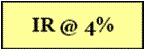
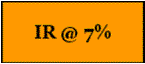
Conventional banks make profit from the margin between loans and cost of
deposits. But model of Islamic banks are different.
Figure 2. Islamic bank (model)
|
There are
many principles of financing |
||
|
|









Source: National
Bank of RK
A religious aspect also exists. Kazakhstan is
historically a Muslim nation. Despite suppression of the religion during the
Soviet era, a growing number of people recover their national and religios
values now. The main rules of Sharia forming the
boundaries and distinguishing Islamic banks from conventional are the
following.
·
Prohibition of riba that
means usury and includes all forms of interest
·
Prohibition of gharar,
maiisir and qimar that means uncertainty, gambling and game of chance.
·
Prohibition of risk
transferring and risk selling. Instead, risk must be shared amongst business
partners.
·
Restrictions on sale of
debt and financial assets and their pledge as collateral
·
Prohibition of finance
for haram business. This means business that are repugnant to Sharia law
including, but not limited, alcohol, tobacco and pork production, entertainment
related to gambling and vulgarity, as well as interest-bearing financial
services.[4]
Since there is no profit to the Islamic
banks, it does not issue loans (Qard-Hasanah). As per the existing practice,
the Islamic banks adopt Musharakah and Mudarabah on deposit side, but do not
normally provide loan to their clients, due to certain unavoidable
circumstances, and instead, financing is done through Murabaha, Ijarah, Salam
or have Musharakah etc. however, sometimes the banks adopt Musharakah in
exports, being less risky. Direct Investment The Islamic banks invest their
capital in the following business. [3]
In favor of these projections we can claim
the following:
1. Simple comparison of proportion of the
total Sharia-compliant asset under management, which is about 1% of global
financial asset size, and proportion of Muslim population in the world, which
is about 20%, gives us a strong argument that there is a huge room for the
industry to grow. It is estimated that nowadays only 12% of Muslim population
use Islamic Finance.[2]
2. The Middle–East cash flow from oil is a
strong support for expansion of Islamic finance in the region and beyond. The
region has more than half of the world’s proven oil reserves (53%1).
3. Economic growth in Asia will also be
supportive due to significant Muslim population in the region, especially in
countries like India, Malaysia and Indonesia.
4. Ethical and social responsible
investments are on increasing demand in the West in the light of economic
crisis and social unrests, banking corporate scandals and environmental issues.
5. Governments and financial centers are
aiming for growth and diversification of investments in their countries and
therefore have to open doors for Islamic finance.
Currently in
Kazakhstan oversees 38 commercial banks, including one islamic bank opened in
2010. At first glance Islamic Finance potential in Kazakhstan seems
overwhekming to traditional banking, owing to the majority of Muslim
population. However, it is worth saying that due to some historical reasons,
including Soviet era restrictions, the religious commitment of the population
is quite low comparing to other countries.
A subsidiary of Al Hilal Bank was
established in Kazakhstan in 2010.The bank has opened so far three outlets
including head-office in Almaty, the commercial capital, and two branches in
the capital city of Astana and Shymkent, most populated center on the South of
the country.
Figure 4: ‘Al Hilal Bank Kazakhstan’
Performance Indicators, 2010-2013
|
Particular, USD billion |
FY 2010 |
|
FY 2011 |
FY 2012 |
FY 2013 |
|
|
|
|
|
|
|
|
|
|
|
|
Total
assets |
6.5 |
|
10,8 |
11,9 |
13,4 |
|
|
|
Total
liabilities |
42 207 700 |
|
66 108
300 |
90 950 600 |
5,7 |
|
|
|
25 661 600 |
|
55 356 600 |
61 058 200 |
5.5 |
|
|
|
Capital |
6,5 |
|
10,7 |
10,7 |
10,7 |
|
|
|
Total
comprehensive income |
4 702 800 |
|
26 665 600 |
34 433 100 |
66 401 700 |
|
Source: FMSA, 2012b.
The assets of the bank grew by 36% in
2011, but went down by 8% for six month of this year. The main reason of
decrease was in the settlement of US$ 12 million borrowings from other
financial institutions. However, the clients’ funds are not growing this year
in contrast with 16% growth in 2011.
The main strategy of the bank is focused
on corporate clients especially national companies where the bank tries to
leverage on the Kazakhstan government support thanking the intergovernmental
agreement between Kazakhstan and UAE. In the retail segment the bank is
targeting only wealthy people with minimum deposit amount of US$5,000.
According to the bank’s annual report (Al
Hilal bank, 2012) the main products offered to the corporate clients are
commodity Murabaha (58%) and Ijara (42%). The retail banking presents a current
account based on Qard-Hassan and a deposit based on Mudaraba contracts. As we
can see the biggest proportion of the bank’s financing portfolio falls under
Murabaha, which is the most criticized and disputable product.
Being a part of ‘Al-Hilal Group’, the bank
receives support from the head-office in Abu-Dhabi in terms of Sharia
supervision, risk management and funding base.[1]
Islamic banking is a very young concept.
It has already been implemented in few Muslim countries; there are Islamic
banks in many Muslim countries and a few in non-Muslim countries as well.
Despite the successful acceptance there are problems, these problems are mainly
in the area of financing. With only minor changes in their practices, Islamic
banks can get rid of all the problems relating to financing and offer a clean
and efficient interest-free banking. The present Islamic Banking system may be
modified according to Shariah Laws using only two forms of financing, (a) loans
with a service charge and (b) Mudaraba participatory financing – both of which
are acceptable to all the Muslim Scholars. Islam focuses on people and their
desires, rather than production. All the Shariah rules increment each other.
This means Islamic banking system is more than proficient of being practical
and impact has a flourishing history of dealing with economic issues. Such a
system will offer an effective banking system where Islamic banking is
obligatory and a powerful alternative to conventional banking where both
co-exist. Additionally, such a system will have no problem in obtaining
authorization to operate in non-Muslim countries.[5]
It is not about finding billion-dollar petroleum
projects or becoming the next Islamic finance multi-millionaire. Rather, it is
to do with alleviating poverty and wealth gops around the world.
References
1.
Madi Akhmambet, How
attractive is setting up an Islamic bank in Kazakhstan, 2012
2.
Ayub, M. Understanding Islamic
finance. John Wiley & Sons, Chichester, England, 2007
3.
Chapra, Dr. M. Umar The
Economic System of Islam Bureau of composition, Completion & Translation,
University of Karachi, 1995
4.
National Bank of RK,
RFCA, Almaty 2014
5.
FMSA (2012b) Banking
Sector Statistics [Online] Available from:
http://www.afn.kz/?switch=eng&docid=441 [Accessed 18 August 2012].