Экономические науки/3.Финансовые отношения
PhD (Economics), Ass. Prof.
Konstantiuk N.I.
Ternopil Ivan Pul’uj National Technical University, Ukraine
The impact of education on society
The
level of development of modern society is characterized by the favourable
conditions for the development of a person in all spheres of social life.
Nowadays most countries try to create ideal conditions for the development of a
personality, having realized the importance of human capital in providing
effective changes in the national economy. It should be stressed that UN uses
three main criteria for estimation of the level of development of every
country: life expectancy at birth, people living standard and gross enrolment
ratio in tertiary education.
Education is a common
precondition of economic and political development, the only proper path
towards democracy and social justice.
On average across 24 OECD countries, adults with a
tertiary education are half as likely to be obese compared to those with only a
below upper secondary education.
 Upper secondary education
 Below upper secondary education
 Tertiary education
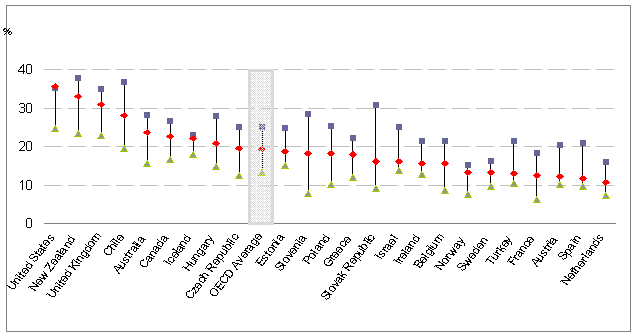
Fig. 1. Proportion of obese adults, by level of educational
attainment (2011)*
* Data from the OECD (2013),
Education at a Glance 2013: OECD Indicators
On average across the 24 OECD
countries with available data, approximately 19% of adults are obese. The
incidence of obesity is particularly high among those with below upper
secondary education (25%) and
relatively low among those with tertiary education (13%). The incremental
difference in health outcomes associated
with more education (in this case, 12 percentage points) is commonly called the
education gradient.
More-educated adults are less
likely to be obese and smoke daily. The reduction in obesity rates by
educational attainment is much greater among women and in countries that have a
high average level of obesity. The reduction in smoking rates by educational
attainment is much greater among men than women. The reduction is also greater
in Central European and predominantly English-speaking countries than in other
OECD countries.
The relationship between
educational attainment and health indicators (obesity and daily smoking)
remains strong even after taking into account differences in individuals’
gender, age and income.
 Upper secondary education
 Below upper secondary education
 Tertiary education
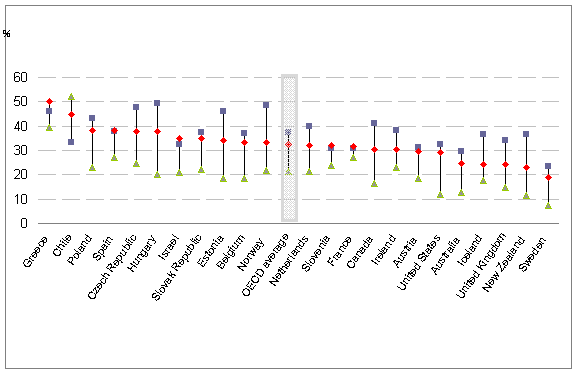
Fig. 2. Proportion
of adults who smoke, by level of educational attainment (2011)*
* Data from the OECD (2013),
Education at a Glance 2013: OECD Indicators
Across the 23 OECD countries
covered in this indicator, 30% of adults smoke daily. The incidence of daily
smoking is particularly high among those with below upper secondary education
(37%) and low among those with tertiary education (21%).
Certain Central European
countries, namely the Czech Republic, Estonia, Hungary and Poland, the
predominantly English-speaking countries; i.e. Australia, Canada, New Zealand,
the United Kingdom and the United States, as well as Norway, show particularly
high education gradients. In all these countries, adults with at least a
tertiary education are half as likely to be currently smoking compared to those
with only a below upper secondary education.
The relationship between
educational attainment and health indicators (obesity and daily smoking)
remains strong even after taking into account differences in individuals’
gender, age and income.
Education
may have a direct impact on health behaviors and outcomes in that through
education, individuals can learn to choose healthier lifestyles and avoid
behaviors that are detrimental to health. Education may also indirectly affect
health since those with higher levels of education are more likely to earn more
and be able to afford better health care and lifestyles.
References:
Eurostat (2013) Statistical Database.
http://epp.eurostat.ec.europa.eu/portal/page/portal/population/data/database
OECD (2013),
Education at a Glance 2013: OECD Indicators, OECD Publishing.
http://dx.doi.org/10.1787/eag-2013-en
OECD (2007), Understanding
the Social Outcomes of Learning, OECD Publishing.
http://dx.doi.org/10.1787/9789264034181-en
OECD (2010), Improving
Health and Social Cohesion through Education, Educational Research and
Innovation,
OECD Publishing. http://dx.doi.org/10.1787/20769679
OECD (2011), Health
at a Glance: OECD Indicators, OECD Publishing.
http://dx.doi.org/10.1787/health_glance-2011-en