Economics / 2. Investment activity and
capital markets
Master’s
student: Arman Narbotayev
Scientific adviser: Candidate of Economic Sciences Tazhieva S.K.
Kazakh National University named after al- Farabi,
High school of business and economics
MODERN INNOVATION LEVER
FOR ECONOMIC GROWTH OF THE REPUBLIC OF KAZAKHSTAN
In today's world, technological innovation
is increasingly vital not only to economic growth but also to educational,
social and cultural exchange and advancement. It is therefore vital to us
all that we protect technological innovations and the people who create
them. This year's celebration of World Intellectual Property (IP) Day on
April 26 emphasizes visionary innovators whose ingenuity and artistry have
broken molds, opened new horizons and made a lasting impact. To honor
these innovators, whether located in California's Silicon Valley or Almaty's
Institute of Nuclear Physics, we have an obligation to ensure that they can
benefit from their investments of financial and human capital, which will
encourage further innovation and drive our economies.
Today in Kazakhstan, a new generation of
researchers, scientists, entertainers and entrepreneurs is already playing an
important role in helping to diversify this country's economy. It is in
our common economic interest to protect these industries from threats, whether
those threats come in the form of counterfeit goods on the sidewalk, illegal
distribution of copyrighted content on the Internet or the failure to protect
industrial and technological information. This means continuing to
strengthen protections for intellectual property and its creators.
Innovation and productivity drive economic growth.
They allow countries to lead in today’s fast-paced global economy. They can
raise living standards for everyone. Nobel prize-winning economist Paul Krugman
has said, “Productivity isn’t everything, but in the long run it is almost
everything.”
Kazakhstan’s economy has expanded rapidly over the
last decade, posting one of the fastest paces of growth in the region. As a
country with abundant natural resources, Kazakhstan is still facing challenges
in transforming into a knowledge-based economy. The strategic course of
Kazakhstan for industrial-innovative development provides necessary conditions
for elaboration and implementation of new scientific ideas and technologies.
The strategy of development of Kazakhstan till 2050 together with such
documents as the Strategic Development Plan up to 2020, or the State program of
Forced Industrial-Innovative Development of Kazakhstan for 2010-2014 provide
regular, necessary conditions that support the development of research,
technology and innovation in Kazakhstan.
Kazakhstan is an upper-middle company, according to
the World Bank classification with GDP per capita of around 13 609.8 in
2014. Large and sparsely populated, the country is rich in natural resources,
with very significant reserves of oil, gas, minerals. While the development of
its natural resources has provided a major impetus to the recent expansion of
Kazakhstan’s economy, the authorities have stressed the need to develop other
sources of growth and improve overall economic competitiveness. In order to
support these aims, growing resources are being devoted to the modernization of
the economy and the revamping of its infrastructure, seeking to facilitate economic
diversification. Kazakhstan set up different institutions and developed many
programs aimed at encouraging innovation and modernization. Kazakhstan has put
a growing emphasis on the promotion of innovation as a driver of economic
development and diversification.
Kazakhstan is becoming a critical part of the emerging
‘New Silk Road’ that connects the East with Europe, Turkey and Middle East. And
advantageous geographical position, regional integration initiatives and an
improving business climate are three key reasons why Kazakhstan is emerging as
an attractive investment destination. Kazakhstan has an increasingly
business-friendly environment.
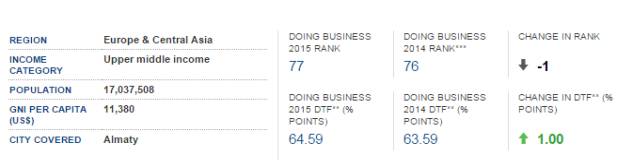
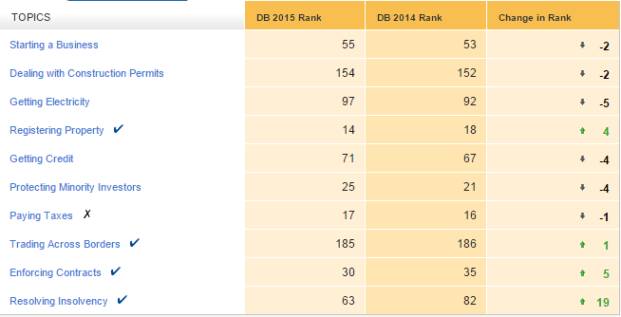
If we look at current case, this
table summarizes Doing
Business 2015 data for
Kazakhstan. The first section presents the Ease of Doing Business rank (out of
189 economies) and the distance to frontier (DTF)** measure, overall and by
topic. The second section summarizes the key indicators for each topic
benchmarked against regional averages.
Economy overview
Rankings
Distance to frontier

DB2014:
 Starting a Business:
Kazakhstan
made starting a business easier by reducing the time it takes to register a
company at the Public Registration Center.
Registering Property:
Kazakhstan
made it easier to transfer property by introducing a fast-track procedure for
property registration.
DB2015:
Registering Property:
Kazakhstan
made registering property easier by introducing effective time limits and an
expedited procedure.
 Paying Taxes:
Kazakhstan
made paying taxes more complicated for companies by introducing a mandatory
contribution to the National Chamber of Entrepreneurs and by increasing the
vehicle and environmental taxes.
Trading Across Borders:
Kazakhstan
made trading across borders easier by opening a new border station and railway
link that helped reduce congestion at the border with China.
Enforcing Contracts:
Kazakhstan
made enforcing contracts easier by introducing an electronic filing system for
court users.
Resolving Insolvency:
Kazakhstan
made resolving insolvency easier by clarifying and simplifying provisions on
liquidation and reorganization, introducing the concept of creditors’ meetings,
expanding the rights of creditors during insolvency proceedings, authorizing
payment in kind to secured creditors and clarifying the process for submitting
creditors’ claims.
Innovation policy in Kazakhstan plays a
great role in Kazakhstan’s economic strategy. There is a clearly stated policy
objective to move from a resource-based to a knowledge-based economy, using
earnings from the oil, gas, and mineral sector to facilitate diversification
and modernization. A major challenge for innovation policies in Kazakhstan is
the weak domestic demand for innovation, which reflects the structural
characteristics of the economy and the dominance of extractive industries.
First, we need stronger protection for intellectual
property rights, to allow Kazakhstan’s companies to take risks, and to compete
in the global economy.
Second, we need to return to funding less applied
research, and more basic research. Ironically the world’s truly revolutionary
inventions – the telephone and genetic testing, for example – were not born out
of a search for profit, but of basic research. Governments are rarely good at
forecasting winners!
Third, we need to unleash venture capital to help
innovators take new risks. The money is there. Tax cuts to large multinationals
are useless, unless tied to clear criteria for innovation or capital
investment, increasing added value, or at least job creation.
Finally, we need to recognize that environmental
protection and economic growth are not enemies. Well-designed regulations and
revenue-neutral carbon pricing that does not compromise economic growth could
boost innovation and productivity! Investment in clean technology is a key
element toward reconciling resource development and sustainable growth.
Kazakhstan could be a world leader in innovation, if
and when we encourage value-added production in all sectors, including resource
development. With smarter tax policies supporting sustainable development, we
can capitalize on our wealth of natural resources and make Kazakhstan more
competitive in the global economy and
more prosperous.
Kazakhstan has the opportunity and potential to
improve its capacity to innovate, and join the world leaders in innovation.
Towards achieving this, Kazakhstan should ensure the effectiveness and
coherence of all the constituent elements of the National Innovation system.
Ensuring the market economy with dynamic innovation capacity requires not only
sound government policies and tools, but also private sector initiatives. Being
a young market economy, Kazakhstan has strong potential, and should give
special attention to effective partnership between public and private sector
for generating an environment conducive to a functional knowledge-based
economy. In order to move up the value chain and ease dependence on natural
resources, Kazakhstan should develop and enhance the competitiveness of its
knowledge-based and non-extractive sectors. With input from the corporate
sector, the Government should better define and identify clusters that are
competitive. It can work with private sector players and strategic foreign
partners that have the requisite knowledge-intensive technology and know-how.
Kazakhstan needs to defend its place better in the
new, emerging world economic and political order. It must be flexible, dynamic
and innovative to seize opportunities when they appear, as the global division
of labour evolves. It must be able to
deliver value added, with concrete solutions to people’s problems – tackling
climate changes, confronting poverty, dealing with demographic and health
issues. It must remain a place where people want to live and investors want to
invest. To reach these goals, targets and flagship initiatives have been set
along the following three priorities:
1. Smart growth by developing an economy based on knowledge and innovation.
2. Sustainable growth by promoting a resource-efficient and competitive
way.
3. Inclusive growth by fostering a high employment economy delivering
social and territorial cohesion.
REFERENCES
1. Camison, C., Monfort, V., (2012) ‘Measuring innovation in tourism from
the Schumpeterian and the dynamic-capabilities perspectives’.
3. Report of the World Bank Group for 2015, http://www.doingbusiness.org/data/exploreeconomies/kazakhstan/
4. Langley, D., Pols, N., Ortt, J. (2005) ‘Adoption of behavior: predicting
success for major innovations’, European journal of Innovation Management,
8(1): 56-78.