Математика/4.Прикладная математика
O.F. Ryaboshtan,
Ph.D. A.M. Milenin, Ph.D. S.M.
Skofenko
Kharkov National Technical
University of Agriculture after P. Vasilenko
The use of
transition functions for comstructing bypass gas turbine blade
Consider bypass arc passing through the points  and
and  and its derivatives
  ,
,  ,
,  ,
,  . Arc equation can be written as
 , (1)
, (1)
where the  - transition functions from
  having a bypass nodes together with their derivatives
up to the second and including zero values, except for one that ensures the implementation
of the specified conditions:
having a bypass nodes together with their derivatives
up to the second and including zero values, except for one that ensures the implementation
of the specified conditions:  .
.
 ,
,  (2)
(2)
As the transition functions, you
can use algebraic polynomials, although not ruled out the possibility of using
other functions.
If we consider polynomials of the
same degree, then  will have the form
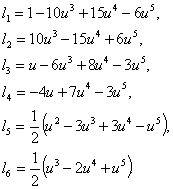 (3)
(3)
In differentiating (1) to  have
have
 (6)
(6)
 (5)
(5)
Equations (1) to (4) and (5)  give
give  ,
,  ,
,  . At
. At  have
have  ,
,  ,
,  .
.
Equation (1) can be written in
powers 
 (6)
(6)
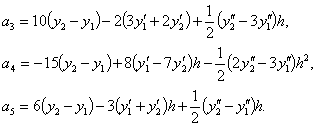 (7)
(7)
Transition functions can be used to
construct the arc II order of smoothness of I commit. In this case, in Equation (1) member  will be omitted, and the coefficients
  you can take other
 (8)
(8)
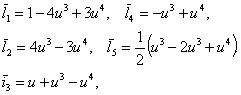 (9)
(9)
The meaning  a first bypass point is given from the additional
conditions (e.g., convexity input), then the equation of the second derivative
of the arc (8) is determined
a first bypass point is given from the additional
conditions (e.g., convexity input), then the equation of the second derivative
of the arc (8) is determined  and equation (8) is used for the next arc.
If the paint (8) in powers  obtain
 (10)
(10)
To bypass the zero fixation
 , (11)
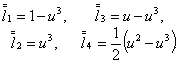 (12)
(12)
Value  and
and  selecting only the first point bypass, the remaining
points are calculated sequentially.
selecting only the first point bypass, the remaining
points are calculated sequentially.
After the transformation (11), we
have
 . (13)
To bypass the I-order smoothness
 (14)
(14)
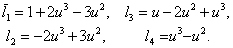 (15)
(15)
or powers  (16)
(16)
Arc bypass I order smoothness zero
fixation described by the equation
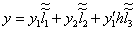 , (17)
where 

 (18)
(18)
 selected at the first point, and the rest is
calculated by the equation
selected at the first point, and the rest is
calculated by the equation
 ,
,  (19)
(19)
Here is a set of trigonometric
polynomials as transition functions to bypass II order smoothness and fixing
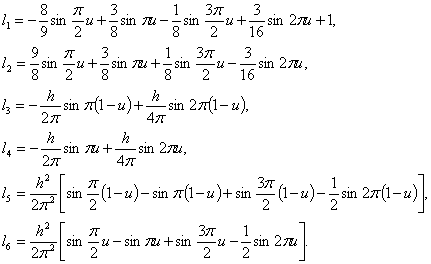 (20)
(20)
You can create a similar set of
contours for a smooth and fixation, but with the implementation of the
necessary conditions preassigned turbine blade design.