Педагогические науки/5.Современные методы преподавания.
Tyshyk Iryna
The Kirovohrad Volodymyr Vynnychenko State Pedagogical University,
Ukraine
The Role of
Tutorial Accompaniment
in
Formation of Occupational Availability
of a Prospective
History Teacher
One of
the consequences of Ukraine joining the European educational space is the
dynamic development of cross-cultural communications that resulted into
appearing of separate processes inside the domestic educational system. These
processes have become traditional in West European educational system long ago,
still being considered innovative in Ukrainian one. The example is tutorial
institute distributed in many countries of Europe.
The report of
International Commission of UNESCO «Education: Hidden treasure of 21st century»
states that the creation of conditions for a person’s independent choice and
the formation of a specialist’s availability to act on conditions of constant
alternative should become the foreground task of 21st century
education. Hence the updating of modern system of higher education is
characterized by direction towards realization of personality-oriented
educational process. And so the nature of interaction of subjects of
educational process is changing alongside with traditional teachers of higher
educational establishments (professor, supervising professor), new role
functions – tutor, academic consultant appear. Modern qualitative training of a
specialist in higher educational establishments of the country demands the
introduction of tutoring into the practice of teachers’ work. And tutoring in
its turn will increase student-centered training and personalized formation of
a student in the process of becoming individuality and a prospective expert.
The object of our investigation is conceptualization of the notion «tutor» and definition of the role of tutorial accompaniment in the formation of professional availability of a prospective history teacher at the stage of
studying for a master’s degree.
Tutorial institution is relatively «new» for the domestic educational paradigm therefore it requires special attention of modern scientists.
General survey of tutor’s activity and theoretical basis of tutorship are
stated in the works of S. Shchennikov. Particular
aspects of organization of tutorial activity are represented in the studies
of O. Andreiev, V. Bykov, L. Bendova,
A. Boiko, O. Kaidanova, Y. Komrakov, V. Kukharenko. The term «tutor» is observed much more
detailed in the works of Russian researchers ( T. Kovalova, V. Maksymov, A.
Zinchenko, S. Zmieiev and others). The names of V. Hlikman, B. Denis, H.
Krisli, K. Selik should be mentioned among European researchers, who
investigated problems, functions and peculiarities of tutorial accompaniment in
higher educational establishments.
Taking
into consideration the innovational activity of a tutor in the domestic
educational space we find it reasonable in the given article to make a short
historical review of appearing of the notion «tutor».
The
phenomenon of tutorship is closely connected with the history of European
universities and comes from Great Britain. It was formed approximately in the 14th century at the classical English universities – Oxford and a
little bit later – at Cambridge. Henceforth tutorship is understood as the
organized form of university guidance. In the Middle Ages a university
corresponded to brotherhood that professed common values, spoke the same
language and recognized the same scientific authorities. The English University
wasn’t much concerned that all the students took certain courses. The students
of one college could be the listeners of professors’ lectures from other
colleges. Each professor lectured and commented upon his own book. A student
had the right to choose professors and subjects for listening. The university
only made demands on examinations and a student had to choose his own way for
gaining knowledge needed for taking his degree. And it was a tutor who helped him
in that.
In the
17th century the scope of tutor’s activity increased – educational
functions gained greater importance. Tutor defined and recommended to a student
which lectures and practical courses he should attend, how to plan his academic
work, watched his students study well and were prepared for the exams at
university. Tutor is the nearest
adviser and assistant of a student in all of his difficulties. In the 17th century the tutorial
system was officially recognized as the part of the English university system
and gradually supplanted the professorial one. Since 1700 until 1850 there were no public courses
and chairs at English universities. It was tutor who trained a student for the
exams. When both free chairs (private lectures) and collegiate lectures
appeared at universities at the end of the 19th century, a student
was reserved the right to choose professors and courses [4, p.40-45].
Thus during 18-20th centuries at the oldest universities of England the tutorial system did not merely lose its ground but occupied a central place in training, lecture system served only as supplement to the tutorial one. At
present tutorship is widespread at the leading higher educational
establishments of the world: in Great Britain, in the USA, in Finland, in Japan
and France.
Freedom
as the fundamental value of tutorship – comes into contradiction with
standardization and control, underlying the domestic model of education. That
very model, officially recognized and approved, once borrowed in Germany with
rigid principles, standards, class-and-lesson system, timetable and control
still predominates in the system of Ukrainian education, and tutorial activity
is on the stage of its formation.
On
basis of analysis of research and educational literature some approaches to the
definition of the notion “tutor” can be distinguished:
·
tutor – is
the mediator between a lecturer and a student, organizer of activity and
programmes of individual development. In a broader sense, tutor is defined by
T.M. Kovalova as the one, who accompanies the process of mastering the activity
[7]. According to N.
Rybalkina’s definition tutor – is the position of «senior», who helps «junior»
in building of his individual educational path. In contrast to a teacher, who
controls, a tutor – is the one, who helps in the first place [6].
·
in the system of distant higher education, built on the basis of traditional training system with the usage of information and
communications technology (V. Kukharenko, O. Rybalko, N. Syrotenko), tutor – is a teacher’s
assistant, who performs
organizational rather than pedagogical function;
·
tutor as the specialist in the field of organization of education and self-education is studied in the works of such domestic scientists as O. Andreiev, S. Kaplan, H.
Krasnova, S. Lobachev, K. Lupanov, A. Poliakov and others.
In the monograph of S.A. Shchennikov the notion of «tutor» is defined as a teacher-consultant – «specialist in the field of organization of education and self-education. A tutor is charged
with responsibility for conducting of the whole educational module,
organization of individual and group work with students. Among the tasks of a
tutor the following ones can be distinguished: methodical preparation and conduction
of group practical studies (tutorials); assistance in doing certifying works,
their checking and assessment; consultations and other forms of psychological
and pedagogical supporting of students; individual assistance to students in
solution of academic or personal problems, connected with studies; vocational
guidance and consulting on career issues. Didactic, organizational, marketing,
consulting, leader roles are the topical ones for a tutor.» [8, p. 4, 488].
Taking into consideration socially humanitarian orientation
of a prospective history teacher in the given research we will keep to the viewpoint that tutor – is the one, who accompanies, shares his experience and expands educational horizons of a
student or the group of students.
According
to the British tradition the structure of tutorial accompaniment includes three
elements: director of studies, who ensures students’ learning and counsels them
concerning their work during vacation; moral tutor, responsible for social life
of a student at university in the broadest sense of the word; tutor, who
accompanies student’s learning throughout
academic year. At the University of Oxford these three functions are
performed as a rule by one and the same person. At Cambridge University as well
as at many other ones tutor conducts practical studies with students and is named «supervisor» [4, р.46-47].
The
situation in Ukrainian educational environment takes a little bit different turn. We share the
opinion of
Ala Boiko, the professor of Poltava V.G.
Korolenko National Pedagogical University, regarding the following: «tutorship in
Ukraine is the profession, which isn’t there and which is already there and will exist in
connection with the situation in the society, with the contraction of students and
schoolchildren, with the upbringing crisis» [2,p. 9].
It should be
mentioned that tutorial accompaniment is not typical for higher educational
establishments of our country and both educational and organizational functions
are entrusted to a professor in charge of an academic group. However, the
peculiarity of modern standard of education is the activity character of training, chief
aim of which is the development of individual abilities of every student. In traditional didactic
systems explanation is the foundation of any pedagogical technology whereas in
personality-oriented approach – mutual understanding is. V.S. Bibler explains
the difference between these phenomena in the following way: «In the process of explanation there is only one
subject, one
mind, monologue; during mutual understanding – there are two subjects, two minds, dialogue.
Explanation is always «downright» look and mutual understanding is collaboration, equality» [1].
Taking
into consideration the above mentioned it is tutorial approach that is appealed
to widen student’s educational environment and perform its accompaniment. The
purpose of educational activity of a student is defined by himself on the basis
of his personal interest and a tutor only helps him with their realization. In
such a way one of the contradictions, typical of a student’s age, is solved –
aspiration for independence in selection of knowledge, means of its acquiring
in sufficiently strict training forms and methods for a specialist at a higher
educational establishment. Substantial characteristic of tutorial accompaniment
is the fact that a student does the task by independently chosen rules and
after that he discusses their effectiveness with a tutor.
Tutor’s
position is the position of a teacher, who together with a student reveals the
needs and resources of the latter. It is tutor who specifies three directions
for consideration of every student’s action. These three directions correspond
to three components of availability of prospective history teachers for cultivation
of interethnic tolerance: what I know (cognitive level), what I can (practical
level), why do I need this (personal level). Consequently, tutorial
accompaniment helps to structurize and comprehend acquired knowledge.
In our
research study we will examine potential possibilities of usage of tutorial
accompaniment for the formation of availability of prospective history teachers
in the process of their training for a master’s degree.
Taking into account multiethnicity of
Ukraine on the one hand and integration processes in the field of domestic
education on the other, the issue of tolerance cultivation becomes the call of
the times. Educational sphere expert
constantly comes across the absence of accompaniment competence during teaching
and educational process under conditions of multiethnic environment.
We consider that introduction of tutorial accompaniment will be the most efficient on the very stage of learning for a master’s degree since the position of a tutor is the position of a teacher whose immediate target is not to pass the knowledge but together with a student to reveal the needs
and resources of the latter and help in their full realization. It should be
noticed that during studying for a master’s degree tutorial accompaniment concerning
the formation of interethnic tolerance can be performed by both teachers as to
undergraduates, studying for a master’s degree, and the very undergraduates,
studying for a master’s degree, as to the students, studying for a bachelor’s
degree.
In
realization of our presented pattern of the formation of interethnic tolerance
of teachers in the process of their training for a master’s degree a tutor has sufficient
potential resources as the formation of interethnic tolerance is based in the
first place on the pedagogy of cooperation which in its turn is the foundation
of tutorial accompaniment.
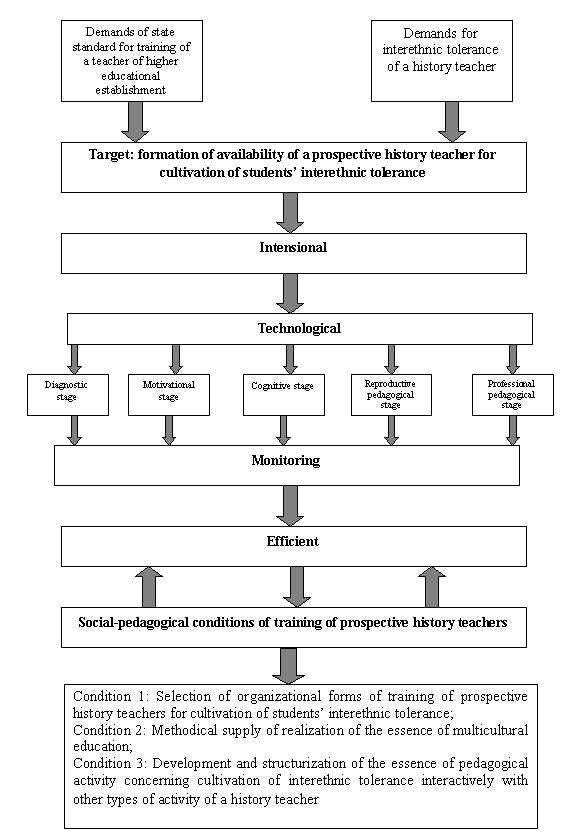
The
pattern is the interconnection and interdependence of the components: target (formation of interethnic
tolerance of teachers in the process of their training for a master’s degree), intensional (informational supply of the formation of ethnotolerant
ideology of an undergraduate studying for a master’s degree), technological (staged activity that
guarantees the achievement of set objective), monitoring (valuation of the course and
the results of goal achievement); efficient (the level of
achievement of set objective as well as principles and conditions necessary for
its realization).
The principles of pattern realization are the following: value-oriented (formation of the system of value orientations); ethno-cultural self-preservation (preservation of one’s ethnopsychological individuality); social adaptation (adaptation of undergraduates studying for a master’s degree to living conditions in modern multiethnic society). Fundamental stages of the technology of pattern realization concerning formation of interethnic tolerance of history teachers are given below: diagnostic (valuation of interethnic tolerance of history undergraduates studying for a master’s degree and perspectives prediction of formation in each of them the basis of ethnotolerance of a teacher at a higher educational establishment); motivational (arousing of interest for ethnopsychology, actualization of value attitude to ethnotolerant consciousness and cross-cultural interaction in educational activity at higher educational
establishment), cognitive (understanding and accumulation of
multicultural knowledge that determines the basics of a prospective teacher’s
outlook concerning ethnocultural tolerance); reproductive
pedagogical (application of
acquired qualities, knowledge and skills in the sphere of ethnic tolerance in
pedagogical practice of an undergraduate studying for a master’s degree); professional pedagogical (accumulation of pedagogical
experience in ethnocultural environment of a higher educational establishment).
Basic
conditions for pattern realization concerning the formation of ethnic tolerance
of teachers are: ethnopedagogical competence and everyday display of ethnic culture by teachers who are involved in teaching of undergraduates studying for a master’s degree; ethnocultural component as the constituent of professional pedagogical training of prospective history teachers; ensuring of cross-disciplines ties determined by the
needs of ethnocultural education and the formation of ethnocultural tolerance
of prospective teachers, ethnocultural
educational environment of training of prospective teachers and their
undergoing of pedagogical practical training; motivatedness and activity of
students in gaining professional experience of ethnopedagogical work (illustration 1).
Illustration 1
Pattern of Formation of Interethnic
Tolerance
of a History Teacher in the Process of his Training for a Master's Degree

Thus, in our opinion a tutor has sufficient potential resources for cultivation of interethnic tolerance since with the exception of educational activity it is he who involves students into the work of social utility at a higher educational establishment, ipso facto he assists in comprehension of interethnic peculiarities of modern Ukrainian socium on tolerant
grounds.
However, it should be certified that there is no educational establishment for training of tutors by now in Ukraine, in scientific pedagogical literature positions of a supervising professor and a tutor are often identified, but
they have certain differences: tutorial activity what is more introduces the
principle of individualization of studying. Consequently taking into account
the increased interest in the process of individualization intensification of
studying within the scope of modernization programme according to the ideas of
Bologna it would be appropriate to transfer the elements of positive practice
of West-European tutor to the field of domestic educational system especially
on the stage of studying for a master’s degree.
References:
1.
Библер В.С. От наукоучения – к логике культуры: Два философских введения в
двадцать первый век – М.: Политиздат, 1990.
2.
Бойко А. Тьютор - якісно вища педагогічна позиція і новий простір
духовно-моральної взаємодії / А. М. Бойко // Збірник наукових праць
Полтавського держ. педагогічного університету ім.В.Г.Короленка: Педагогічні
науки . – 02/2011 . – Вип.2: Педагогічні науки . – С. 4-10.
3.
Дем’яненко Н.М. Система тьюторства: актуалізація ретродосвіду Великої
Британії / Н. М. Дем’яненко // Зб.наук. праць Полтавського держ. пед. ун-ту
імені В.Г. Короленка. – Полтава, 2006. – Вип. № 6 (57). – С. 72–75.
4.
Ковалева Т. М., Кобыща Е. И. и др. Профессия
«тьютор». М.-Тверь: «СФК-офис»2012. – 246 с.
5.
Лукіна Т.О. Тьютор / Т.О.Лукіна // Енциклопедія освіти / гол. ред. акад. В.Г. Кремінь. – К., 2008.
– 1024 с.
6.
Рыбалкина Н.В. Открытое
пространство образования: способы представления и построения Материалы
конференции "Традиционные и инновационные процессы в образовании:
стратегии личностного развития", Секция 1. Исследование феноменов и
тенденций перехода к Открытому образовательному пространству, М., 2004
7.
Тьюторство как культура индивидуализации Отечественные записки, 2012 №4
8.
Щенников С. А. Открытое
дистанционное образование : учеб. пособ./ Щенников С. А. - М. : Наука, 2002. -
527 с.
9.
Forster F. Tutoring and Demonstrating: A Handbook / F. Forster, D. Hounsell,
S. Thompson. – Centre for Teaching, Learning and. Assessment, University
of Edinburgh, 1995. – 94 p.