Физическая
культура и спорт/1. Физическая культура и спорт: проблемы, исследования,
предложения
Irina Burlaka
National Technical University
of Ukraine
“Kyiv Polytechnic Institute”,
Ukraine
THE
REASERCH ON MOTIVATION OF STUDENTS FOR PRACTISING SPORTS AND EXERCISE IN TENNIS
GROUPS
Studying at the university makes students work
intensively. Very often tough academic calendar does not leave much time for
physical exercise or sports which are an integral part of healthy lifestyle.
Apart from that, modern social environment does not provide enough patterns to
motivate youth for sports. Many young people underestimate value of physical
exercise for health. They do not relate lack of physical activity and
deterioration of health. Both Ukrainian and foreign researchers in their works
stress on the importance of motivation of students to practise physical exercise or sports [3,6,7,8,9].
Observing the level of physical fitness of students, their physical endurance and activity during tennis lessons have led to the idea to research their motivation for
exercise in tennis groups and reveal the motivational keys which may help improve pedagogical and educational
methods of coaching and make the lessons more effective.
In the frame of the preparation for the research there was considered
a number of methodologies used by other researchers in different countries [1,2]. Considering
the objective for the research, the SMS-28 (SMS – Sport Motivation Scale) methodology presented in the work of Luc G. Pelletier and others [4]
was selected as most applicable. Since 1995 this
methodology has been used to study motivation in sports and physical exercise by many scientists
in different countries [5].
To research the motivation of students in tennis groups the SMS-28 methodology was
adapted for tennis as physical exercise activity. Self-completion paper
questionnaires were used in the survey. The standardized SMS-28 questionnaire
was taken as a basis and supplemented with two additional sections of
questions. The questionnaire consisted of three sections:
·
Section А. SMS - 28 (intrinsic
motivation - 12 statements; extrinsic
motivation – 12 statements; amotivation – 4 statements).
Likert scale.
·
Section B consisted of three questions aimed at probing
general attitude of students to physical exercise, in particular to tennis
·
Demographics – sex, age, education (term of study at the
university)
The survey was conducted during last week of 2014. General number of respondents was 96 (60
males, 36 females). Descriptive statistics
was used for analysis (SPSS Statistics software) and MS Excel for graphs
presentation.
Based on the data obtained in the survey,
analysis of intrinsic and extrinsic motivation as well as amotivation was made
and the differences between the data obtained for the sets of motivational
categories were presented by frequency characteristics.
To
compare the importance of intrinsic and extrinsic motivation in the group of
students under research the data were analyzed separately for the setss of intrinsic
and extrinsic motivation categories. The number of respondents with predominance
of a certain motivation category in relation to other categories was defined, that
is the number of answers “yes” and “rather yes” for the questionnaire’s statement
belonging to this motivation category quantitatively exceeded or equaled the
number of “yes” and “rather yes” in other categories of the analyzed type of motivation
(Fig. 1).
Based
on the data obtained, it is possible to claim that in the group of students the
intrinsic motivation is stronger than extrinsic one.
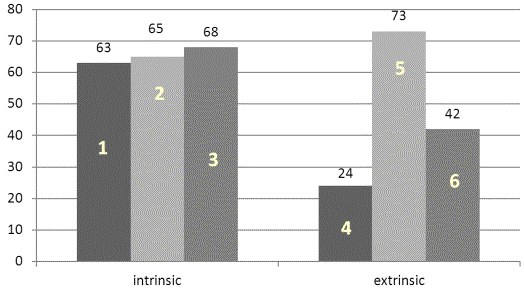
Fig.1. Comparison
of intrinsic and extrinsic motivation categories
1 - to experience stimulation (1,13,18,25);
2 - to know (2,4,23,27); 3 - to accomplish (8,12,15,20); 4 - identified (7,11,17,24); 5 - introjected (9,14,21,26); 6 – external
regulation (6,10,16,22)
The
results obtained in this research show that the level of students’ motivation for
exercising tennis in the studied group is generally high. Intrinsic motivation
is higher than extrinsic one.
It
was found that the level of amotivation in the group was quite low and this was
also confirmed by students’ optimistic projective evaluation of their
expectations regarding their achievements in tennis by the end of the two year
course of training in the university tennis groups (section B of the questionnaire).
The
results give the ground for the following conclusion: to make the tennis
lessons more effective it makes sense to consider intrinsic motivation factors
when making the training plans. This means regular introduction and exercise of
new techniques, studying tactics of the game and psychology of competition (exploiting
“to know”). It seems reasonable to create more favorable conditions for
realization of students’ need in improvement of their tennis skills and
awareness of their achievements (“to accomplish”). It is also very important to
create atmosphere that would facilitate such an important component of
intrinsic motivation as “experiencing stimulation”.
As
to extrinsic motivation, although it showed to be a bit weaker in the studied
group of students, this does not mean that it can be neglected. For example,
the extrinsic category statement “introjected”, taken separately, appeared to
be most important for the biggest number of students. This means that
pedagogical techniques based on this category can also be used as a powerful
enhancer of student’s motivation.
References:
1. Лукачина А.В. Стислий
огляд методик визначення мотивації до занять фізичною культурою та спортом у
студентської молоді / А.В. Лукачина // Вісник Чернігівського
національного педагогічного університету. Сер. : Педагогічні науки. Фізичне виховання та спорт . – 2014. – Вип.
118(3). – С.174–176.
2. Остапенко Р.И.
Математические основы психологии / Остапенко Р.И. // Учебно-методическое
пособие. Воронеж. ВГПУ – 2010. – С. 76
3. Халімовська Т. С. Мотивація студентів до здорового способу життя в умовах
використання особистісно-орієнтованого підходу в процесі фізичного виховання / Т.С.
Халімовська, В. Г. Лосик, Н. Ф. Соломко // Духовність особистості: методологія,
теорія і практика. – 2013. – № 5(58). –
С. 204 – 208.
3. Adeyemo, Kehinde. Influence of Demographic Variables on Students’ Choice
of Sports Activities in Lagos State. / Kehinde Adeyemo, Gbenga Ajibola // Journal
of Research & Method in Education.
– 2014. – Vol. 4. – No. 1. –
P. 26 – 29.
4.
Pelletier, Luc G. Toward a New Measure of Intrinsic Motivation, Extrinsic
Motivation, and Amotivation in Sports: The Sport Motivation Scale (SMS). / Luc
G. Pelletier, Kim M. Tuson, Michelle S. Fortier, Robert J. Vallerand, Nathalie
M. Brikre, Marc R. Blais. // Journal of Sport & Exercise Psychology. – 1995 – Vol. 17 – P. 35 – 53.
5. Wasden Kaylene M. Motivation
in Physical Education: A Multicultural Perspective [Electronic source] / Kaylene M. Wasden // Access
mode:
http://gse.gmu.edu/assets/docs/lmtip/vol3/K.Wasden.pdf
6. Crespo, Miguel.
Motivation
in Tennis. / Miguel Crespo, Machar M Reid
// British Journal of Sports Medicine. – 2007. –
Vol. 41. – No. 11. –
P. 769 – 772.
7. Reiss, Steven. Multifaceted Nature of
Intrinsic Motivation. / Steven Reiss. // Review of General Psychology. – 2004. – Vol. 8. – No.3. – P.
179 – 193.
8. Ntoumanis, Nikos. A self-determination approach to the understanding of
motivation in physical education./ Nikos Ntoumanis // British Journal of Educational
Psychology. – 2001. – Vol. 71. – Issue 2. – P. 225 – 242.
9. Бурлака І.В. Про важливість деяких аспектів фізичного
виховання
студентів для їх майбутньої адаптації до умов роботи в
конкурентному середовищі / І.В. Бурлака // Вісник Чернігівського
національного педагогічного університету. Сер. : Педагогічні науки. Фізичне виховання та спорт . –
2014. – Вип. 118(3). – С.39–41.