Babkin
Vladislav, Komarova Lilia
Dnipropetrovsk National University
OPTICAL BUILDER
While studying the «Geometrical optics» of the school
course of physics, I noticed the absence of some optical objects demonstration (e.g.
thick lenses and balls). That’s how the idea of “Optical Builder” program
appeared. The aim is to create a piece of software, which can build path of
rays inside an optical system, consisting of such objects, automatically. Having
conducted the review of existing software programs, I found that some similar ones
already exist. But none of them include thick lenses or prisms, for example. We
cannot take into consideration the professional software for physical modeling,
because, on one hand hardly anyone can afford it because of its price and
complexity. On the other hand it requires quite a powerful computer or, more
precisely, powerful hardware. That’s the reason for writing some software with
the same aim, but which works with slightly different objects, than existing
programs do. And, one of the objectives was to make it user-friendly and easy
to use, so that people, who are not familiar with the optics very much, can use
it. Also, the program should not require powerful hardware.
Target audience is the people, who start to learn optics, and those, who need to visualize
their own optical systems:
· Pupils, who study optics at school
· Teachers of physics and astronomy (e.g., possibility to show simplified
model of a telescope on the astronomy lesson make this program useful)
· and others
Benefits of using the virtual environment are obvious:
there is no need to keep lenses, prisms and other objects, no need to fill the
room with dust, the greater visibility of the experiment (it is not that easy
to make a thin ray. Also, it can hardly be seen). To use it is enough to have
at least one computer and not necessarily a powerful one by today's standards (the
description follows).
Resulting software requires installed Microsoft .NET
2.0, OS Microsoft Windows XP or later (there is a theoretical possibility to
launch this application on Windows 98, but this was not checked),
OpenGL-compatible video card, installed Adobe Reader 9 (not necessary).
Required operative memory varies according to used OS. Program uses
approximately 60-80 megabytes of operative memory for system consisting of 10
optical objects and 10 rays (which is enough for its main aims, because larger
system is hard to percept). Thus, 512 megabytes should be enough for any
operating system (if its requirements do not set other limits). As one can see,
this application will work on the most of the nowadays computers.
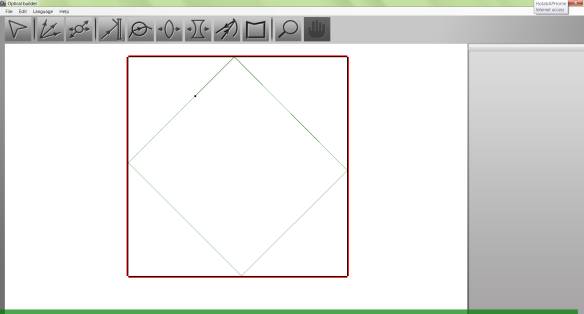
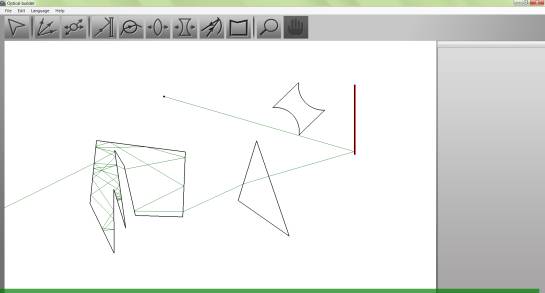
Here are two screenshots:
Conclusion: A software product which allows
demonstrations of optical systems was written. It does not demand fast
hardware, any special knowledge to be used, and thus can be applied in most of
the schools and universities to conduct experiments in virtual
environment.